

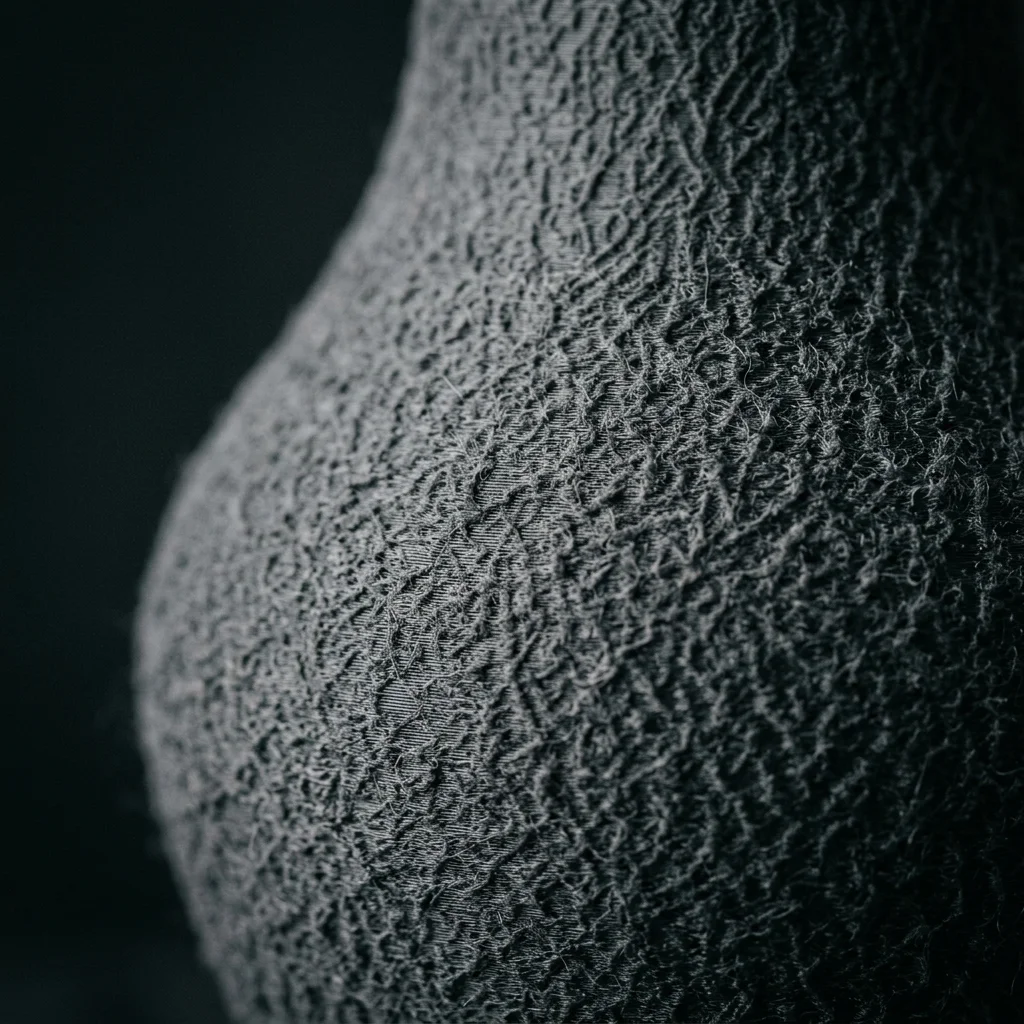
In 2025–2026, Fuzzy Skin has become a widely used slicer feature that transforms smooth FDM walls into textured, organic surfaces with controlled roughness. By adding random micro-deviations to perimeter XY coordinates, Fuzzy Skin creates a “shagreen” texture that masks layer lines and provides unique tactile feel.
Algorithm
- Point Jitter: Each perimeter point receives random XY offset ±D.
- Controlled Chaos: Amplitude D (0.1–0.8 mm) and point distance (0.2–1.0 mm) are user-controlled.
- Outer Walls Only: Applied to outermost perimeter only, inner walls remain precise.
Interactive Filament Selector
Answer 3 quick questions and find the optimal material for your project.
1. What are the mechanical requirements for the part?
2. What temperature will the part operate at?
3. Are there any specific environmental requirements?
Our recommendation:
PLA filament
Ideal for easy printing, model visualization and decorative parts.
Applications
- Grips and Handles: Improved ergonomics and tactile feel.
- Decorative Objects: Organic, “stone” or “leather” appearance.
- Defect Masking: Hides layer lines during fast printing.
- Light Diffusion: Textured transparent surfaces (PETG, PC).
Pros and Cons
Pros:
- Free: Software feature, zero hardware cost.
- Masks Defects: Effectively hides layer lines.
Cons:
- Dimensional Inaccuracy: External dimensions vary by ±D.
- Not for Functional Surfaces: Seals, bearings, threads.
FAQ
Fuzzy Skin: Fdm Surface Texturing Through Controlled Chaos Calculator
Interactive optimization calculator.
The full picture
This article is one page from The Big Book of 3D Printing: 704 illustrated pages covering every technology, material and fix in one reference.
Read it on Kindle →Engineer, author of The Big Book of 3D Printing and additive manufacturing expert