

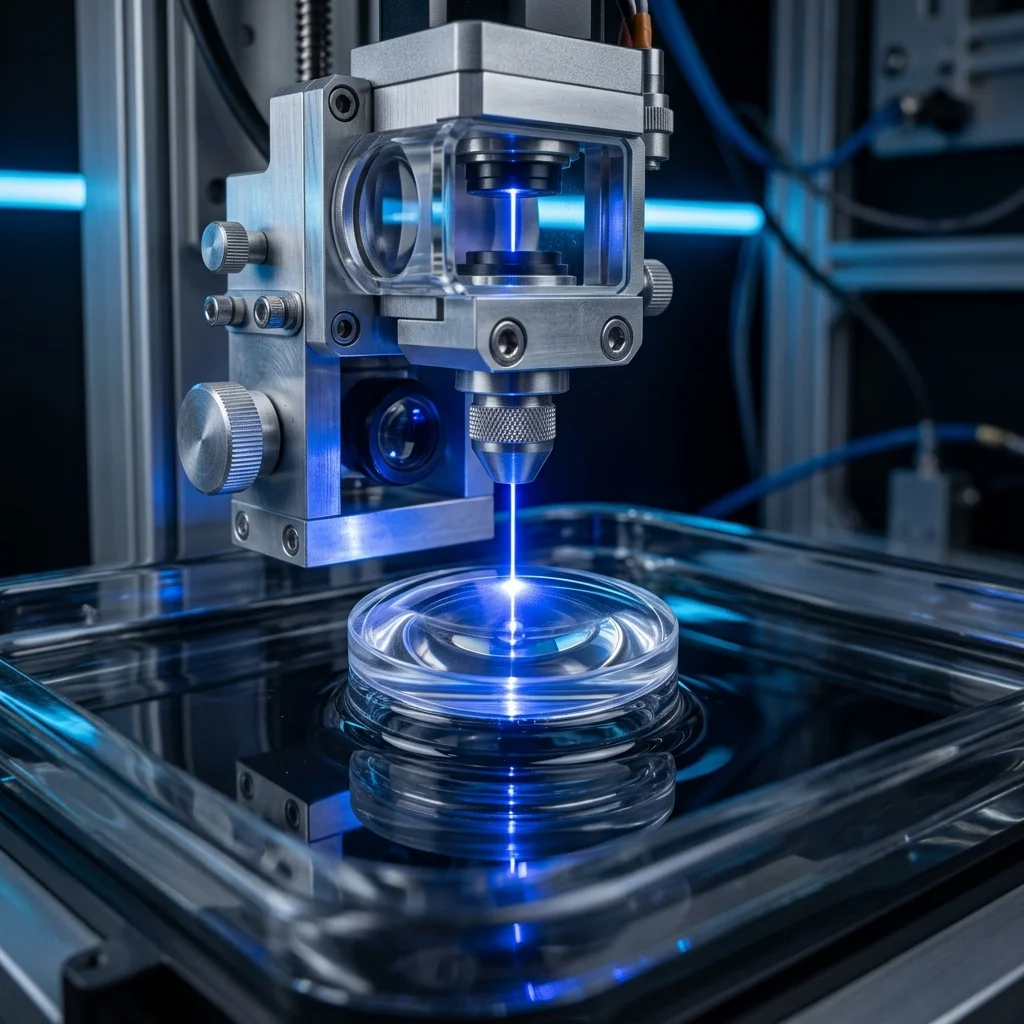
Clear SLA resin is one of the most visually striking materials in 3D printing. With optical transparency of 80-95% (with proper processing), it enables printing of lenses, optical prototypes, light installations with LEDs behind, transparent enclosures for visual prototypes, and artistic objects that look like glass. In this guide we cover clear resin types, when Formlabs Clear is worth it vs alternatives, how to achieve real optical transparency after printing (without this key step, most clear prints come out semi-transparent and ugly), and real applications from artists, designers, and engineers.
What makes clear resin ‘clear’
To understand the challenges of transparent SLA printing, you need to know a bit about optics.
Optical transparency (light transmission) depends on two factors:
- Material purity. Polymer chains without coloring, without additives, without catalysts.
- Surface smoothness. A rough surface scatters light: the material becomes semi-transparent.
A standard MSLA print has micro-steps between layers (50-100 µm). Even with perfectly clear resin, the surface scatters light and the print looks matte-transparent (frosted glass effect).
For truly optically transparent SLA printing, you need:
- Clear resin with high purity (Formlabs Clear, Anycubic Translucent).
- Surface smoothing post-print:
- Sanding with 240 → 400 → 800 → 1500 → 2500 grit wet sandpaper.
- Polishing with automotive polish.
- Finally: a layer of UV-resistant clear varnish (Vallejo Gloss Varnish).
With this process you can reach 80-90% transparency. For 95%+ transparency (like injection-molded PMMA) you need a specialized bureau with a top-down DLP printer (Carbon, EnvisionTEC) and post-processing.
Key to understand: SLA Clear resin ALWAYS starts as a semi-transparent result after printing. Final transparency depends on post-print processing, not on the printer or the resin.
Clear resin types
Formlabs Clear Resin (€175/liter):
Industry standard. Optical transparency after standard curing: ~85%. After polishing: 90-95%. Recommended for Formlabs Form 3+ and Form 4. Resolution: 25 µm XY.
Specs:
- Light transmission: 85-95% (depends on processing)
- Yellowing: moderate at 6-12 months UV exposure
- Cost per 100 ml: €17.50
- One typical clear model needs 30-100 ml = €5-€17.50
Anycubic Translucent Resin (€45/liter):
Hobbyist alternative to Formlabs Clear. Available for MSLA printers (Anycubic Photon Mono M5s, Elegoo Saturn). Transparency after polishing: ~80%. Yellows faster than Formlabs Clear (4-8 months UV exposure).
Anycubic Crystal Clear (€55/liter):
Higher quality than the standard Anycubic Translucent. Transparency: ~85% after polishing. Recommended for boutique clear projects.
Elegoo ABS-Like Clear (€40/liter):
Clear tough resin. Suitable for clear functional prototypes (snap-fits, test enclosures). More impact-resistant than standard clear resins, but slightly lower optical quality.
Phrozen Aqua-Gray Clear (€55/liter):
Taiwanese competitor. Quality clear resin, good availability.
Siraya Tech Clear (€60/liter):
Professional clear resin from Siraya Tech (USA). High purity, good long-term clarity.
3DXTech Optically Clear (€95/liter):
Professional optical resin for industrial applications (lenses, sighting systems, optics). High purity, minimal yellowing.
Anycubic Water-Wash Clear (€50/liter):
Clear resin that washes with water (no IPA). More eco-friendly, but slightly lower optical quality.
Recommended printers
For beginner clear resin experience:
- Anycubic Photon Mono M5s (€368): 12K MSLA, excellent resolution (19 µm XY). Works with Anycubic Translucent, Crystal Clear, Phrozen Clear.
- Elegoo Saturn 3 Ultra (€402): larger build volume. Same resolution.
For boutique clear projects:
- Phrozen Sonic Mighty 8K (€420): alternative with slightly higher resolution (28 µm).
- Anycubic Photon Mono X 6Ks (€500): larger build volume.
For optical-quality applications:
- Formlabs Form 3+ (€3500): LFS technology gives cleaner surfaces than MSLA, slightly less post-processing for optical quality.
- Formlabs Form 4 (€4500): 4× faster, same optical quality.
For industrial optical applications (lenses, sights):
- EnvisionTEC Perfactory 4 (€35,000): DLP with high repeatability and optical quality.
- 3D Systems ProJet 3600 (€80,000+): industrial SLA with multi-material support.
For a small artist or designer needing clear projects (5-15 per month): Anycubic Photon Mono M5s (€368) + 1 liter Anycubic Crystal Clear (€55) + Wash & Cure (€150) + Polishing kit (sandpaper + polish, €30) = €603 for a full start.
Post-print processing for optical transparency
This is a CRITICAL section. Without proper processing, clear resin will NEVER look optically transparent: only matte semi-transparent.
Step 1: Standard post-print
- Removal from platform.
- IPA wash 3-5 minutes.
- Air dry.
- UV cure 10-20 minutes in UV chamber.
After this standard process the print will look matte-transparent. To achieve true clarity: continue with the following steps.
Step 2: Sanding
This is the most labor-intensive but most critical step. Goal: remove micro-steps between layers.
- Start with 240 grit wet sandpaper. Sand with water to reduce heat (which can deform the resin).
- Move to 400 grit. Sand until the surface looks uniformly matte.
- 800 grit: surface begins to become semi-transparent.
- 1500 grit: almost clear.
- 2500 grit: optically clear by visual inspection.
- (Optional) 5000 grit, for absolutely smooth surface.
Time for full sanding of a 50×50×50 mm object: 1-3 hours by complexity.
Step 3: Polishing
- Automotive polish with microfiber cloth.
- Polishing paste (Brasso, Meguiar’s PlastX) for additional smoothness.
- Alternative: Novus Plastic Polish #1 + #2 + #3 (for plexiglass, excellent for SLA).
Step 4: UV-resistant clear varnish layer
There’s a question whether varnish helps or harms optical transparency. Reality:
- Without varnish: surface is clearer, but UV exposure yellows the resin in months.
- With varnish: surface is slightly less clear (2-3% light absorption), but resin is protected from UV exposure for 1-2 years.
Recommended:
- For indoor applications without UV exposure, without varnish.
- For outdoor or near a window, with varnish (Vallejo Gloss Varnish or Krylon UV-Resistant Clear).
Step 5: Additional stabilization
Clear resins continue to cure slowly for days and weeks after standard UV cure. Final clarity and stability achieve after 7-14 days.
Result after full processing:
- Transparency: 85-95% (depends on resin and work quality).
- Durability: 1-3 years without significant degradation (indoors, no UV exposure).
For comparison: injection-molded PMMA (plexiglass), 92% transparency, 10+ years durability. Injection-molded PC: 88% transparency, 5+ years durability. SLA Clear with post-processing is close to them.
Real applications
Application 1: Light installations with LED
Artists make light sculptures with clear SLA objects and LED strips behind. Print complex geometric forms (fractals, spirals, web structures) not possible in injection-molded PMMA.
Example: a fractal light sculpture 200×200×300 mm, 3D print on Anycubic Photon Mono M5s (3 pieces, 8 hours total print), full polishing (6 hours labor), assembly with LED strip and controller ($25 electronics), gallery installation.
Cost: €25 resin + €30 polishing supplies + €25 LED electronics + €200 labor = €280. Artist resale price: €800-€2500.
Application 2: Clear enclosures for engineering prototypes
Engineers developing a new smart-home sensor model. Need a transparent enclosure for visual presentation: clients see the internal PCB.
Solution: Anycubic Photon Mono M5s with Anycubic Crystal Clear. Enclosure 80×40×20 mm. Print: 3 hours. Polishing: 2 hours. Assembly with PCB.
Cost: €5 resin + €10 polishing supplies + €30 labor = €45 per enclosure. Alternative: injection-molded PMMA enclosure (€800 mold + €3 per enclosure = €803 for the first 100). SLA is optimal for prototypes and small series.
Application 3: Clear chess pieces
Artists make custom chess sets with clear SLA pieces. CAD design with classical chess (king, queen, knight, bishop, rook, pawn). Print 32 pieces in 2 builds (8 hours). Full polishing of each piece (1-2 hours per piece = 32-64 hours of labor!).
Cost: €15 resin + €30 polishing supplies + €1500 labor = €1545 per set (32 pieces). Artist resale price: €3000-€5000 for a custom clear chess set.
Application 4: Clear presentation prototypes of perfume bottles
Design studios make custom bottle designs for cosmetics companies. Before injection of a test run (€5000-€20,000) clients want to see how the bottles look and feel physically.
Solution: Formlabs Form 3+ with Formlabs Clear. Print 5 different designs, each 50×30×120 mm. Full polishing for optical quality.
Cost: €30 resin (for 5 prototypes) + €200 polishing labor + €100 professional design labor = €330. Alternative: Chinese bureau for clear injection prototypes (€3000-€6000 for 5 versions + 4-6 weeks). SLA is irreplaceable for fast presentation clear prototypes.
Application 5: Optical lenses for prototyping
Engineers with a smart glasses project. Need 10 iterations of lens form (different curves, thicknesses, focal lengths) for testing.
Solution: Formlabs Form 4 with Formlabs Clear. Print 10 lenses (each 30×30×10 mm). Full polishing for optical quality. Testing with real users.
Cost: €50 resin + €300 polishing labor = €350 for 10 lenses. Alternative: industrial PMMA optical machining (€500-€1500 per lens × 10 = €5000-€15,000). SLA is optimal for iterative optical prototyping.
Frequently Asked Questions (FAQ)
Interactive Analyzer for Sla With Clear Resin, For Optics, Light Installations, And Transparent Enclosures
Select a profile to view detailed analysis.
The full picture
This article is one page from The Big Book of 3D Printing: 704 illustrated pages covering every technology, material and fix in one reference.
Read it on Kindle →Engineer, author of The Big Book of 3D Printing and additive manufacturing expert