

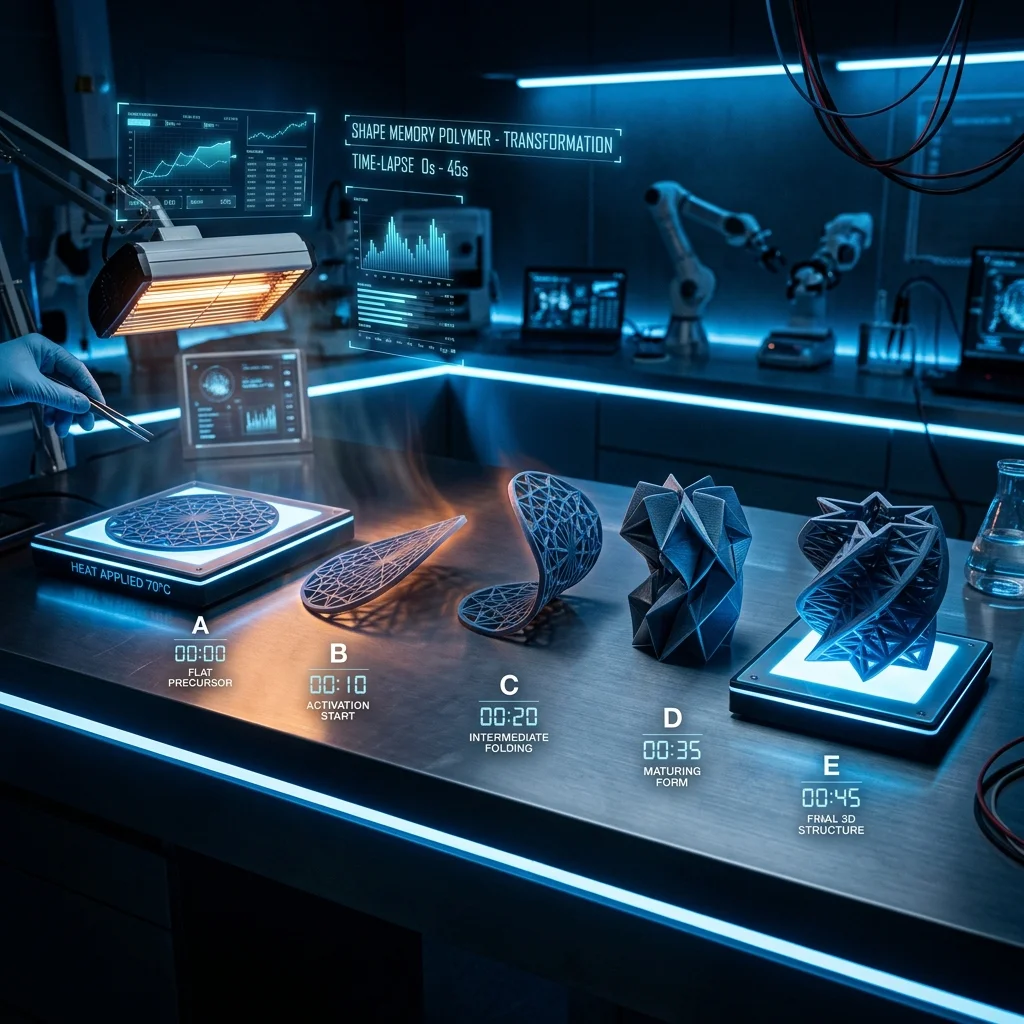
In 2025–2026, the concept of 4D printing has moved from academic curiosity to functional engineering reality. Shape Memory Polymers (SMPs) are the enabling material class: polymers that can be programmed into a temporary configuration and then recover their original geometry upon exposure to a stimulus, typically heat.
This article examines the molecular physics of the glass transition mechanism, the shape programming cycle, and the engineering applications driving adoption of 4D printing.
Molecular Physics of Shape Memory
The shape memory effect is governed by the glass transition temperature ($T_g$): the phase transition between a rigid glassy state and a rubbery elastic state in amorphous polymer chains.
Dual-Phase Polymer Network
SMPs consist of two key components:
- Permanent (Hard) Phase: Chemically or physically crosslinked network nodes that define the “memorized” permanent shape. These nodes remain intact during deformation.
- Switching (Soft) Phase: Polymer segments whose chain mobility is temperature-dependent. Below $T_g$, the chains are frozen; above $T_g$, they become mobile and elastic.
The Programming and Recovery Cycle
The Shape Memory Effect (SME) proceeds through four steps:
- Heating above $T_g$: The polymer is heated above its glass transition (e.g., $T_g + 20°C$), mobilizing the soft segments.
- Deformation: The object is mechanically deformed to a desired temporary shape (bending, stretching, twisting).
- Cooling below $T_g$ (Locking): While maintaining deformation, cooling below $T_g$ “freezes” the soft segments, locking the temporary shape.
- Reheating above $T_g$ (Recovery): Upon reheating, soft segments regain mobility. The permanent phase provides the elastic restoring force, driving the shape back to its original geometry. Recovery ratios ($R_r$) for high-quality SMPs reach 95% – 99%.
Interactive Filament Selector
Answer 3 quick questions and find the optimal material for your project.
1. What are the mechanical requirements for the part?
2. What temperature will the part operate at?
3. Are there any specific environmental requirements?
Our recommendation:
PLA filament
Ideal for easy printing, model visualization and decorative parts.
SMP Material Classification and Temperature Ranges
| SMP Material | Transition Type | $T_g$ Range | Applications |
|---|---|---|---|
| PLA-based SMP | Glass Transition | 55°C – 65°C | Educational models, self-assembling structures |
| PCL-based (Polycaprolactone) | Melting Point ($T_m$) | 55°C – 60°C | Biomedical stents, orthopedic braces |
| Epoxy-based SMP | Glass Transition | 80°C – 200°C | Space antennas, self-deploying structures |
| Polyurethane SMP | Glass Transition | 30°C – 80°C | Smart textiles, adaptive footwear |
4D Printing: From Static to Dynamic
4D printing combines SMPs with additive manufacturing. Parts are printed in their permanent shape, programmed into a compact temporary configuration for transport, and activated on-site:
Example 1: Space Antenna: A large parabolic antenna is printed and programmed into a compact folded form that fits within a rocket payload bay. In orbit, solar heating (or an embedded heater) triggers shape recovery, deploying the antenna to full operational size without mechanical actuators.
Example 2: Self-Expanding Biomedical Stent: A PCL-based SMP stent is printed in its expanded geometry, programmed into a narrow cylinder for catheter insertion, and activated by body temperature (37°C) to expand and support the vascular wall.
FDM/FFF Print Parameters for SMPs
| Parameter | Value | Rationale |
|---|---|---|
| Nozzle Temperature | $T_g + 60°C$ to $T_g + 100°C$ | Sufficient for complete melt flow without thermal degradation. |
| Bed Temperature | $T_g – 10°C$ to $T_g$ | Maintains adhesion without prematurely triggering SME. |
| Print Speed | 20 – 40 mm/s | Lower speed ensures better inter-layer chain entanglement. |
| Infill | 20% – 50% (Gyroid/Tri-Hexagonal) | Allows deformation during programming. |
| Part Cooling Fan | 50% – 80% | Required for rapid layer solidification. |
Pros and Cons
Pros:
- Self-Assembly: Objects transform from flat to 3D with a single thermal command.
- Compact Transport: Programmed shapes occupy significantly less volume.
- Biocompatibility: PCL and PLA-based SMPs are biodegradable and medically approved.
- No Mechanical Complexity: Eliminates motors, gears, and actuator systems.
Cons:
- Limited Cycle Life: Most SMPs degrade after 10–50 programming/recovery cycles.
- Slow Recovery: Full shape recovery can take seconds to minutes depending on part mass and $T_g$.
- Low Recovery Forces: SMPs generate significantly less force than Shape Memory Alloys (SMA, e.g., Nitinol).
- Temperature Dependence: Ambient temperature must be precisely controlled for predictable performance.
Frequently Asked Questions (FAQ)
Interactive Analyzer for Shape Memory Polymers: Entering The Era Of 4D Printing
Select a profile to view detailed analysis.
The full picture
This article is one page from The Big Book of 3D Printing: 704 illustrated pages covering every technology, material and fix in one reference.
Read it on Kindle →Engineer, author of The Big Book of 3D Printing and additive manufacturing expert