

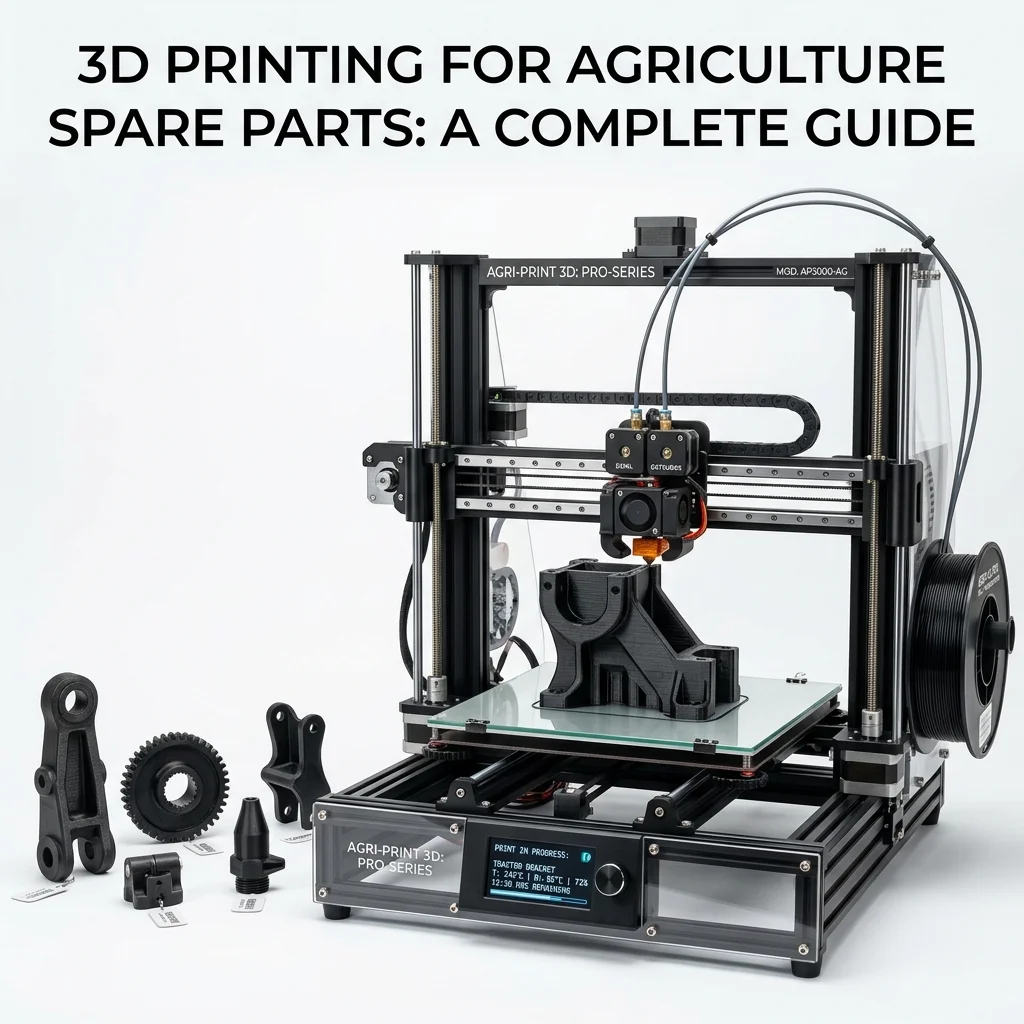
3D printing is revolutionizing the way industries approach manufacturing and development. In the field of Agriculture spare parts, this technology offers unmatched flexibility, allowing for the creation of customized solutions that meet strict quality and durability requirements. By adopting additive manufacturing, companies can significantly reduce time-to-market and optimize their production processes. This guide will walk you through the primary requirements, recommended technologies, and financial expectations.
Typical Requirements and Recommended Technologies
The specific needs of Agriculture spare parts require the use of materials and technologies that can withstand high stress, temperature variations, and chemical exposure. Key requirements include exceptional precision, part repeatability, and mechanical strength.
Recommended technologies vary based on needs but typically include:
- FDM (Fused Deposition Modeling): Ideal for rapid prototyping and manufacturing robust functional parts.
- SLS (Selective Laser Sintering): Preferred for complex geometries without the need for support structures.
- SLA/MSLA: Used when exceptional surface detail and smoothness are required.
Recommended printers for this purpose: 1, fdm-2, 3, sls-2, mjf-1, mjf-2, cff-1, cff-2.
Advantages and Disadvantages
Integrating 3D printing into the workflow for Agriculture spare parts has both strengths and weaknesses that must be carefully considered.
- Pros: Extremely fast production of custom parts.
- Pros: Significant reduction in spare parts warehousing costs.
- Pros: Easy design iteration and modification.
- Cons: Higher initial cost for industrial-grade equipment.
- Cons: Limitations in the maximum size of monolithic printed objects.
- Cons: Need for post-processing with certain specific materials.
Recommended Materials and Real-World Examples
Material selection is crucial for the success of Agriculture spare parts. Recommended materials include petg-1, petg-2, abs-1, abs-2, pa12-1, pa12-2, ny-1, ny-2, cf-1, cf-2, which provide the necessary properties for durability.
Real-world applications include creating prototypes to test functionality before mass production, as well as manufacturing custom tools that speed up workflows by up to 40%.
Workflow (Timeline)
Successful implementation of the technology requires a structured approach. Here is what a typical process looks like:
- Step 1: Conceptualization and creation of a 3D CAD model.
- Step 2: Design optimization for additive manufacturing (DfAM).
- Step 3: File preparation (slicing) and selection of the appropriate material.
- Step 4: Printing process and quality monitoring.
- Step 5: Post-processing and final testing.
Financial Expectations (Cost Breakdown)
The investment in 3D printing for Agriculture spare parts can vary significantly, but a basic breakdown looks like this:
- Equipment: 5000
- Training: 1000
- Materials: 1500
- Total: 7500
Frequently Asked Questions (FAQ)
Interactive Analyzer for 3D Printing For Agriculture Spare Parts: A Complete Guide
Select a profile to view detailed analysis.
The full picture
This article is one page from The Big Book of 3D Printing: 704 illustrated pages covering every technology, material and fix in one reference.
Read it on Kindle →Engineer, author of The Big Book of 3D Printing and additive manufacturing expert