

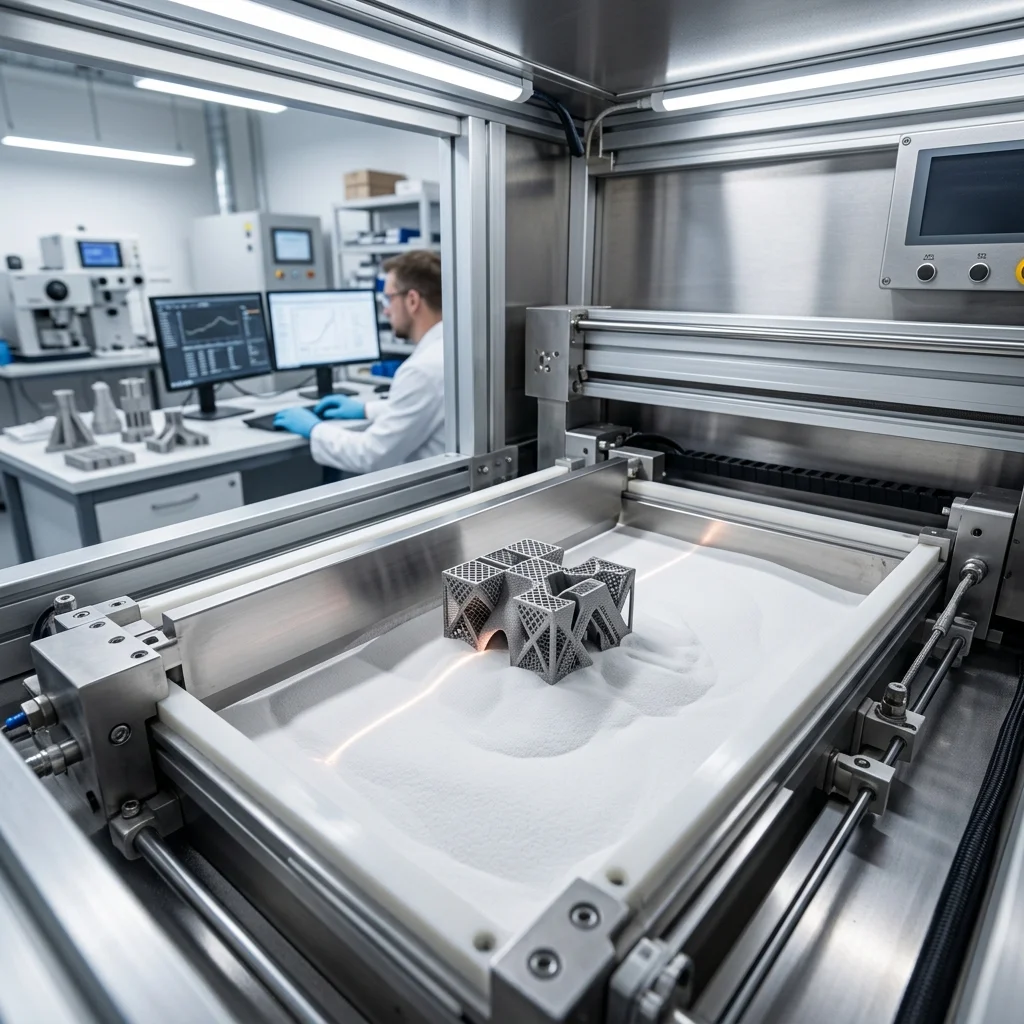
Selective Laser Sintering (SLS) has established itself as a powerhouse technology in industrial additive manufacturing. Its ability to create robust, highly functional parts with complex, support-free geometries makes it indispensable in modern production. However, transitioning from prototyping to high-volume manufacturing requires more than just hitting the print button.
The true potential of SLS technology is only unlocked through a deep understanding and precise calibration of process parameters. Every subtle adjustment to laser power, scanning speed, or chamber temperature can drastically alter the mechanical properties, dimensional accuracy, and surface finish of the final component. In this guide, we look at the technical core of the SLS process, exploring how visionary engineers optimize parameters to achieve flawless, repeatable results.
The Magic of Energy Density
At the heart of SLS optimization lies the concept of Energy Density. This is a combined metric that quantifies the total amount of thermal energy delivered to the powder bed. The most comprehensive form is Volumetric Energy Density (VED), calculated as: VED = P / (v * h * d), where P is laser power, v is scan speed, h is hatch spacing, and d is layer thickness.
Understanding VED is critical because these parameters are deeply interdependent. Insufficient energy density results in incomplete melting of the polymer particles, leading to a porous internal structure and weak mechanical bonds. Conversely, excessive energy density can cause thermal degradation of the material, oversintering (where surrounding powder inadvertently melts), and excessive shrinkage. The ultimate goal is to find the 'Goldilocks zone' for your specific material, whether handling standard PA12, flexible TPUs, or advanced composites.
Balancing Laser Power and Scan Speed
Laser power and scan speed are the two most dynamic parameters at the operator's disposal. Laser power determines the absolute amount of energy introduced at the focal point. Higher power ensures deeper melt pools and superior interlayer adhesion. Scan speed, meanwhile, dictates the interaction time between the laser and the powder.
If the speed is too high for a given power level, the polymer lacks the time required to melt fully and flow. This often results in the 'balling effect': the formation of small spheroidal beads driven by the surface tension of the inadequately wetted melt track. On the flip side, running a slow speed with high power causes overheating and material degradation. Industrial best practices dictate that these parameters must be optimized in tandem to guarantee a continuous, smooth melt track without compromising overall build times.
Temperature Control: The Secret to Dimensional Stability
While the laser does the heavy lifting of fusing the material, the thermal management of the entire build chamber guarantees the geometric fidelity of the part. The powder bed temperature is arguably the most critical macro-parameter in the SLS process. The powder must be maintained at a temperature just below its melting point (or glass transition temperature for amorphous polymers).
This precisely controlled thermal environment serves two primary functions. First, it minimizes the requisite energy the laser must input to initiate melting. Second, and most importantly, it drastically reduces the thermal gradient between the freshly sintered layer and the surrounding un-melted powder. Large temperature differentials induce internal residual stresses, which inevitably lead to warping, curling, and severe loss of dimensional accuracy. Furthermore, a slow, highly controlled cooling phase after the print completes is just as vital as the active printing phase.
Modern Optimization: AI and Design of Experiments
Historically, process optimization relied heavily on trial-and-error. Today, industry leaders employ sophisticated engineering methodologies such as Response Surface Methodology (RSM) and Design of Experiments (DOE). By running structured, orthogonal experimental arrays, engineers can mathematically model how various parameters interact and influence final part characteristics like tensile strength, relative density, and surface roughness.
In manufacturing environments, Artificial Intelligence is taking optimization to the next level. Artificial Neural Networks (ANN) and Genetic Algorithms are being trained on vast datasets of previous builds to predict part quality before a single layer is sintered. These predictive models enable real-time, dynamic adaptation of laser parameters to achieve 'Zero Defect' manufacturing: the exact philosophy driving the future of EduFacturing's ecosystem.
Conclusion
Optimizing the Selective Laser Sintering process is not a one-off task, but a continuous journey of engineering refinement. By mastering the delicate interplay between energy density, thermal dynamics, and advanced statistical modeling, manufacturers can transform raw powder into components that rival or exceed traditionally manufactured parts. This is the science of forging the next generation of industrial innovation.
The full picture
This article is one page from The Big Book of 3D Printing: 704 illustrated pages covering every technology, material and fix in one reference.
Read it on Kindle →Engineer, author of The Big Book of 3D Printing and additive manufacturing expert