

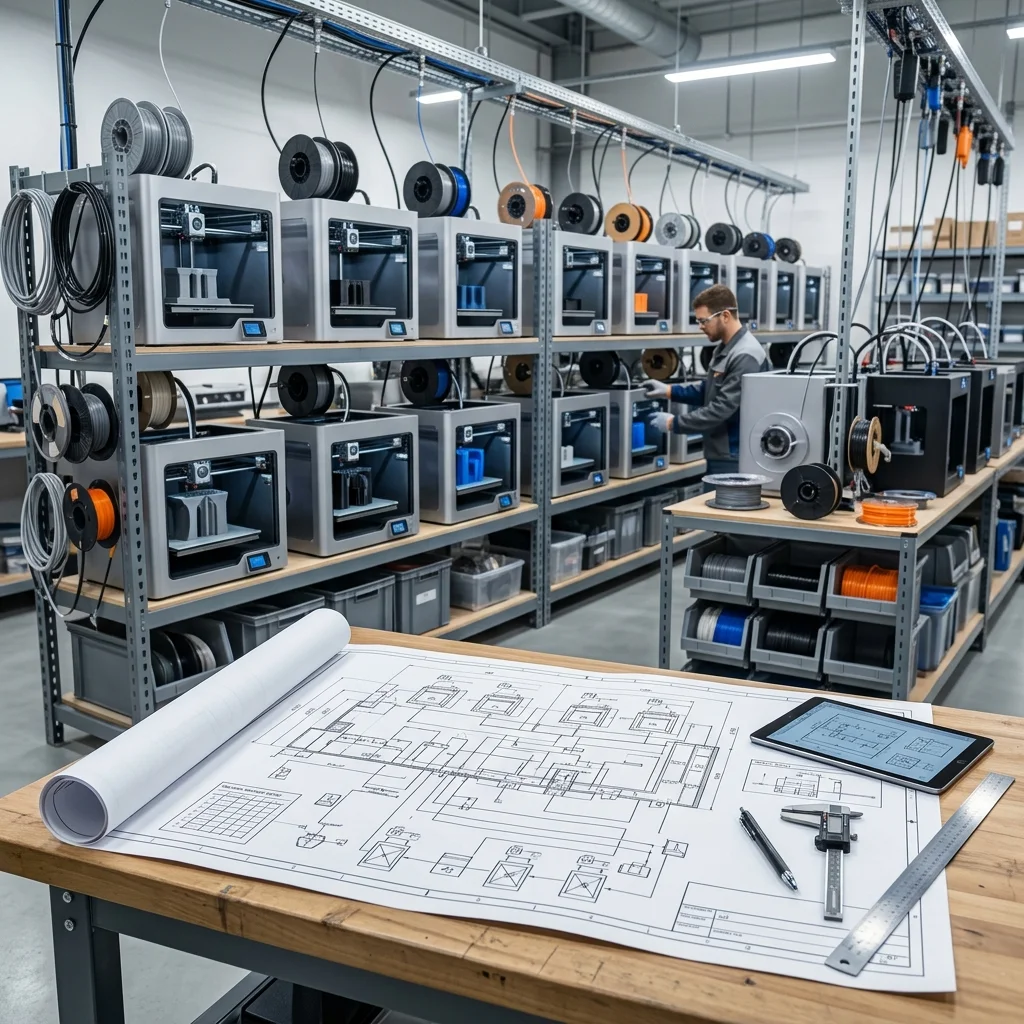
The journey from a few desktop 3D printers to a full-scale production farm is fraught with logistical and technical challenges. While a small setup relies heavily on manual intervention, true scalability demands a paradigm shift. Scaling a 3D print farm is not simply about acquiring more machines; it is about engineering a cohesive, autonomous ecosystem where hardware and software work in perfect synchronization.
In the modern manufacturing landscape, efficiency is measured by uptime, minimal human intervention, and the smooth flow of data. To achieve true "lights-out" manufacturing, operators must transition from reactive troubleshooting to proactive orchestration. This article explores the critical hardware advancements, software solutions, and operational strategies necessary to elevate your print farm from a scattered collection of machines to a highly optimized, automated production engine.
Centralized Software: The Nervous System of Your Farm
As your printer fleet grows, manual slicing, SD card shuffling, and individualized job assignment quickly become the primary bottlenecks. To scale efficiently, your farm requires a centralized management platform acting as its nervous system. Solutions like 3DPrinterOS, Printago, and AutoFarm3D offer architectures that replace chaotic manual queues with automated job dispatching and intelligent routing.
These platforms provide a unified dashboard to monitor telemetry across the entire fleet in real-time. Features such as cloud-based slicing, auto-queue management, and API integrations with e-commerce platforms enable a smooth pipeline from customer order directly to the print bed. Furthermore, advanced software leverages AI for failure detection, pausing failed prints to save material and alerting technicians instantly. By centralizing operations, you transform disparate machines into a single, cohesive manufacturing unit.
Hardware Automation: Achieving Lights-Out Manufacturing
The physical bottleneck in any 3D print farm is the transition period between prints: the time required to remove a finished part, clean the bed, and initiate the next job. Achieving continuous, 24/7 "lights-out" manufacturing requires aggressive hardware automation. Technologies such as continuous belt printers and automated ejection systems are revolutionizing this space.
Add-on kits and customized bed-swapping mechanisms (like FarmLoop for Bambu Lab ecosystems) allow printers to physically clear their own build volumes without human intervention. In more advanced setups, robotic arms orchestrate bed removal and replacement across an entire aisle of printers. By eliminating the manual part-removal step, you drastically reduce machine idle time, unlocking the true throughput potential of your hardware investments.
Fleet Standardization and Predictive Maintenance
A common pitfall in scaling is the accumulation of diverse, "Frankenstein" setups. Customization is the enemy of scale. Establishing a highly efficient farm necessitates strict hardware standardization. Deploying identical machine models, standardized hotend configurations, and uniform firmware ensures that slicing profiles are universal and spare parts inventory is streamlined.
Standardization also paves the way for predictive maintenance rather than reactive repair. When operating dozens or hundreds of machines, relying on break-fix strategies leads to catastrophic downtime. Implement rigorous, data-driven maintenance schedules. Utilize telemetry data from your management software to track operating hours, extrusion volumes, and thermal cycles, allowing technicians to replace wear components like nozzles and PTFE tubes before they cause print failures.
Optimizing the Physical Infrastructure
Scaling your digital and mechanical systems must be matched by physical infrastructure. A dense cluster of 3D printers generates significant heat, consumes substantial electrical power, and emits VOCs and ultrafine particles. Designing a scalable farm requires meticulous planning of the facility's HVAC (Heating, Ventilation, and Air Conditioning) systems to maintain stable ambient temperatures, preventing print warping and hardware overheating.
Electrical infrastructure must be engineered with overhead, utilizing dedicated circuits and uninterruptible power supplies (UPS) to protect against micro-outages that could ruin hours of production. Additionally, industrial-grade networking gear is non-negotiable. Hundreds of machines streaming telemetry and webcam feeds demand a resilient, high-bandwidth local area network. A well-architected physical space not only safeguards your equipment but also ensures a safe and efficient working environment for your operations team.
Conclusion
Scaling a 3D print farm is a multifaceted engineering challenge that extends far beyond buying more hardware. It requires a holistic approach, blending intelligent fleet management software with advanced hardware automation and robust facility infrastructure. By prioritizing standardization, predictive maintenance, and automated workflows, manufacturers can transcend the limitations of manual operation. The future of decentralized manufacturing lies in these highly efficient, autonomous print farms, ready to deliver on-demand production at unprecedented scales.
The full picture
This article is one page from The Big Book of 3D Printing: 704 illustrated pages covering every technology, material and fix in one reference.
Read it on Kindle →Engineer, author of The Big Book of 3D Printing and additive manufacturing expert