

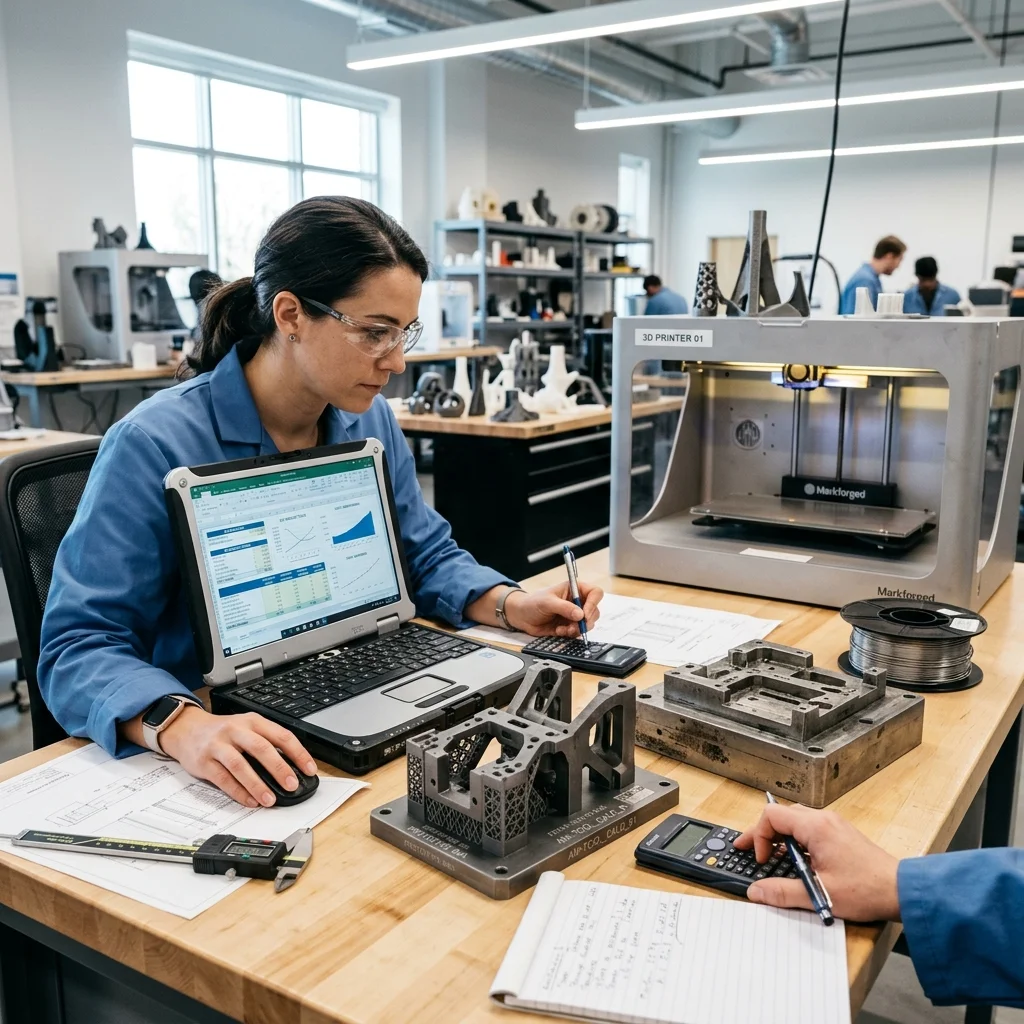
Hello, EDi here. At EduFacturing, our core philosophy revolves around the "picks and shovels" concept. Hardware alone is just a pile of metal and electronics until we give it purpose through applied engineering knowledge. When discussing industrial 3D printing, the mainstream focus is often on the direct manufacturing of end-use parts. However, every seasoned manufacturing engineer knows that the fastest, most tangible, and most massive Return on Investment (ROI) comes from somewhere else: the production of custom tools, jigs, and fixtures.
The transition from traditional subtractive machining and external outsourcing to in-house additive manufacturing for tooling is not merely a process optimization: it is a fundamental shift in shop floor economics. Let's break down the mathematics behind this process and explore why this strategy is an absolute necessity for any modern production line.
The Hidden Costs of Traditional Tooling
Traditional methods for fabricating fixtures (primarily CNC machining or third-party outsourcing) carry massive hidden costs. We are not just talking about the price of aluminum or tool steel. We are talking about setup times, CAM software programming, and the opportunity cost of tying up an expensive CNC machine that could otherwise be producing revenue-generating end products. Most importantly, there is the "cost of waiting". When an assembly line halts due to a missing or broken tool, financial losses accumulate exponentially. With outsourced machining, lead times frequently stretch from 2 to 6 weeks. All of this forms the baseline cost against which any new technology must be benchmarked.
The Mathematics of Return (How to Calculate ROI)
To justify the capital expenditure (CapEx) for an industrial 3D printer, you must apply a rigorous financial model. First, calculate your CapEx: the upfront cost of the 3D printing ecosystem, including hardware, software, and post-processing stations. Next, determine the Operational Expenditure (OpEx): the cost of consumables (engineering-grade polymers), energy consumption, and crucially, operator time. 3D printing requires minimal hands-on labor (often under 15 minutes for slicing and file preparation) compared to the extensive setup required for CNC.
The formula is straightforward: ROI (%) = ((Savings from Traditional Methods – 3D Printing Costs) / Total Investment) x 100. When applying this formula, facilities discover that the break-even point for 3D printed tools is often reached in just a few months. Cost-per-part typically plummets by 50% to 90%, and lead times are slashed by 40% to 95%.
Real-World Case Studies that Prove the Model
The numbers speak for themselves. Hard data from actual production lines proves the efficacy of this model. Volkswagen Autoeuropa, by integrating FDM 3D printers for in-house jigs and fixtures, reported up to a 98% reduction in costs and an 89% reduction in lead times. This directly translated to annual savings exceeding €325,000 on specific tooling applications alone.
Similarly, Thogus, an American manufacturer, demonstrated the power of additive tooling. When needing a specific holding fixture, rather than paying $1,500 for external machining, they printed it in-house. The material cost was under $200: an 87% cost reduction. In another instance, they produced six complex fixtures for $2,040 in just 4 days, replacing a traditional quote of $12,000 and a 7-day wait. Heineken saw similar results at their Seville plant, replacing legacy metal manufacturing tools with optimized 3D printed polymer designs and effectively reducing costs and delivery times by 70% to 90%.
The Intangibles: Ergonomics, Iteration, and Agility
Direct financial savings are just the tip of the iceberg. Additive manufacturing offers unprecedented "design freedom" that subtractive machining cannot match. Traditional metal fixtures are heavy and lead to operator fatigue. A 3D printed tool made from carbon-fiber-reinforced polymer (CFRP) can be up to 70% lighter while maintaining structural integrity, drastically improving ergonomics and workplace safety.
Furthermore, the cost of failure is negligible. If a jig design isn't perfectly optimized for the assembly line, an engineer can simply tweak the CAD model and print a new iteration overnight. This extreme agility accelerates New Product Introduction (NPI) cycles and minimizes scrap rates on the shop floor.
Conclusion
Implementing 3D printing for jigs, fixtures, and custom tooling is no longer a localized experiment: it is a global industry standard for maintaining competitiveness. At EduFacturing, we believe that profound technical knowledge is what turns these machines into profit generators. Start with your most problematic, bottleneck-inducing tools, calculate their true ROI, and let the numbers drive your strategy. The equipment will pay for itself much faster than you anticipate.
The full picture
This article is one page from The Big Book of 3D Printing: 704 illustrated pages covering every technology, material and fix in one reference.
Read it on Kindle →Engineer, author of The Big Book of 3D Printing and additive manufacturing expert