

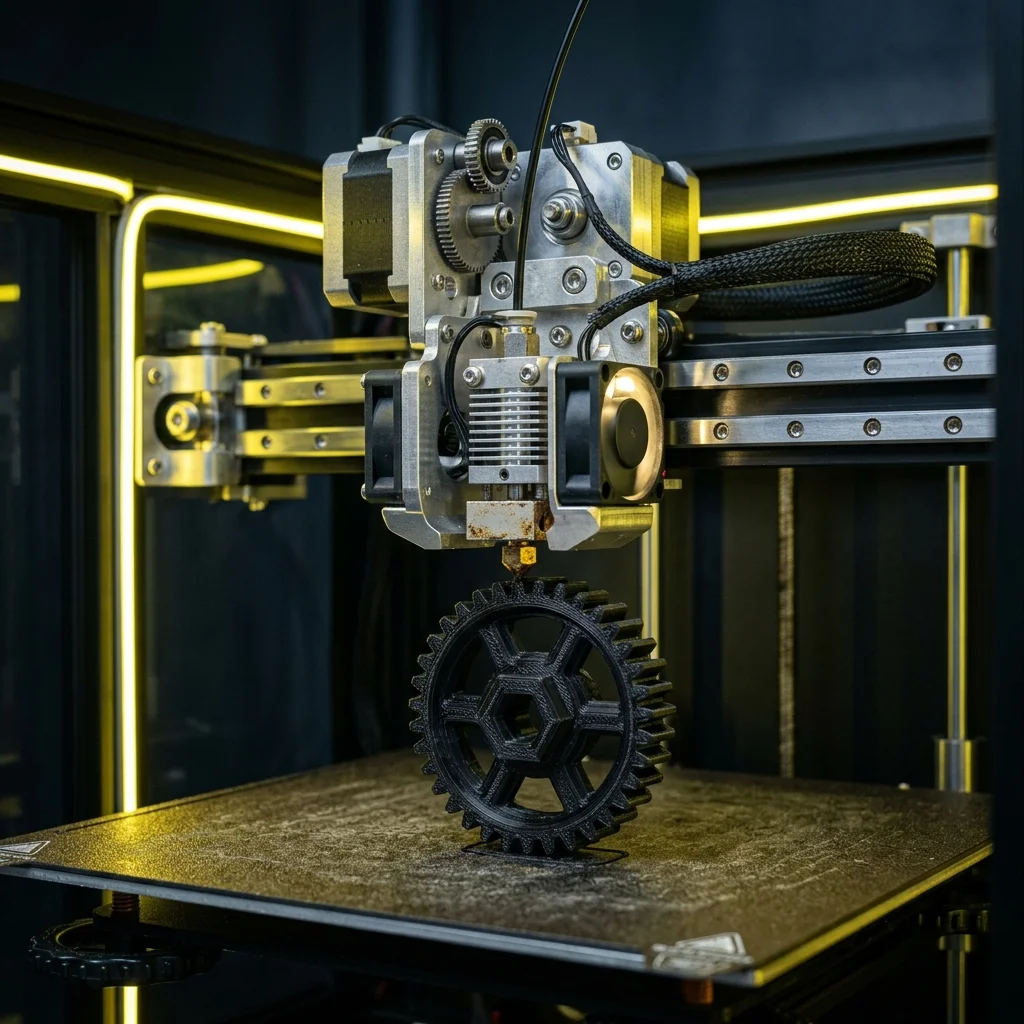
Spare parts are one of the most practical applications of 3D printing for households and small workshops. A broken fridge handle, a worn plastic gear in a printer, a lost bottle cap, a leaking gasket – all can be 3D printed for €0.50-€5.00 in material, saving €20-€200 on an original spare or full product replacement. In this guide we cover how to measure a broken part, which material to choose, when 3D printing is more sensible than ordering an original, and what the limits are – when you simply need to buy a new machine.
When 3D printing is a sensible alternative to an original spare
3D printing a spare is a sensible alternative under these conditions:
1. The original part is no longer made (old appliance, retro motor, antique). This is the strongest argument – without 3D printing the product goes to the bin. An old German sewing machine from 1965 with a plastic handle no longer in production – 3D printing saves it.
2. The original part is overpriced (manufacturer asks €80 for a plastic handle that costs €0.50 in material). Coffee machines, dishwashers, household appliances have pricey spares. 3D printing cuts costs 10-50×.
3. Delivery time is too long (spare from China – 6-8 weeks). 3D printing – 1 day.
4. You have a ready CAD model (from manufacturer, Thingiverse, Printables). No need to design from scratch.
5. The part is under mechanical load within safe limits (handle, protective cap, bezel). NOT under high pressure or safety-critical (car brakes, pressure valves).
6. Good fit with the original product (you can measure the original or 3D-scan it).
When 3D printing is NOT sensible:
- High-temperature parts (Teflon gasket in an oven – 3D printing doesn’t work)
- High-pressure parts (hydraulic, gas) – fail under load
- Precision parts (clock mechanisms) – standard 3D print resolution is insufficient
- Electrical contact parts (terminals, relays) – current safety
- Metal parts under heavy load (nuts, bolts, bearings) – FDM plastic can’t
For metal spares, you need metallurgical equipment – SLM or DED 3D printing, starting at €250,000.
How to measure a broken part
This is the critical step – without accurate dimensions, even the best printer doesn’t help.
Tools:
- Digital calipers (€15-€30 decent, €60-€100 for precision Mitutoyo)
- Thread micrometer (€20-€50)
- Profile gauge for internal forms (€10-€20)
- 3D scanner for complex shapes (€300-€2000 decent, €5000+ precision)
Method 1: Hand measurement (for simple shapes)
Measure all external and internal dimensions with calipers. Record on a sketch. Then measure:
- Length, width, height
- Hole diameters
- Threads (if any) – pitch and type (M3, M4, M5…)
- Distance between mounting holes
For a handle with screw holes: measure center-to-center distance between two screws, screw head diameter, cone depth (if any).
Method 2: 3D scanning (for complex shapes)
For forms with curves, texture, asymmetry – a 3D scanner is wiser. Scanning services charge €30-€80 per object, delivering an STL for printing.
Method 3: Photo + AI reconstruction (experimental)
With at least 15-20 photos from different angles + Meshroom or RealityCapture software. Quality is variable but free. Works for matte surfaces (not shiny, transparent, or metallic).
Method 4: Reverse engineering from drawing/CAD
If you have an original drawing from the manufacturer (Service Manual, IPL – Illustrated Parts List), just recreate the CAD model in Fusion 360 or OnShape. Free for personal use.
Tolerances:
- Free fit (two parts moving relatively): +0.3 mm to internal dimension, -0.3 mm from external.
- Snug fit (push-fit): ±0.1 mm.
- Press fit (heat-set inserts): +0.05 mm.
- Screws: M3 → 3.2 mm hole; M4 → 4.2 mm; M5 → 5.3 mm.
Recommended materials by application
Handles and bezels for household appliances: PLA or PETG. Polymaker PolyLite (€28/kg). Withstands temperatures up to 60°C (PLA) or 75°C (PETG). For appliances near the oven – PETG.
Gears and mechanisms: PETG or Nylon. PETG for low-speed small mechanisms (lid latches, hand winches). Nylon for higher load and wear (printer gears, machinery). Polymaker PolyMide PA6 (€60/kg).
Gaskets and seals: TPU 95A or 85A. NinjaFlex or Polymaker PolyFlex (€50-€80/kg). For taps – TPU 65A (even softer). NOT for high temperatures (silicone is better).
Electronic enclosures: PETG or ABS. PETG for easier printing, ABS for higher heat resistance (near a heat source – power modules). Polymaker PolyLite PETG (€28/kg) or Polymaker PolyLite ASA (€32/kg).
Threaded inserts, metal-like parts: Nylon with heat-set inserts. Print with metal inserts → heat-press → you have metal threads in a plastic body. Brass insert kit M3-M6: €15-€25.
Decorative emblems and badges: PLA with Silk finish or with metal powder. Cosmetic PLA with gold, silver, bronze tones.
Durable household items (hangers, bathroom holders): PETG-CF or Nylon-CF. With carbon fibers for extra strength. €60-€90/kg. Prints on an all-metal hotend.
Transparent covers (lenses, lamp shades): Clear PETG or MSLA Clear resin. PETG for simple shapes, MSLA for optical quality.
Electrically isolated parts: ABS or Nylon. ABS has higher dielectric strength. WARNING: for above 50V, check local standards.
Recommended printers for spare parts
For a beginner home user with simple needs:
- Bambu Lab A1 (€420) – easy interface, multi-color AMS lite, prints PLA and PETG cleanly. Ideal for handles and bezels.
- Anycubic Kobra 3 Combo (€430) – alternative with similar features.
For a home user with more complex needs (multiple materials):
- Bambu Lab X1-Carbon (€1449) – enclosed body for ABS, PA, CF composites. Universal printer for all materials.
- Prusa MK4S with Prusa Enclosure (€999 + €330) – open source, all upgradable by hand.
For a small studio offering spare parts as a service:
- Bambu Lab X1-Carbon + AMS (€1799) – multi-color prints, fast processing.
- Anycubic Photon Mono M5s (€368) – for fine precise shapes, small parts.
- Bambu Lab P1S (€700) – enclosed body, budget for ABS, ASA.
For a car shop needing metal parts:
For plastic parts (handles, levers, housings) – Bambu X1-Carbon. For metal parts – send to a specialized SLM/DED bureau. Cost for a metal spare (old car, retro motor) – €80-€500 depending on complexity.
Specialized bureaus for spares:
- Print Centers – plastic spares in 24-48 hours, €5-€50 per part.
- Industry hubs – plastic and metal (via partnerships with EOS, SLM Solutions centers). Metal: €100-€800 per part.
- Internal 3D printing services at large companies – own printers for internal needs.
Real examples of 3D-printed spare parts
Example 1: Handle for a German Bosch washing machine from 1985
Customer: a homeowner who doesn’t want to scrap a working washer because of a broken handle. The original spare is no longer produced.
Solution: 3D print in matte gray PETG. Caliper measurement, CAD design in Fusion 360 (1 hour), print on Prusa MK4 (3 hours). Cost: €4 material + €30 design labor = €34 total.
Alternative: new washer €450. Saved €416.
Example 2: Gear in a DeLonghi coffee machine
Customer: a café. Machine works, but the plastic gear is worn and coffee doesn’t grind correctly.
Solution: 3D print in Nylon (Polymaker PolyMide PA6). Measurement, CAD modeling, print on Bambu X1-Carbon with all-metal hotend. Cost: €15 material + €40 labor = €55.
Alternative: original part from DeLonghi service €120 + 4 weeks delivery from Italy. Saved €65 and 4 weeks.
Example 3: Rubber gasket for an old Liebherr fridge
Customer: a restaurant. Fridge is from 1998, still works, but the gasket leaks and the fridge loses cold air.
Solution: 3D print in TPU 85A. Sliced in Lychee Slicer, printed on Bambu A1. Cost: €8 material + €25 labor = €33.
Alternative: new fridge €1200, or specialty bureau for the gasket €180. Saved €1167 or €147.
Example 4: Reverse engineering of a missing heater fitting
Customer: car repair shop. Old garage heater from the 1970s broke its fitting. No spare part exists.
Solution: 3D scan of broken pieces, reconstruction in Fusion 360, print in PETG-CF (for higher heat resistance – near heater). Cost: €50 material + €120 labor + €30 scanning = €200.
Alternative: new heater €800. Saved €600.
Frequently Asked Questions (FAQ)
Interactive Analyzer for 3D Printing Spare Parts And Repairs – Materials, Precision, When It’S Worth It
Select a profile to view detailed analysis.
The full picture
This article is one page from The Big Book of 3D Printing: 704 illustrated pages covering every technology, material and fix in one reference.
Read it on Kindle →Engineer, author of The Big Book of 3D Printing and additive manufacturing expert