

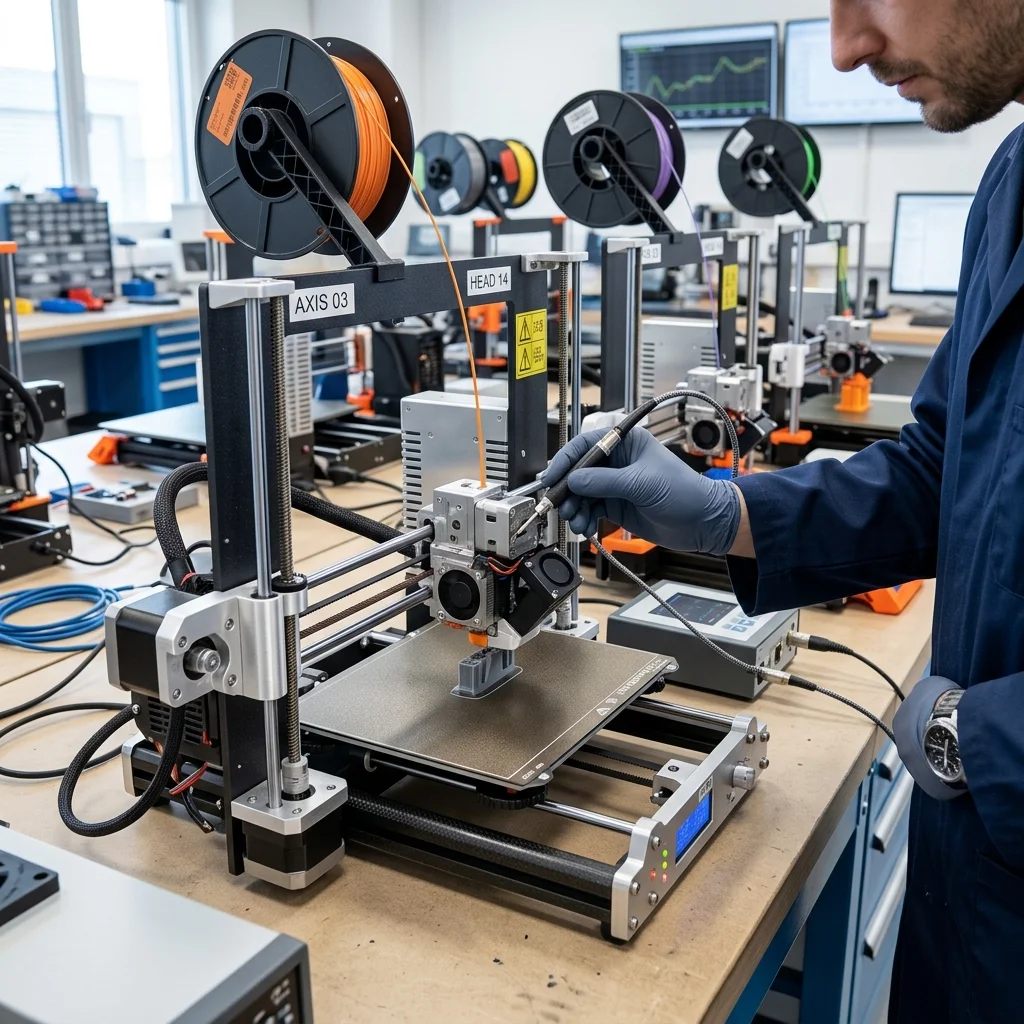
The concept of 'lights-out' manufacturing (factories operating in the dark without human intervention) was long the exclusive domain of multi-million dollar industrial giants. Today, however, thanks to the convergence of accessible hardware, edge computing, and artificial intelligence, this vision is becoming a reality in the heart of decentralized manufacturing: 3D printer farms.
Managing a fleet of dozens or hundreds of 3D printers no longer requires physical presence and manual SD card shuffling. Modern remote monitoring and orchestration systems have transformed scattered clusters of machines into a single, intelligent organism capable of self-diagnosing issues, dynamically planning its workload, and guaranteeing uncompromising print quality.
The Foundation: Edge Computing and Real-Time Telemetry
For a print farm to function autonomously, it requires a digital nervous system. At its core are microcontrollers and edge devices (like Raspberry Pi or specialized industrial boards) running next-generation firmware such as Klipper. These systems do more than just translate G-code commands; they ingest massive arrays of real-time telemetry data: hotend temperature fluctuations, stepper motor resistance, vibration resonances (via accelerometers for input shaping), and extrusion pressure.
This data is broadcast via lightweight protocols like MQTT to centralized local servers or cloud platforms (e.g., 3DPrinterOS, AutoFarm3D). This architecture allows operators a comprehensive overview of the farm’s topology through a unified dashboard, enabling them to monitor low-latency WebRTC video streams and dispatch new jobs to hundreds of machines simultaneously.
AI and Computer Vision for Anomaly Detection
Even the most precisely calibrated printer can fail. A detached first layer, a clogged nozzle, or the infamous 'spaghetti' effect (printing material into thin air) can result in significant losses of both material and machine time. This is where Machine Learning-based computer vision systems (such as Obico) step in.
These AI models analyze the live video feeds from each printer frame by frame. Upon detecting an anomaly (like a layer shift or a visual defect in the print structure) the system autonomously pauses the print, cuts power to the heaters, and triggers a notification (Push, Slack, or Telegram) to the operator. This 'visual insurance' is critical for operating farms outside of standard working hours, turning potential catastrophic failures into easily resolvable minor incidents.
Predictive Maintenance: Digital Twins and Remaining Useful Life
Reactive maintenance (fixing a machine after it breaks) is prohibitively expensive at scale. The latest breakthrough in farm management as we enter 2025 is the shift toward Predictive Maintenance driven by AI analytics. Specialized software analyzes historical sensor data to predict the Remaining Useful Life (RUL) of critical components like heater cartridges, thermistors, belts, and bearings.
This concept effectively creates a 'digital twin' of the hardware. If the AI detects that a printer’s thermal heating curve has degraded by 3% over the past month, it will flag a pending heater failure well before the machine stalls during a critical production run. This transforms farm upkeep from a rigid, time-based schedule into an efficient, data-driven process based on actual hardware wear.
Intelligent Orchestration: From Files to Goal-Based Scheduling
The next evolutionary step is the transition from manual print queues to Goal-Based Scheduling. Instead of an operator deciding which file runs on which printer, AI agents assume control of production logistics. The user simply inputs a goal: 'We need 300 units of this specific part by Friday, using PETG.'
The system automatically analyzes the available fleet, checking installed nozzle sizes, filament status, and historical machine reliability. It then routes the jobs optimally, balancing the workload to extend hardware lifespan and minimize idle time. If a machine drops offline, its queued jobs are instantly re-routed to the remaining available fleet, ensuring continuous production.
Conclusion
Remote monitoring and managing 3D printer farms is no longer just about watching a webcam in a browser tab. It is a complex, AI-driven ecosystem that elevates discrete hardware nodes into a high-performance, self-governing micro-factory. At EduFacturing, we believe that mastering these 'picks and shovels' (the software architecture, data pipelines, and automation) is the true key to democratizing advanced manufacturing for the future.
The full picture
This article is one page from The Big Book of 3D Printing: 704 illustrated pages covering every technology, material and fix in one reference.
Read it on Kindle →Engineer, author of The Big Book of 3D Printing and additive manufacturing expert