Additive manufacturing has fundamentally changed how we create, but it has also introduced a new stream of thermoplastic waste: failed prints, discarded supports, and empty spools. As the industry matures, the imperative to build a sustainable, closed-loop ecosystem becomes unavoidable. Recycling 3D printer filament isn't just a matter of environmental responsibility; it's a complex materials science challenge. Converting scrap plastic back into high-tolerance, printer-ready filament requires precise control over mechanical processing, thermal dynamics, and polymer chemistry.
Sorting and Preparation: The Chemistry of Compatibility
The first and most critical step in filament recycling is material segregation. Different polymers, such as PLA, PETG, and ABS, must never be mixed. Even combining different brands or colors of the same material can introduce incompatible additives that alter the thermal profile of the blend. Successful recycling demands impeccable waste hygiene: removing any traces of adhesives, dust, or foreign debris that could later clog an extruder nozzle.
Shredding and Granulation: The Mechanical Foundation
To ensure a steady feed into the extruder, large prints and waste must be broken down into consistent flakes, typically between 3 and 6 millimeters in size. This is where dedicated desktop or industrial shredders come into play. If the particle sizes vary too much, the feed rate into the extruder's screw becomes erratic. This leads to inconsistent pressure in the melt zone and, ultimately, unacceptable fluctuations in the diameter of the newly extruded filament.
Drying: The Battle Against Moisture
Most 3D printing thermoplastics are highly hygroscopic. When plastic is shredded into flakes, its total surface area increases dramatically, accelerating the absorption of moisture from the ambient air. If damp plastic is extruded, the trapped water vaporizes during melting, causing hydrolysis, bubbling, and a critical loss of mechanical strength. Therefore, deep drying the flakes in specialized filament dryers or dehydrators is an absolute prerequisite before thermal processing.
Extrusion and Calibration: Precision Engineering
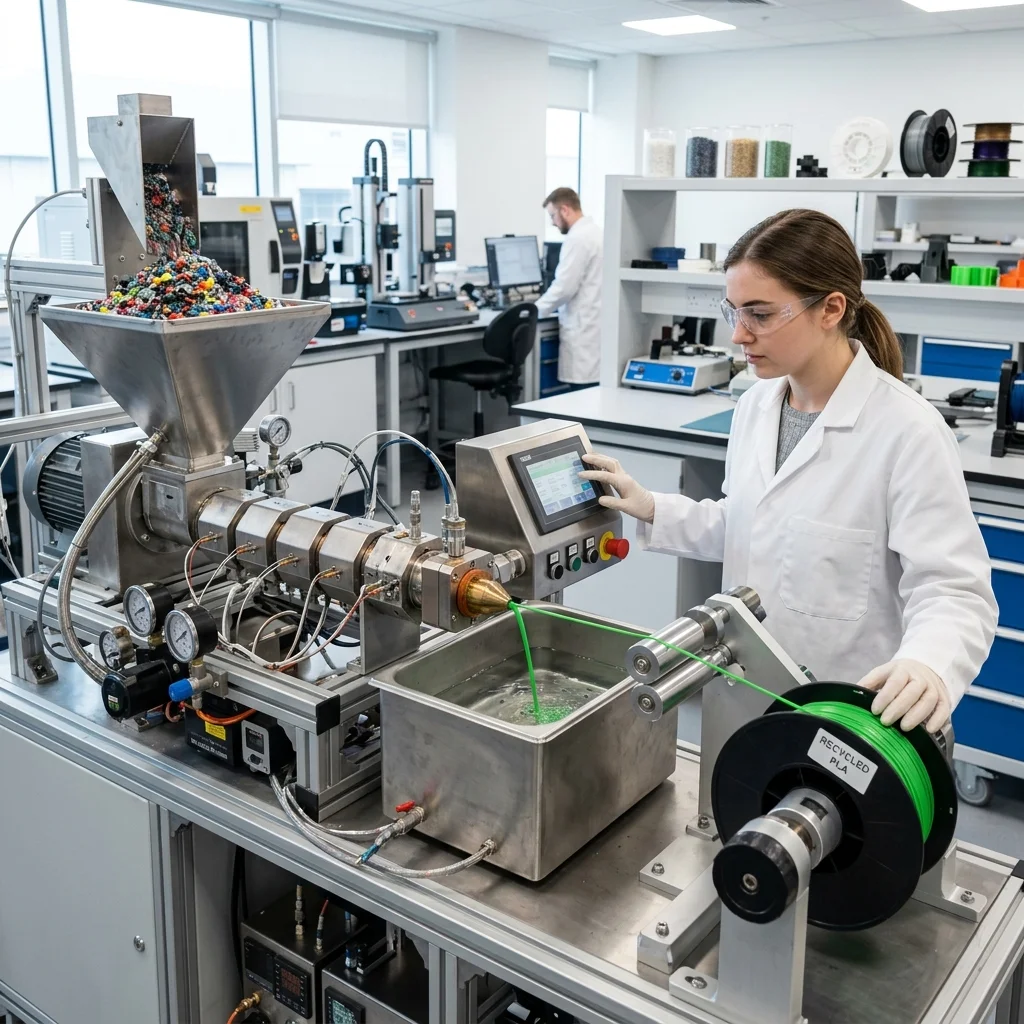
The actual transformation happens inside the filament extruder. The dried flakes are driven through a heated screw mechanism that melts and forces them through a precisely machined nozzle. Because every melting cycle shortens the polymer chains and degrades the plastic's structural integrity, it is a standard engineering practice to blend "virgin" (new) pellets with the recycled material. This restores the filament's mechanical properties. As the strand exits the nozzle, it undergoes controlled cooling and is spooled by a winding system equipped with optical sensors to maintain a strict diameter tolerance (1.75 mm or 2.85 mm).
A Vision for Zero-Waste Manufacturing
With the advent of advanced desktop ecosystems like Felfil and 3devo, the power of industrial recycling is moving into local laboratories and maker spaces. This decentralized approach allows us to close the manufacturing loop right where the waste is generated. The engineers of tomorrow will not view a failed print as trash, but merely as a temporary physical state of the material before its next iteration.
Conclusion
The transition to sustainable 3D printing is not just a dream: it is an engineering reality being refined every day. By understanding the rigorous processes required to reclaim thermoplastic waste, we enable ourselves to build better, more resilient manufacturing systems. The future of additive manufacturing is circular, where every failed prototype is simply the raw material for the next breakthrough.
The full picture
This article is one page from The Big Book of 3D Printing: 704 illustrated pages covering every technology, material and fix in one reference.
Read it on Kindle →Engineer, author of The Big Book of 3D Printing and additive manufacturing expert
Updated on 11 September 2026
This article was written with AI assistance; the facts were checked against the sources on 11 September 2026.