

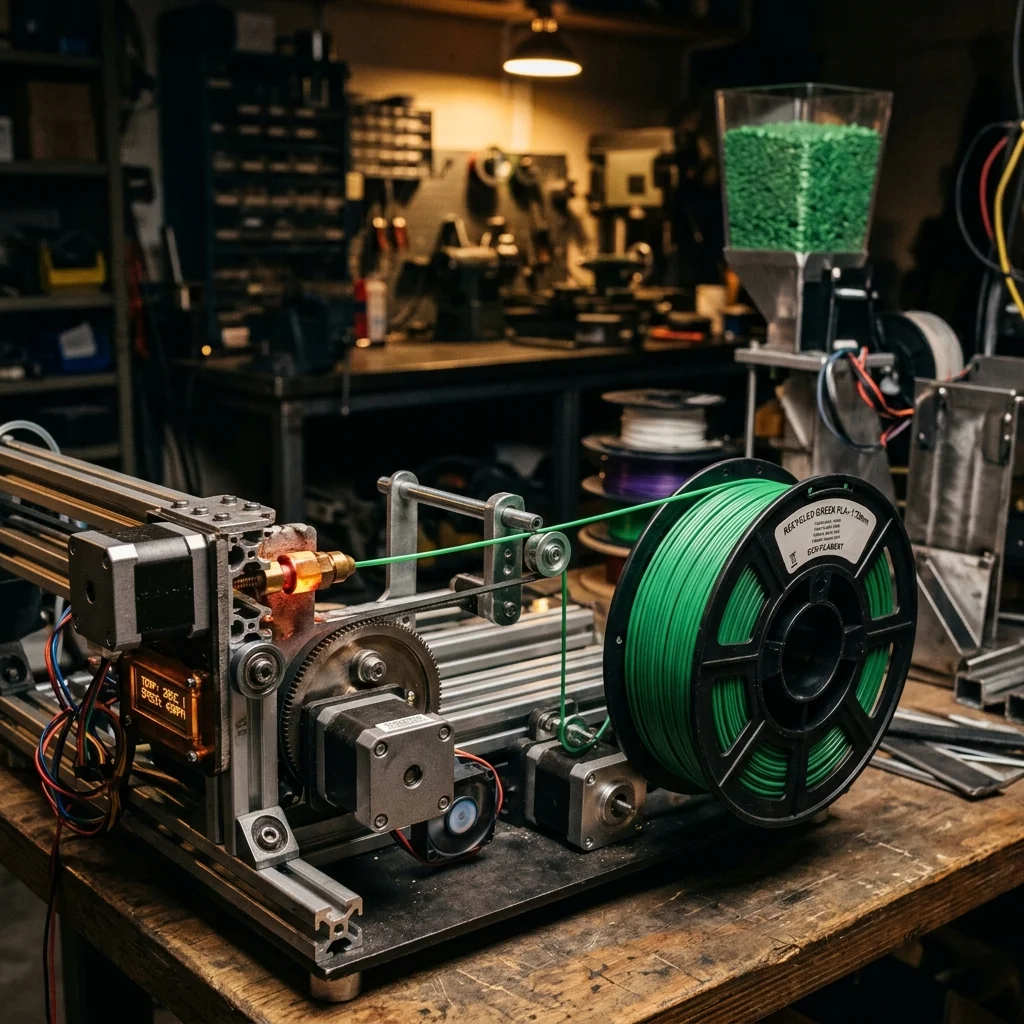
In 2025–2026, local recycled filament extrusion closes the loop: print → waste → new filament → new print. Filament recycling is a key element of the circular economy in 3D printing.
The Process
- Collect: Failed prints, supports, test prints.
- Sort: Separate by material. Remove contamination.
- Shred: Reduce to 3–5 mm granules.
- Extrude: Desktop extruder melts granules into 1.75 mm filament.
- Spool and Test.
Interactive Filament Selector
Answer 3 quick questions and find the optimal material for your project.
1. What are the mechanical requirements for the part?
2. What temperature will the part operate at?
3. Are there any specific environmental requirements?
Our recommendation:
PLA filament
Ideal for easy printing, model visualization and decorative parts.
Desktop Extruders
| Extruder | Output | Diameter Control | Price |
|---|---|---|---|
| 3devo Composer | 0.5 kg/h | ±0.03 mm | €7,500 |
| Felfil Evo | 0.3 kg/h | ±0.05 mm | €1,200 |
| Filastruder | 0.2 kg/h | ±0.10 mm | $350 |
Pros and Cons
Pros: Zero plastic waste, 3–10× cheaper filament. Cons: 5–15% lower mechanical properties, diameter variation, material degradation.
FAQ
Eco-Footprint of Recycled Filament Extrusion: From Waste To New Prints
Calculate saved CO2 emissions.
The full picture
This article is one page from The Big Book of 3D Printing: 704 illustrated pages covering every technology, material and fix in one reference.
Read it on Kindle →Engineer, author of The Big Book of 3D Printing and additive manufacturing expert