

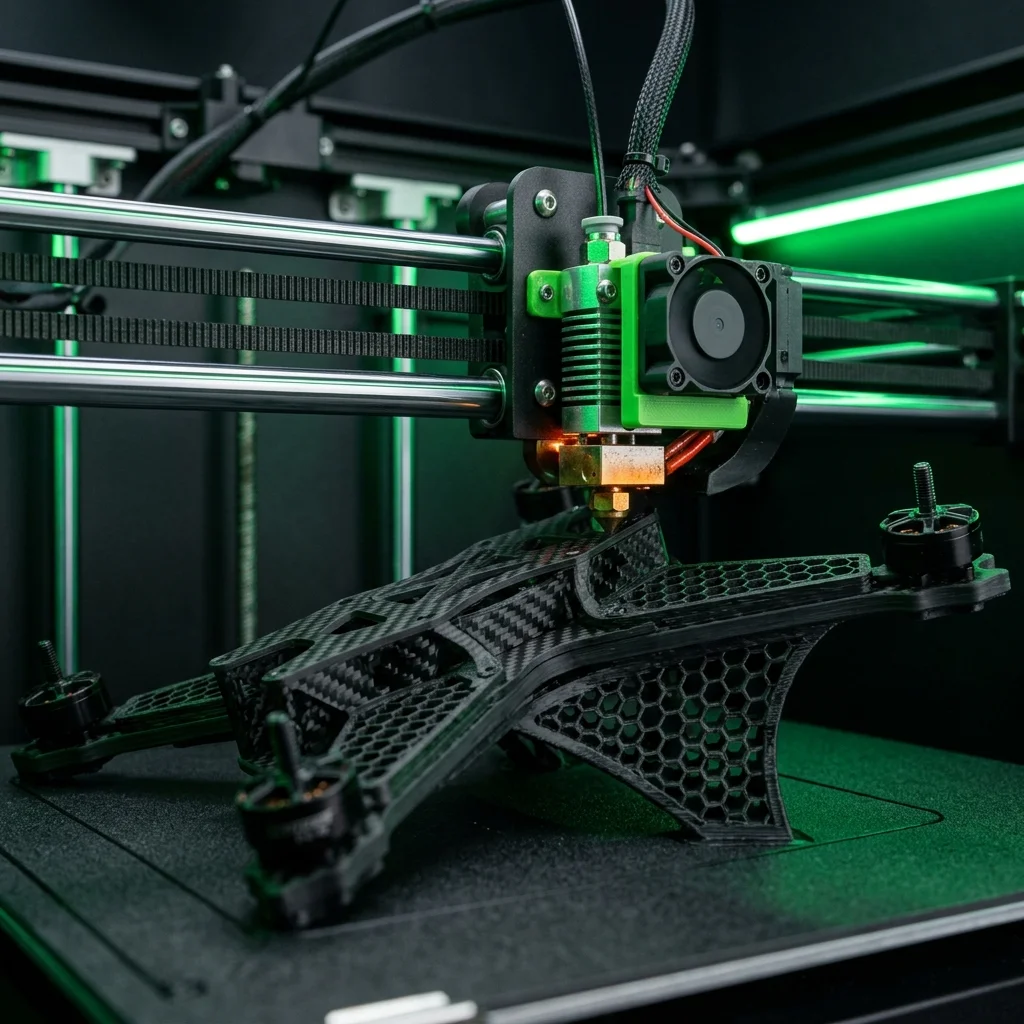
RC modeling and the drones community were among the first hobbyists to adopt 3D printing seriously: frame designs since 2015 integrate printed components, and fully 3D-printed drones became the norm around 2019-2020. With carbon-fiber filled nylon (PA-CF) you can print a frame that’s equivalent to CNC-machined aluminum at 1/3 the weight: critical for flight time and agility. This guide: what gets printed in RC/drone hobby, recommended materials and printers, and design considerations for lightweight + tough parts.
What gets printed in RC/drone
Categories of RC/drone 3D printing:
-
Drone frames: complete framework holding motors, FC, props. PA-CF dominates the market. Premium choice: full carbon fiber composite (hand-laid for highest performance), but 3D-printed PA-CF achieves 80-90% of composite performance at 1/10 the cost.
-
Motor mounts: custom mounts holding motors to frame. PA-CF or PETG-CF for vibration damping. Often printed when stock options don’t fit specific frame.
-
Camera/gimbal mounts: vibration-damped mounting for GoPro, FPV cameras. TPU dampers + PA12 mounts.
-
Propeller guards/ducts: protective rings around propellers for indoor flying or crowd safety. PETG common. Some racers use printed shrouds for performance gains.
-
Battery holders: custom shapes for specific batteries. PETG or PLA. Hot-swap snap-fits common.
-
Antenna mounts: typically TPU (flexible, doesn’t fracture on crash). Lower-RF interference materials than metal mounts.
-
Landing gear: TPU absorbs impact. Replaces traditional carbon fiber + foam landing gear with printable variants.
-
RC car bodies: PLA shells for entry RC, ABS for tough applications, ASA for outdoor UV resistance.
-
Suspension components: RC crawlers + racers use TPU shock dampers, PA-CF a-arms for rigid lightweight.
-
Custom servo mounts: fit servos to specific scratch-built RC airplane/car designs.
Recommended materials
For frames and structural (load-bearing): Bambu Lab PAHT-CF (€70/kg): optimized for Bambu X1-Carbon AMS. Best drone frame material under €100/kg. Polymaker PolyMide PA612-CF (€85/kg): Polymaker’s PA-CF. Slightly tougher than Bambu’s. Markforged Onyx (Markforged only, €100/kg effective): gold standard for CFF (continuous fiber reinforced). Nanovia PA-CF (€80-€100/kg): premium choice. Used by professional drone manufacturers.
For motor mounts + bracketry (medium load): Polymaker PolyMide PA612 (€55/kg): pure nylon, no carbon fiber. Easier to print, sufficient strength. Bambu Lab PA-Basic (€55/kg): similar to Polymaker, optimized for Bambu.
For dampers and landing gear (flexible/impact): NinjaTek NinjaFlex (TPU 85A) (€55/kg): pioneer TPU, excellent for vibration damping. Polymaker PolyFlex TPU95 (€35/kg): budget TPU. Slightly stiffer than NinjaFlex. Bambu Lab TPU 95A (€30/kg): Bambu’s TPU. Good entry choice.
For RC car bodies (cosmetic + light protection): Polymaker PolyLite PLA (€28/kg): entry choice. Polymaker PolyLite ASA (€35/kg): UV stable for outdoor use. Polymaker PolyLite ABS (€28/kg), for weight-conscious + acetone smoothing options.
For lightweight propellers (experimental): Most racers buy injection-molded props (€2-€5 each). 3D printed props possible from PA-CF, but bench testing required for balance + structural integrity.
Avoid: PLA for anything structural, too brittle, deforms on summer day. PETG for impact components: creeps under sustained vibration.
Recommended printers for RC/drone work
For PA-CF frames (most-demanded RC application):
Bambu Lab X1-Carbon (€1449): recommended. Hardened steel nozzle standard, enclosed chamber, AMS multimaterial. Perfect for PAHT-CF.
Prusa MK4S + Enclosure (€1329): alternative. Open-source firmware. Requires hardened nozzle upgrade (€30) for PA-CF.
Creality K1 Max (€800): budget choice with enclosed chamber. Hardened nozzle included. Good for frame builders on budget.
For TPU components (dampers, landing gear):
Any direct-drive printer: Bambu A1 (€420): direct drive, prints 95A TPU cleanly. Prusa MK4S (€999): direct drive with modified Bondtech extruder. Bambu A1 mini (€280): entry-level, sufficient for TPU.
For RC car bodies (large parts, simple materials):
Bambu A1 (€420) or Creality K1 (€500): both have adequate build volume for typical RC body parts.
Pro setup (€2000-€3000) for serious RC builder: Bambu X1-Carbon (€1449) + AMS (€350) for frames + multi-color Bambu A1 mini (€280) for TPU components Materials inventory: 2 spools PAHT-CF, 1 spool TPU, 1 spool PLA, 1 spool ASA = €240 Total: €2320 setup pays back in 6-12 months for serious RC hobbyists who otherwise buy €100+ frames + €50+ accessories each.
Design tips for lightweight + tough
Topology optimization:
Use Fusion 360 Generative Design (free education license) or Altair Inspire (€2000): automated topology optimization creates organic structures minimizing weight while maintaining strength.
Typical weight reduction: 30-60% vs naive design with same strength.
Print orientation:
Print frames with longest axes vertical: maximum tensile strength along longest dimension. Print mounting holes vertical (Z axis = thread axis): strongest threads. Print impact-receiving surfaces flat to build plate: supports avoid critical areas.
Wall thickness:
Frames: 4-6 perimeters (1.6-2.4mm wall thickness with 0.4mm nozzle). Strong without excessive weight. Brackets: 3-4 perimeters. TPU dampers: 2 perimeters with 25-40% gyroid infill, flexible.
Infill:
Gyroid 25-35% standard for frames. Stiffer than rectilinear, weaker than honeycomb, but best per-weight strength ratio. 100% infill only where solid needed (motor pad surfaces). Otherwise gyroid.
Specific drone frame design:
Standoffs (vertical connection between top and bottom plates): solid 5-6mm diameter PA-CF rod, or printed integral standoffs with 4 perimeters + 30% gyroid. Arm joints: where most stress is, use higher infill (60%) + 5+ perimeters. Motor mounting plate: solid PA-CF, mostly compressed loading.
Anti-vibration design:
Add TPU isolators between frame and motor mounts. 95A TPU works for most drone vibration. Camera mounts: TPU dampers absorb prop vibration. Battery mount: TPU strap or mounts cushion battery from impacts.
Real-world RC examples
FPV racing drone build (5-inch quad):
Frame: Custom designed in Fusion 360, topology optimized. Print PAHT-CF on Bambu X1-Carbon. Frame weight 42g (vs 80g typical aluminum, 35g full carbon fiber composite). Cost: €4-€8 PA-CF material. Frame strength comparable to carbon fiber.
RC crawler suspension (1/10 scale):
A-arms printed PA-CF, dampers TPU 60A (very soft). Cost: ~€10 material per full vehicle. Vs OEM aftermarket: €30-€80 for equivalent custom parts.
Cinema drone gimbal mount (DJI Phantom 4 replacement):
Original DJI mount $40 retail. Custom designed lightweight equivalent in PAHT-CF: 8g material, €2 cost, equivalent stiffness. Saves $38 per mount; allow custom camera attachments (RED Komodo, GoPro Hero 12, etc.).
RC car body (1/8 scale):
Polymaker PolyLite ABS, print 12 hours on Bambu X1-Carbon with textured PEI for adhesion. Cost: €15-€25 material per body. Acetone vapor smooth for glossy finish. Vs OEM Lexan body: €40-€80 retail. Replace damaged body cheaper printed.
Frequently Asked Questions (FAQ)
3D Printing For Rc Models And Drones Calculator
Interactive optimization calculator.
The full picture
This article is one page from The Big Book of 3D Printing: 704 illustrated pages covering every technology, material and fix in one reference.
Read it on Kindle →Engineer, author of The Big Book of 3D Printing and additive manufacturing expert