

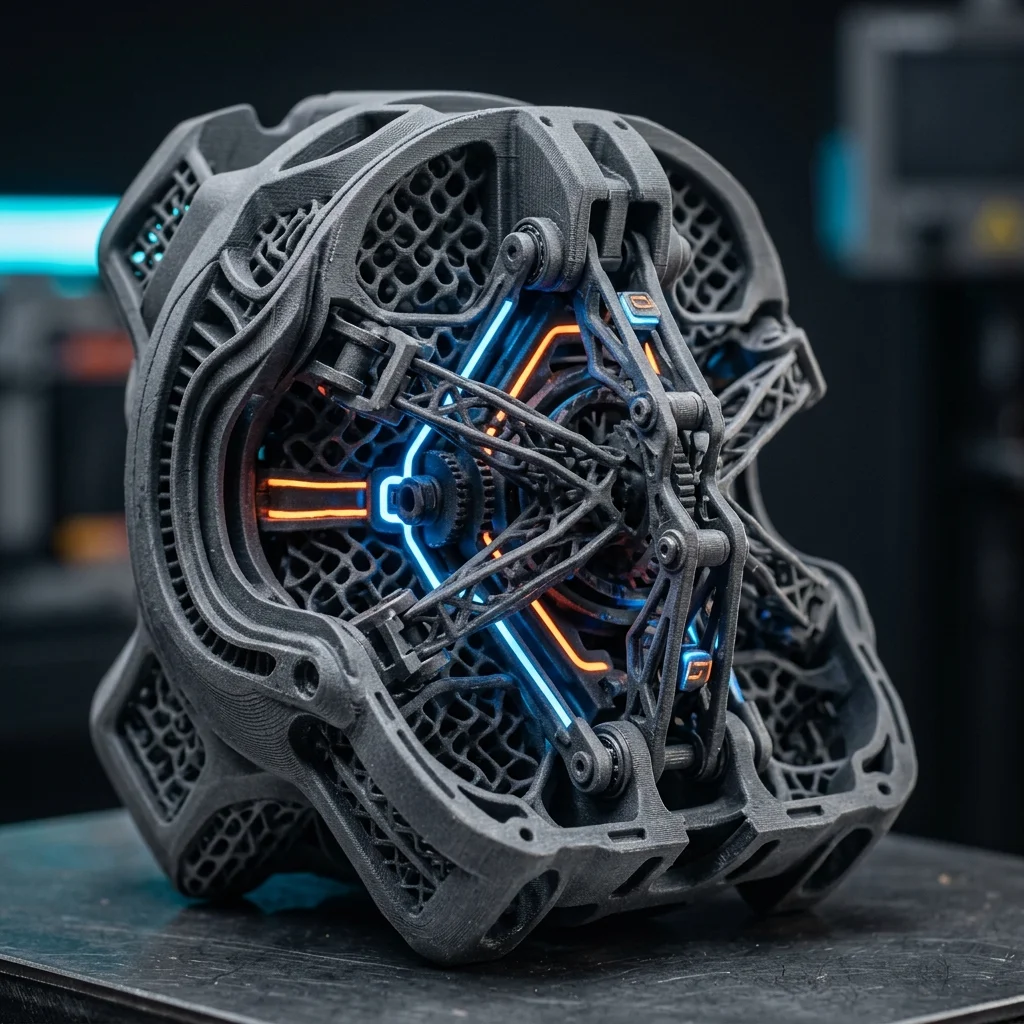
Prototyping is the application that birthed 3D printing in the 80s: Stratasys and 3D Systems originally sold SLA and FDM EXCLUSIVELY as “rapid prototyping” machines. Today 3D printing remains the fastest way to turn a CAD idea into a physical object, from 30 minutes for a quick FDM concept print to 8 hours for production-quality SLS prototype. This guide shows which tech and materials we recommend for different prototype types (visual, functional, fit & finish), how to optimize workflow for fast iteration, and how to judge when a prototype is good enough to show investors / clients.
Prototype types
Visual prototype (form): proves how the product looks. Single piece, usually in one color, no functionality. Requirements: smooth surface, accurate geometry, decent finish. Suitable tech: SLA/MSLA for small detail-heavy parts (under 150 mm), FDM for larger (print + paint), SLS for geometric complexity without supports.
Functional prototype (function): proves the product works. Has moving parts, snap-fits, threads, or electronic enclosures. Requirements: correct tolerances (±0.2 mm), material strength approximating final. Suitable: FDM with PETG/Nylon/ABS, SLS for tough end-use parts, CFF (Markforged) for high-stress.
Fit & finish prototype (assembly): proves all parts assemble correctly. Multi-part assembly, mounting holes, fastener compatibility. Requirements: dimensional accuracy ±0.1 mm, repeatable. Suitable: SLS (best repeatability), SLA (best surface), CNC milling (when 3D print can’t hit tolerances).
Design-validation prototype (engineering test): pre-production validation for thermal, mechanical, electrical behavior. Requirements: material specs like final product. Suitable: SLS for PA12 end-use parts, MJF for production-equivalent, metal print (SLM) for aerospace/medical.
Workflow for fast iteration
Classic 3D prototyping workflow:
- CAD design in Fusion 360, SolidWorks, or OnShape: 30 min to 4 hours by complexity.
- Export STL: instant.
- Slice in PrusaSlicer/Bambu Studio/Cura: 5-15 minutes.
- Print: 30 minutes to 12 hours by size.
- Inspect → revise CAD → repeat: 1-3 iterations typically.
Optimizations for speed:
- Layer height 0.20-0.30 mm for prototypes (vs 0.10 mm for final).
- 2 perimeters + 10-15% infill (vs 4 perimeters + 30%+ for final).
- Disable cooling fan on first prototype (faster print, not critical for visual test).
- Bambu X1-Carbon + AMS allows overnight multiple-prototype batches with auto-spool-switch.
- For concepts: scale down to 50%, same visual feedback, 1/8 the print time.
Day-to-day timeline for experienced designer:
- 8am: CAD revision
- 10am: Start print (1-3 hours)
- 1pm: Inspect, identify issues
- 2pm: CAD adjustment
- 4pm: Second print
- End of day: 2-3 iterations + working prototype
Recommended setups by budget
Under €500: solo designer: Bambu A1 mini (€280) or Bambu A1 (€420) + PLA Basic. 80% of prototypes (visual, low-detail functional) you can make with this setup. Don’t expect production-quality finish, but iteration time is lightning fast.
Upgraded solo / small studio (under €2000): Bambu X1-Carbon (€1449) + AMS + 5 filament rolls (PLA, PETG, TPU, PA-CF, ABS). You can do 90% of professional prototypes. AMS allows multi-material single print (rigid body + flexible gasket in one print).
Professional design office (under €5000): Bambu X1-Carbon (€1449) + Prusa SL1S SPEED MSLA (€1979) + Anycubic Mono M5s (€368). FDM for size + functional, SLA for high-detail visual. Backup printer ensures workflow continuity.
Design agency / R&D lab (under €20000): add Markforged Mark Two (€11,000) for CFF and Bambu H2D Combo (€2899) for heated chamber + large format. Here real production capability for client work begins.
For 99% of prototyping needs: Bambu X1-Carbon + Anycubic Mono M5s combo (€1817) is unbeatable cost/capability.
Materials by application
Visual concept (single piece, no handling): PLA. Price €25-€30/kg, easy to print, clean colors. Standard Polymaker PolyLite PLA.
Functional prototype (handling, no stress): PETG. Price €25-€35/kg, good layer adhesion, doesn’t warp. Polymaker PolyLite PETG.
Mechanical prototype (stress, load): Nylon (PA12 or PA-CF). Price €45-€90/kg, requires dried filament + enclosed chamber.
Flex prototypes (gaskets, dampers): TPU 95A. Price €30-€55/kg, requires direct drive extruder.
Clear/transparent prototypes (lighting concepts, fluid flow visualization): PETG transparent (FDM) or standard clear resin (MSLA).
High-detail visual (jewelry-quality finish): standard resin on 8K MSLA. Layer 0.025-0.050 mm.
Production-equivalent prototypes (final material match): SLS PA12 (outsource) or Markforged Onyx (in-house CFF).
When to plate, polish, paint: best when prototype goes to business meeting or client review. Vapor smoothing for ABS, sanding + primer + Tamiya rattle-can for PLA. Adds 30-60 min labor but visually transforms prototype from “3D printed” to “production sample”.
Cost + time benchmarks
Quick single-piece visual prototype (50mm × 50mm × 30mm):
- FDM PLA: 30 min print, €0.50 material, €1.50 total
- MSLA standard resin: 20 min print (batch of 1), €1 material, €2 total
- Outsource SLS: 24h turnaround, €15-€25 per part
Functional prototype (housing 100×80×40mm with mounting holes):
- FDM PETG: 4-6 hours, €3 material, €10-€15 total
- SLS PA12 (outsource): 3-5 days, €30-€50
Assembly prototype (10 parts, total volume 500cm³):
- FDM mixed (PLA + PETG + TPU): 2-3 days print time, €20-€40 material, €60-€100 total (including labor)
- SLS outsource: 5-7 days, €200-€400
- SLA mixed: 2-3 days, €30-€60 material, €100-€200 total
Threshold for in-house vs outsource: typically when you have 3+ prototype iterations per month, in-house FDM (Bambu X1) pays back in 6-12 months spread vs SLS outsource bills.
Frequently Asked Questions (FAQ)
Interactive Analyzer for 3D Printing For Prototypes And Concepts
Select a profile to view detailed analysis.
The full picture
This article is one page from The Big Book of 3D Printing: 704 illustrated pages covering every technology, material and fix in one reference.
Read it on Kindle →Engineer, author of The Big Book of 3D Printing and additive manufacturing expert