

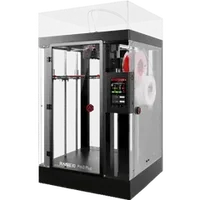
The Raise3D Pro3 is an enclosed professional-class FDM printer with a dual independent extruder (IDEX) system, a 300 × 300 × 300 mm build volume and a stable heated chamber, designed for production environments. It targets engineers and small manufacturers that need reliable output of functional parts from engineering polymers (CF-Nylon, PC, ABS) with a dedicated support extruder.
What it is
The Pro3 is Raise3D's professional offering: a machine built for regular production use, not hobbyists. The two independent extruders (IDEX: Independent Dual Extruder) allow printing with a primary material plus a soluble support (PVA, HIPS), or mirror and duplicate modes for doubled throughput. The enclosed chamber maintains a stable temperature around the part, which is critical for ABS, PC and CF-Nylon. The large 300 × 300 × 300 mm build space makes it suitable for full-sized jigs and small production runs. The machine is built on the premise that stability and repeatability deliver more value than peak speed.
Technical specifications
| Technology | FDM (IDEX: dual independent extruder, enclosed chamber) |
|---|---|
| Build volume | 300 × 300 × 300 mm |
| Extruders | 2 independent (IDEX): primary + support material |
| Maximum speed | up to 150 mm/s (production mode) |
| Calibration | automatic leveling + Z-offset compensation |
| Multi-material | IDEX: 2 materials simultaneously (soluble supports, dual-color) |
| Class / Price | Professional · ~€5 500 |
Who it’s for
- Automotive jigs and fixtures: manufacturing custom alignment tools and production aids from CF-Nylon or PC, with soluble supports from the second extruder (Automotive)
- Functional prototyping: iterative testing of mechanical assemblies requiring tight tolerances and durable engineering materials inside a stable enclosed environment (Consumer electronics and R&D)
- Small-batch production: producing end-use functional components or spare parts in series of up to 100 units, including using IDEX mirror/duplicate mode for doubled throughput (General manufacturing)
Calibration step by step
- Clean the build plate with isopropyl alcohol (IPA) and run the automatic bed leveling procedure. A digital topographic mesh is generated that actively compensates for slight bed unevenness during printing.
- Perform Z-offset fine-tuning by adjusting nozzle height in 0.05 mm increments during the first layer print. Perfect first-layer adhesion and squish without internal gaps or excessive squashing.
- Calibrate the extruder E-steps (M92) by extruding a defined length and adjusting the step multiplier based on measured variance. Accurate material delivery: no structural gaps from under-extrusion or blobs from over-extrusion.
- Calibrate the X-offset between the two IDEX extruders by printing a dual-nozzle alignment test print. Precise alignment of both extruders: no offset between primary material and support.
Common defects and fixes
Recommended settings by material
Pick a material to see the recommended temperatures (empirical ranges from 561 OrcaSlicer/Bambu profiles) plus machine-specific tips:
Conclusion
The Raise3D Pro3 is the choice for engineers and small manufacturers who value reliability and repeatability over speed. The dual IDEX extruder opens the door to soluble supports and complex geometries, the enclosed chamber makes engineering polymers a daily reality, and the generous 300 × 300 × 300 mm build volume handles real production tasks without compromise.
The full picture
This article is one page from The Big Book of 3D Printing: 704 illustrated pages covering every technology, material and fix in one reference.
Read it on Kindle →Engineer, author of The Big Book of 3D Printing and additive manufacturing expert