

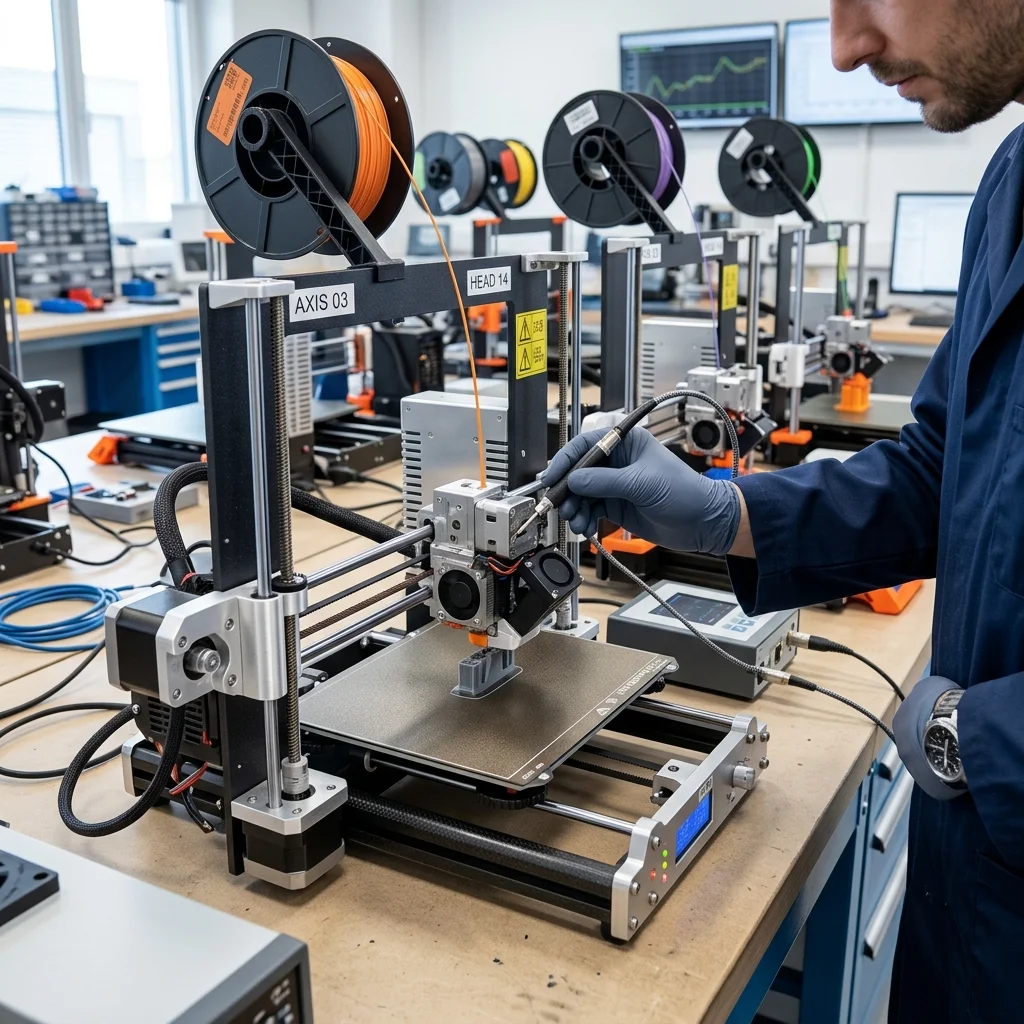
In the additive manufacturing ecosystem, scaling from a few machines to an entire 3D printer farm brings massive opportunities, but also a significant risk: unplanned downtime. Traditional maintenance methods, which rely on reactive repairs (fixing things after they break) or scheduled maintenance (based on fixed time intervals), are no longer sufficient. To get the most out of industrial 3D printing, we need a system that 'feels' problems before they actually occur.
This is where Predictive Maintenance (PdM) enters the stage. By integrating IoT (Internet of Things) sensors and machine learning algorithms, we turn every machine into an intelligent node that continuously analyzes its own health. At EduFacturing, we believe that the knowledge of how to collect and process this data is the real 'picks and shovels' for the modern manufacturing process.
What is Predictive Maintenance and Why is it Critical?
Predictive maintenance is a proactive strategy that uses real-time data to predict when a component is likely to fail. In a farm with dozens or hundreds of 3D printers (FDM, SLA, or SLS), the failure of an extruder or a stepper motor in the middle of a 50-hour print means wasted material, energy, and time. Through PdM, the system shifts the focus from 'repairing what is broken' to 'preventing the breakdown'. Instead of replacing bearings every 1,000 hours of operation (regardless of their condition), you replace them only when sensors detect an anomalous vibration signature.
IoT Sensors: The Nervous System of the 3D Farm
To make successful predictions, we first need raw data. The hardware layer of predictive maintenance involves a network of sensors that monitor critical parameters:
• **Vibration Analysis:** Accelerometers read micro-vibrations in stepper motors and linear guides. Deviations in these vibration signatures are early indicators of mechanical wear or loose belts.
• **Temperature Monitoring:** Thermal cameras and high-precision thermistors monitor not only the hotend and print bed but also the temperatures of stepper drivers and power supplies.
• **Acoustic Emission:** Microphones tuned to specific frequencies can 'hear' extruder skipping or the squeaking of inadequate lubrication long before a human operator notices.
• **Current Monitoring:** Measuring the power consumption of motors can indicate whether the mechanical resistance along the axes has increased.
Machine Learning and AI: The Brains of the Operation
Collecting terabytes of sensor data is useless without adequate analysis. This is where Machine Learning (ML) steps in. Using models like LSTM (Long Short-Term Memory) neural networks, the system learns what the 'normal' operation of the printer looks like.
When current data begins to deviate from baseline values, the artificial intelligence detects the anomaly and triggers an alert. More advanced systems create a 'Digital Twin': a virtual replica of the physical machine that simulates wear in real-time and predicts the Remaining Useful Life (RUL) of critical components.
Core Benefits of Implementation
Implementing predictive maintenance transforms the economics of a 3D farm. First, **unplanned downtime is drastically reduced**. Machines run reliably, and repairs are scheduled during natural production lulls. Second, **print quality is improved**. Because the system catches degradation early, it prevents part defects caused by failing components. Third, **equipment lifespan is extended** and spare part costs are reduced, as components are only replaced when functionally necessary.
Challenges and Looking to the Future
Despite the clear advantages, integrating PdM requires expertise. The biggest challenge is collecting enough high-quality, labeled data to train the algorithms correctly. Furthermore, building a reliable data pipeline and integrating it with existing CMMS (Computerized Maintenance Management Systems) or ERP tools requires initial investment and technical know-how.
The future, however, is clear: intelligent 3D print farms will be fully autonomous. Printers will not only signal their maintenance needs but, through integration into a unified ecosystem, will automatically order necessary spare parts or reroute print jobs to other available machines.
Conclusion
Predictive maintenance is the crucial leap from simply owning many printers to managing a true industrial node. At EduFacturing, we see this technology as the bridge to fully autonomous and efficient production, where data and hardware work in perfect symbiosis.
The full picture
This article is one page from The Big Book of 3D Printing: 704 illustrated pages covering every technology, material and fix in one reference.
Read it on Kindle →Engineer, author of The Big Book of 3D Printing and additive manufacturing expert