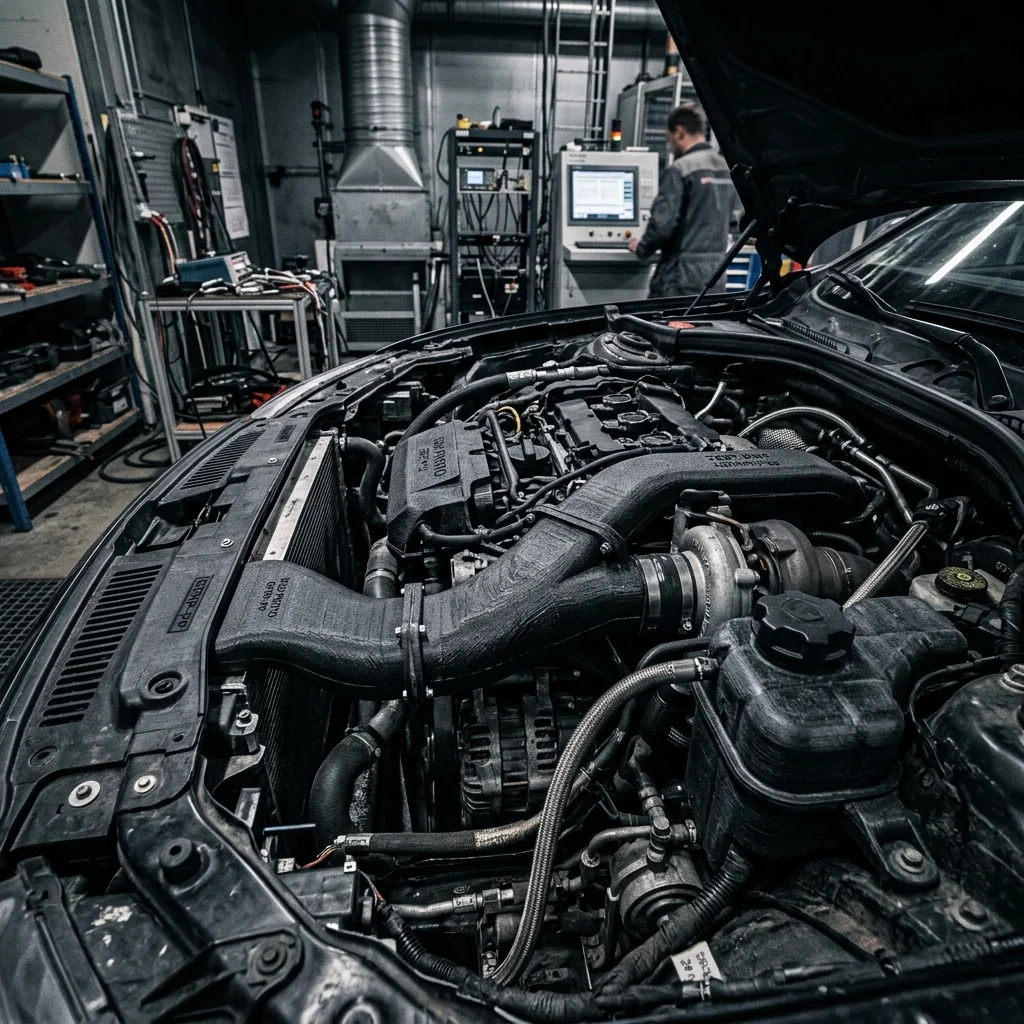
In 2025–2026, structural composite materials dominate automotive additive manufacturing. Glass-Fiber Reinforced Polypropylene (PP-GF30) stands out as a high-performance material that combines the chemical resilience of polypropylene with the mechanical stiffness of glass fibers.
Understanding the semi-crystalline crystallization of PP and the reinforcing mechanics of short fibers is key to successful fabrication.
Mechanical Reinforcement & Thermal Shrinkage Control
Polypropylene (PP) is a semi-crystalline thermoplastic. As the polymer cools from its melt phase, the chains align into dense, ordered crystalline regions (lamellae):
- Volumetric Shrinkage: This crystalline packing causes volume reductions of 1.5% to 2.0%, generating massive internal stresses that warp the corners of printed parts off the build plate.
- Reinforcement via 30% Glass Fibers (GF30): Incorporating short glass fibers (which have negligible thermal expansion) alters this behavior:
- Shrinkage Mitigation: The fibers act as rigid physical barriers, preventing polymer chain movement. Volumetric shrinkage is reduced to 0.3% – 0.5%, improving dimensional stability.
- Tensile Strength & Stiffness: Tensile strength rises from ~25 MPa for pure PP to 75 – 85 MPa, and the flexural modulus increases from ~1.3 GPa to over 6.0 GPa.
These properties, combined with a low density of ~1.1 g/cm³ and high resistance to organic solvents and automotive fluids, make PP-GF30 ideal for engine bay components like intake manifolds and filter housings.
Interactive Filament Selector
Answer 3 quick questions and find the optimal material for your project.
1. What are the mechanical requirements for the part?
2. What temperature will the part operate at?
3. Are there any specific environmental requirements?
Our recommendation:
PLA filament
Ideal for easy printing, model visualization and decorative parts.
The Adhesion Paradox: Why Polypropylene Does Not Stick
Polypropylene is a low surface energy polymer (chemically similar to paraffin wax or PTFE). Most standard 3D printing adhesives, hairsprays, and PEI sheets will not bond to it, causing immediate print failure.
Engineering Adhesion Solutions:
- Chemical Affinity (Like Dissolves Like): The most reliable method is printing on a pure polypropylene surface. Using PP tape (polypropylene packaging tape) applied to the build plate ensures excellent bonding.
- PP-Specific Adhesives: Specialized adhesives formulated with dissolved polypropylene (e.g., Magigoo PP) on glass plates provide adequate adhesion.
- Thermal Control: Keep the heated bed between 80°C and 100°C during the entire print to retard the rate of crystallization and allow the polymer chains to fuse.
Extrusion Mechanics & Hardware Protection
Glass fibers are highly abrasive. Extruding PP-GF30 requires hardware upgrades similar to carbon fiber:
- Hardened Nozzle Requirement: Standard brass nozzles will erode within a few hundred grams of extrusion. A hardened steel or ruby-tipped nozzle is mandatory.
- Nozzle Temperature: 240°C – 270°C is needed to reduce melt viscosity under fiber loading.
- Layer Height: Keep layer heights $ge$ 0.2 mm. Thicker layers allow the short fibers to align parallel to the extrusion path, maximizing planar tensile strength.
Pros and Cons of PP-GF30
Pros:
- Low Density: Lighter than glass-fiber reinforced nylon (PA-GF), crucial for automotive weight reduction.
- Chemical Resistance: Hydrophobic and highly resistant to acids, bases, salts, and automotive fluids.
- High Rigidity: Excellent flexural and tensile properties, replacing metal brackets.
- No Moisture Sensitivity: Does not degrade or warp due to humidity absorption.
Cons:
- Difficult Adhesion: Requires PP build plates or specialized PP adhesives.
- High Nozzle Wear: Mandates the use of hardened steel nozzles.
- Planar Anisotropy: Glass fibers do not cross layers easily, leaving the Z-axis weaker than X/Y-axes.
- Enclosure Recommended: Requires a draft-free enclosure to prevent warping in large parts.
Frequently Asked Questions (FAQ)
Glass-Fiber Reinforced Polypropylene (Pp-Gf) For Tough Automotive Components Calculator
Interactive optimization calculator.
The full picture
This article is one page from The Big Book of 3D Printing: 704 illustrated pages covering every technology, material and fix in one reference.
Read it on Kindle →Engineer, author of The Big Book of 3D Printing and additive manufacturing expert
Updated on 27 June 2026
This article was written with AI assistance; the facts were checked against the sources on 27 June 2026.