

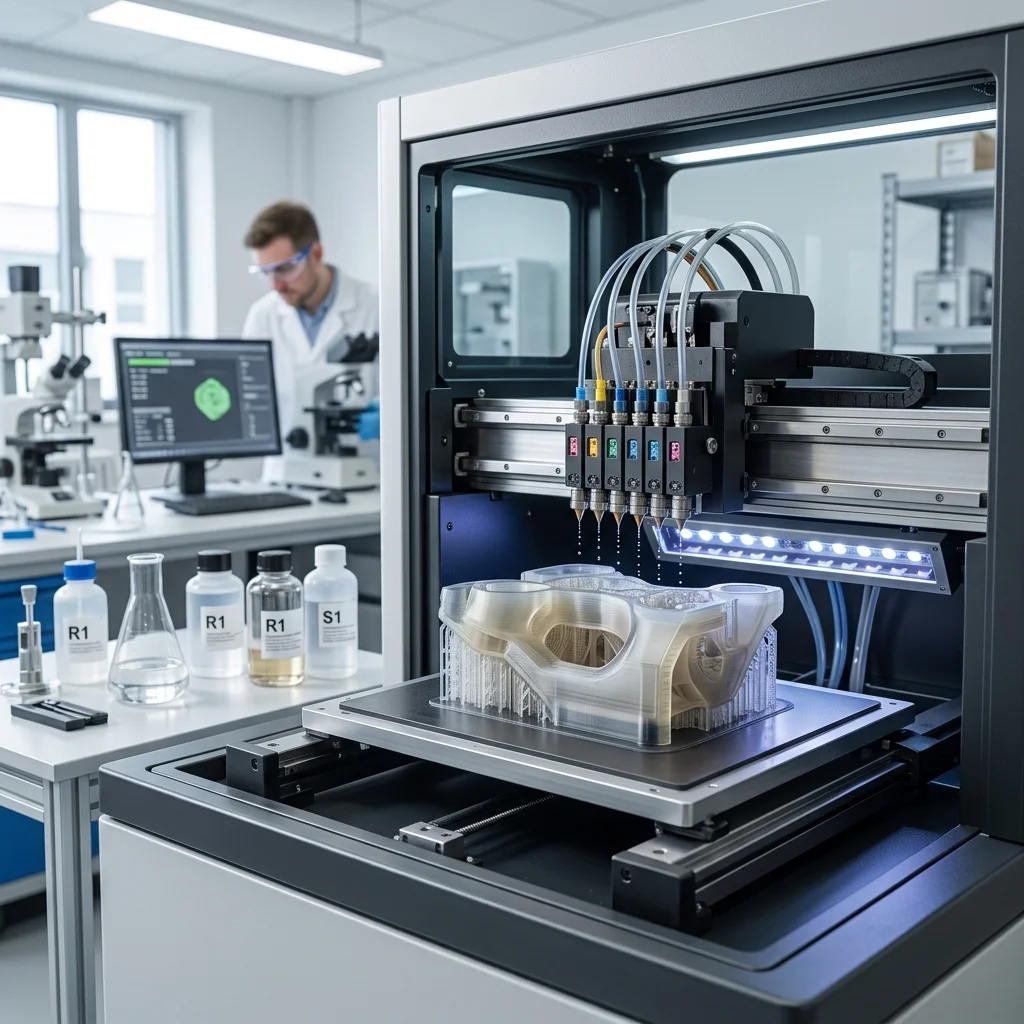
Polymer Jetting (often recognized commercially as PolyJet) has redefined the boundaries of 3D printing. Rather than extruding molten plastics or sintering powders, this technology operates much like a high-end 2D inkjet printer, but with a profound dimensional twist. At EduFacturing, our "picks and shovels" philosophy teaches us that true innovation stems from understanding the precise mechanisms behind the hardware. PolyJet achieves its photorealistic precision by depositing microscopic droplets of liquid photopolymer and curing them instantly with UV light. This opens up unprecedented possibilities in high-fidelity prototyping, medical modeling, and intricate design verification.
The Micro-Mechanics of Material Jetting
The core mechanism of Polymer Jetting is an intricate dance of precision engineering. A specialized print head assembly, equipped with hundreds of microscopic nozzles, traverses the X and Y axes over a build platform. These nozzles jet ultra-thin layers of liquid photopolymer: often as fine as 16 to 30 microns. Mounted immediately adjacent to the print heads are intense UV lamps. The exact moment a droplet is deposited, it is bathed in UV radiation, triggering a rapid photopolymerization process that transforms the liquid into a solid instantly. Once a full layer is cured, the build platform lowers by a single layer increment along the Z-axis, and the rapid sequence repeats. This eliminates the need for thermal management associated with fusion-based technologies and results in high dimensional accuracy, typically ranging from ±0.1 mm to ±0.3 mm.
Digital Materials: The Alchemy of Multi-Material Printing
What truly distinguishes PolyJet is its ability to blend different base resins on the fly. By jetting multiple materials simultaneously in specific volumetric ratios, the system creates what are known as "Digital Materials." This allows engineers to produce a single part with gradient properties: ranging from rigid to flexible, opaque to optically clear, all integrated without post-assembly. Imagine printing a rigid tool handle with an over-molded, soft-touch ergonomic grip in one operation. This multi-material alchemy enables designers to simulate complex assemblies, human tissue, or consumer products with full CMYK color mapping and photorealistic surface finishes directly from the build chamber.
Support Structures and Post-Processing Dynamics
To enable complex geometries, overhangs, and internal cavities, PolyJet employs a separate, gel-like support material that is jetted alongside the primary model material. Unlike FDM breakaway supports, the PolyJet support matrix is specifically formulated for easy removal. It encapsulates the part during the build to ensure the ultra-thin layers do not sag. Once printing concludes, this support structure is removed effortlessly using either a pressurized water jet or by dissolving it in an alkaline chemical bath. Because the droplet size is microscopic and the layers are exceptionally thin, the resulting parts emerge with incredibly smooth surface finishes, requiring virtually no sanding or polishing.
Navigating the Limitations and Applications
While PolyJet is a masterclass in visual fidelity and multi-material complexity, it does have intrinsic limitations that define its operational niche. The technology exclusively utilizes photopolymers, which generally possess lower mechanical strength, lower impact resistance, and lower heat deflection temperatures (HDT) compared to engineering-grade thermoplastics used in SLS or FDM. Parts can be susceptible to creep and may degrade under prolonged UV exposure. Consequently, Polymer Jetting is less suited for heavy-duty end-use parts or harsh environments. Its true power shines in rapid prototyping, detailed anatomical models for surgical planning, transparent fluidic devices, and exquisite design verification where tactile and aesthetic properties are essential.
Conclusion
Polymer Jetting reflects the convergence of fluid dynamics, photochemistry, and high-precision robotics. By mastering the fundamentals of PolyJet, engineers can transcend traditional design constraints, creating prototypes that are indistinguishable from final consumer products. At EduFacturing, we believe that understanding these intricate layers of technology is the key to unlocking the future of digital manufacturing. Equip yourself with the knowledge to wield this technology, and the physical manifestations of your ideas will follow.
The full picture
This article is one page from The Big Book of 3D Printing: 704 illustrated pages covering every technology, material and fix in one reference.
Read it on Kindle →Engineer, author of The Big Book of 3D Printing and additive manufacturing expert