

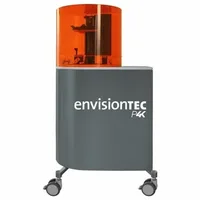
The EnvisionTEC Perfactory P4K is an industrial DLP printer with a 4K optical projector designed for maximum detail in dental, jewelry and medical segments. With a 192×120×230 mm build volume and native XY resolution below 50 µm, the P4K delivers quality that makes direct investment-casting master models without compromise.
What it is
The Perfactory P4K uses a 4K DLP projector (Digital Light Processing): a single light engine cures the entire layer at once, unlike an SLA laser that traces contours point by point. The ultra-high 4K resolution means pixels are significantly smaller than those on standard DLP machines, capturing fine strokes of jewelry engravings or the sub-millimeter channels of dental restorations. The printer uses the patented ERM (Enhanced Resolution Module) motion system, which shifts the optics sub-pixel to further smooth surfaces without loss of precision. The machine targets laboratories and productions where accuracy matters more than volume.
Technical specifications
| Technology | DLP (4K projector, ERM sub-pixel motion) |
|---|---|
| Build volume | 192 × 120 × 230 mm |
| XY resolution | up to ~50 µm native; <30 µm with ERM |
| Layer thickness | 25–100 µm (resin-dependent) |
| Material system | closed: certified EnvisionTEC resins |
| Class / Price | Industrial · ≥ €20 000 |
Applications and industries
- Jewelry master models for lost-wax casting (Printing in burnout-castable resins with fine engravings, filigree grids and islands at sub-0.1 mm detail) a direct replacement for hand-carved wax masters (Jewelry manufacturing and moldmaking studios)
- Dental restorations and surgical guides: Crowns, bridges, temporaries and implant surgical guides in biocompatible and dental-class resins approved to Class IIa (Dental laboratory and oral surgery)
- Hearing aids, microfluidics and medical prototypes: Miniature ITE/ITC hearing-aid shells with individual anatomy, transparent microfluidic chips with channels < 200 µm, functional medical prototypes (Medical electronics and biotechnology)
Production workflow
- Calibrate the 4K projector for light uniformity: check the light engine intensity across the platform periphery and center using the built-in calibration software. Uniform cure across the entire field, no under-cured edges or center shrinkage.
- Level the build platform with a precision dial indicator and set Z-zero using a peel test layer. Perfect first-layer adhesion without delamination or resin bleed.
- Run a test print of thin walls (0.2 mm and 0.5 mm) and verify dimensions with a micrometer. Accurate dimensions within ±20 µm: confirming correct exposure time for the resin.
- Wash the print in the appropriate solvent (IPA or specialized) and post-cure under a UV lamp for the resin-specified time and temperature. Resin final mechanical properties achieved: no tackiness, correct hardness and color stability.
Key considerations
Materials and applications
Pick a material/alloy this machine processes to see its properties and typical applications:
Conclusion
The Perfactory P4K is a specialized instrument for productions where detail matters more than volume: jewelry studios, dental laboratories and medical developers gain sub-50 µm accuracy within a closed, certified material ecosystem. The investment is significant, but in the right production context the P4K replaces expensive manual craftsmanship and standardizes quality.
The full picture
This article is one page from The Big Book of 3D Printing: 704 illustrated pages covering every technology, material and fix in one reference.
Read it on Kindle →Engineer, author of The Big Book of 3D Printing and additive manufacturing expert