

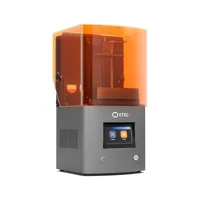
The BigRep ONE is an industrial FDM printer with a build volume of one cubic meter: a machine that prints furniture, full-scale prototypes and casting patterns in a single piece, with no assembly required.
What it is
The ONE is BigRep's flagship: a German company specializing in large-format additive manufacturing. The open-frame architecture supports oversized nozzles (0.6–6 mm) and deposition rates up to 1 kg/h, turning the machine into a tool for industrial design, architectural mock-ups and end-use parts at true object scale. It targets design studios, R&D centers and manufacturers that cannot afford to cut and glue dozens of smaller prints.
Technical specifications
| Technology | FDM (open frame, Cartesian gantry) |
|---|---|
| Build volume | 1005 × 1005 × 1005 mm (~1 m³) |
| Nozzle | interchangeable 0.6 – 6 mm (high-flow) |
| Deposition rate | up to ~1 kg/h (large nozzle) |
| Frame | open frame (no enclosed chamber) |
| Class / Price | Industrial · ~€45,000 |
Applications and industries
- Full-scale prototyping: printing complete furniture pieces, seating or consoles at true scale without assembling modular sections (Industrial design and furniture)
- Casting patterns and composite molds: large-scale sacrificial patterns for sand casting and lay-up molds for composite manufacturing (Foundry and manufacturing)
- Architectural design and art installations: large-scale architectural mock-ups and art objects printed as a single body for exhibitions and competitions (Architecture and fine art)
Production workflow
- Clean the massive build plate with isopropyl alcohol (IPA) and verify an even adhesive coating. A grease-free surface without patches: ensures maximum first-layer adhesion.
- Run the multi-point automatic bed leveling to map the topology of the 1 m² surface. The controller generates a mesh to actively compensate for any micro-unevenness across the entire bed.
- Fine-tune the Z-offset dynamically while printing a large test skirt or first-layer calibration pattern. A perfectly squished first layer with no gaps between lines and no "elephant's foot" deformation.
- Calibrate E-steps: request 100 mm extrusion and measure the actual filament consumed. Accurate linear filament feed that eliminates over- or under-extrusion during long print runs.
Key considerations
Materials and applications
Pick a material/alloy this machine processes to see its properties and typical applications:
Conclusion
The BigRep ONE is practically the only way to print an entire object at true furniture scale without assembly. Its price and print time place it squarely in an industrial context, but for design studios and R&D centers where scale is critical, the machine removes a barrier that previously required CNC milling or manual fabrication.
The full picture
This article is one page from The Big Book of 3D Printing: 704 illustrated pages covering every technology, material and fix in one reference.
Read it on Kindle →Engineer, author of The Big Book of 3D Printing and additive manufacturing expert