

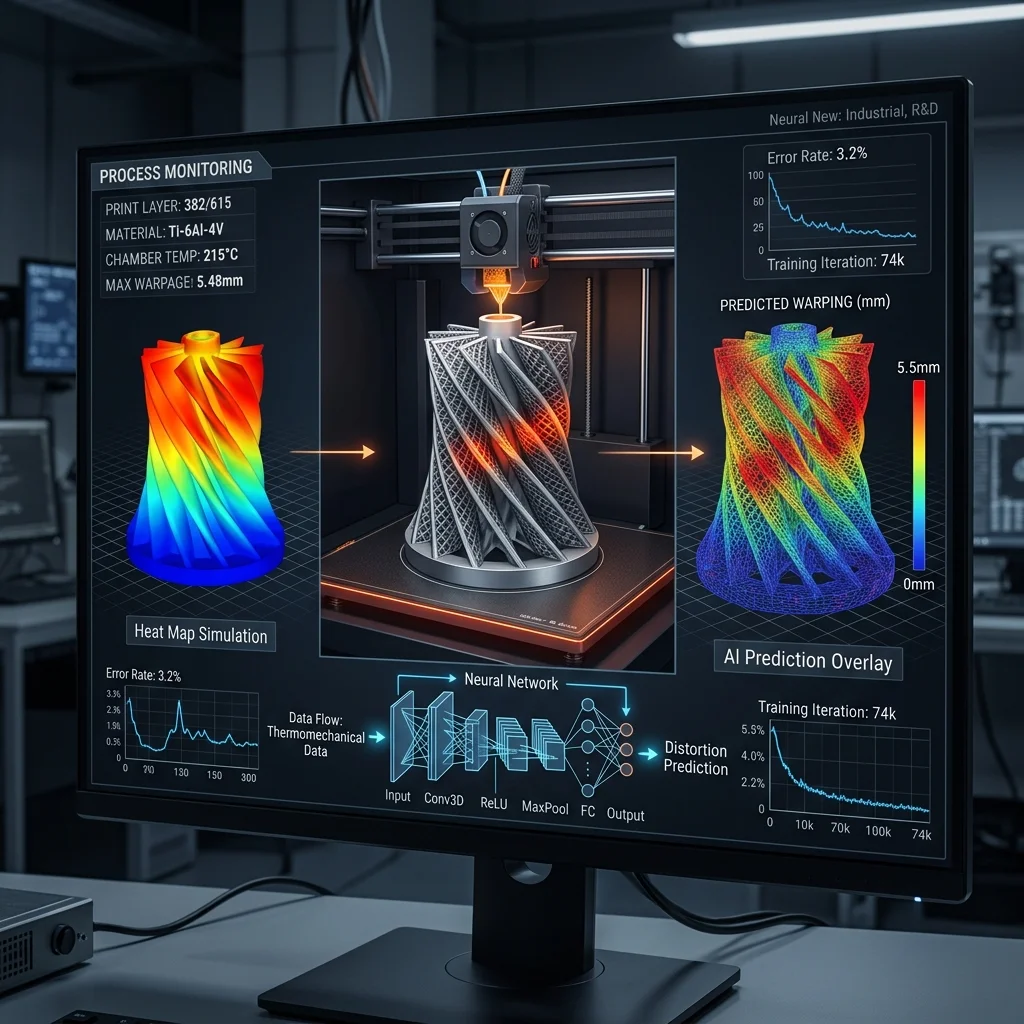
In 2025–2026, neural networks for thermal warp prediction enable preventive identification of warping risk in 3D printed parts before printing begins. Warp (caused by thermal gradients between hot upper and cooled lower layers) is one of the most common FDM and SLS defects.
Physics of Warp
Warp arises from thermal gradient ($Delta T$) between layers. The coefficient of thermal expansion ($alpha$) and part geometry determine severity.
Interactive Filament Selector
Answer 3 quick questions and find the optimal material for your project.
1. What are the mechanical requirements for the part?
2. What temperature will the part operate at?
3. Are there any specific environmental requirements?
Our recommendation:
PLA filament
Ideal for easy printing, model visualization and decorative parts.
Neural Network Approaches
- CNN for Geometric Prediction: Voxel input → displacement field output. Trained on 10,000+ FEA simulations.
- RNN/LSTM for Layer-by-Layer: G-code sequence → predicted deformation per layer. Can suggest cooling pauses.
- Physics-Informed Neural Network (PINN): Combines ML with thermomechanical equations. Fewer training data needed.
Pros and Cons
Pros:
- Preventive: Predicts warp before printing.
- Fast: Seconds vs hours for FEA.
- Actionable: Suggests orientation, infill, or bed temp to minimize warp.
Cons:
- Data-Hungry: Requires thousands of FEA simulations for training.
- Material-Specific: Separate model per material.
FAQ
Neural Network Thermal Warp Prediction For 3D Printing Calculator
Interactive optimization calculator.
The full picture
This article is one page from The Big Book of 3D Printing: 704 illustrated pages covering every technology, material and fix in one reference.
Read it on Kindle →Engineer, author of The Big Book of 3D Printing and additive manufacturing expert