

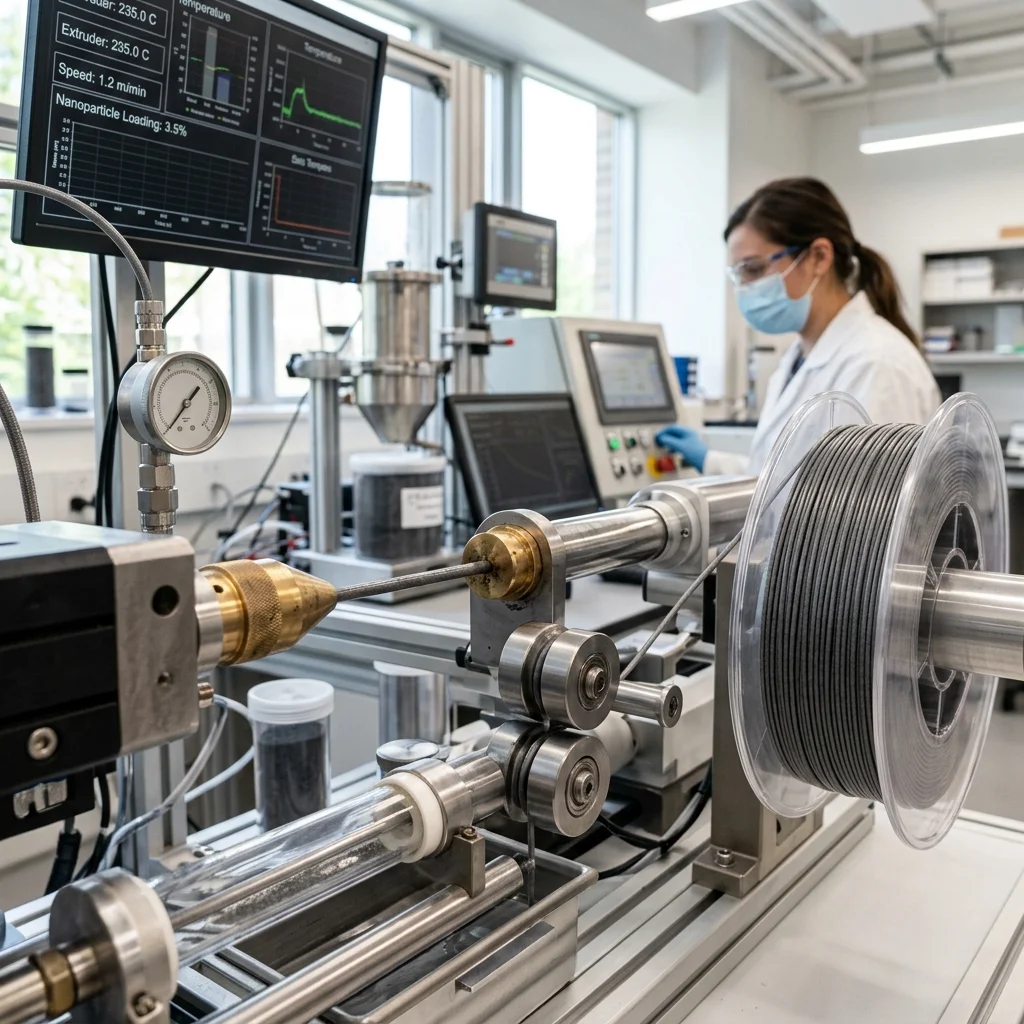
Additive manufacturing has long evolved past the era of mere rapid prototyping. Today, the industry's focus is firmly set on producing end-use, highly functional parts, and the key to this transformation lies within the materials themselves. At EduFacturing, we believe that the true potential of 3D printing is unlocked when precision hardware meets innovative material science.
The development of nanocomposite filaments represents a revolutionary leap forward. By embedding nanomaterials into standard polymer matrices, engineers are formulating 'smart' materials with unprecedented mechanical, thermal, and electrical properties. This is a fundamental paradigm shift: moving from printing passive geometries to engineering active, multifunctional systems.
The Anatomy of Nanocomposites: Matrices and Fillers
The foundation of any nanocomposite filament is its polymer matrix: typically familiar thermoplastics like PLA, ABS, PETG, or industrial-grade polyamides (PA). The true engineering marvel, however, occurs with the addition of nanofillers. Carbon-based nanoparticles, such as Carbon Nanotubes (CNTs) and graphene, are heavily utilized to dramatically boost electrical conductivity and tensile strength. For applications demanding high thermal stability or biocompatibility, ceramic nanoparticles like hydroxyapatite and nanoclays are integrated. Additionally, metallic nanoparticles (silver, copper) are incorporated to impart antibacterial properties or specialized sensing capabilities. This synergy between polymer and nanoparticle creates a composite whose performance vastly exceeds the sum of its parts.
The Dispersion Dilemma and Extrusion Dynamics
Manufacturing high-quality nanocomposite filaments is a complex rheological challenge. The most critical, and often most difficult, step is achieving a homogenous dispersion of nanoparticles within the polymer melt. Due to their immense specific surface area, nanoparticles are highly prone to agglomeration. These clumps not only degrade the filament's mechanical integrity but can also cause severe nozzle clogging during the FDM/FFF printing process. To mitigate this, advanced compounding techniques are employed, such as high-shear twin-screw extrusion or solvent-cast mixing. Furthermore, nanofillers inherently increase the melt viscosity, necessitating precise thermodynamic calibration during the final extrusion of the 1.75 mm or 2.85 mm filament to ensure dimensional accuracy.
Beyond Geometry: Smart Parts and Multifunctionality
The application of nanocomposite filaments is rewriting the rules across multiple high-tech industries. In electronics, conductive filaments enable the direct 3D printing of embedded circuitry, sensors, and electromagnetic interference (EMI) shielding enclosures, effectively eliminating the need for complex post-assembly wiring. In the aerospace and automotive sectors, these materials are critical for fabricating ultra-lightweight components that can withstand extreme mechanical stress. In biomedicine, nanocomposites based on biodegradable polymers are being used to print customized tissue engineering scaffolds and bone grafts that actively promote cellular growth and integration.
Future Horizons and Overcoming Anisotropy
Despite rapid advancements, the widespread industrial adoption of nanocomposite filaments in FDM/FFF printing faces ongoing hurdles. A primary concern is the inherent anisotropy of 3D printed parts: specifically, the weakness in Z-axis interlayer adhesion. The inclusion of rigid nanoparticles can sometimes exacerbate this issue if printing parameters are not meticulously optimized. Current research is heavily focused on developing chemical compatibilizers to strengthen the polymer-nanoparticle interface and standardizing manufacturing protocols. As these materials become more refined and accessible, we are moving toward a future of reliable, 'plug-and-play' functional composites available to engineers worldwide.
Conclusion
Nanocomposite filaments are not just a novel niche; they are the foundational building blocks for the next generation of intelligent manufacturing. By mastering these advanced materials, we provide engineers with the 'picks and shovels' necessary to unearth innovations that push the boundaries of what is possible in additive manufacturing.
The full picture
This article is one page from The Big Book of 3D Printing: 704 illustrated pages covering every technology, material and fix in one reference.
Read it on Kindle →Engineer, author of The Big Book of 3D Printing and additive manufacturing expert