

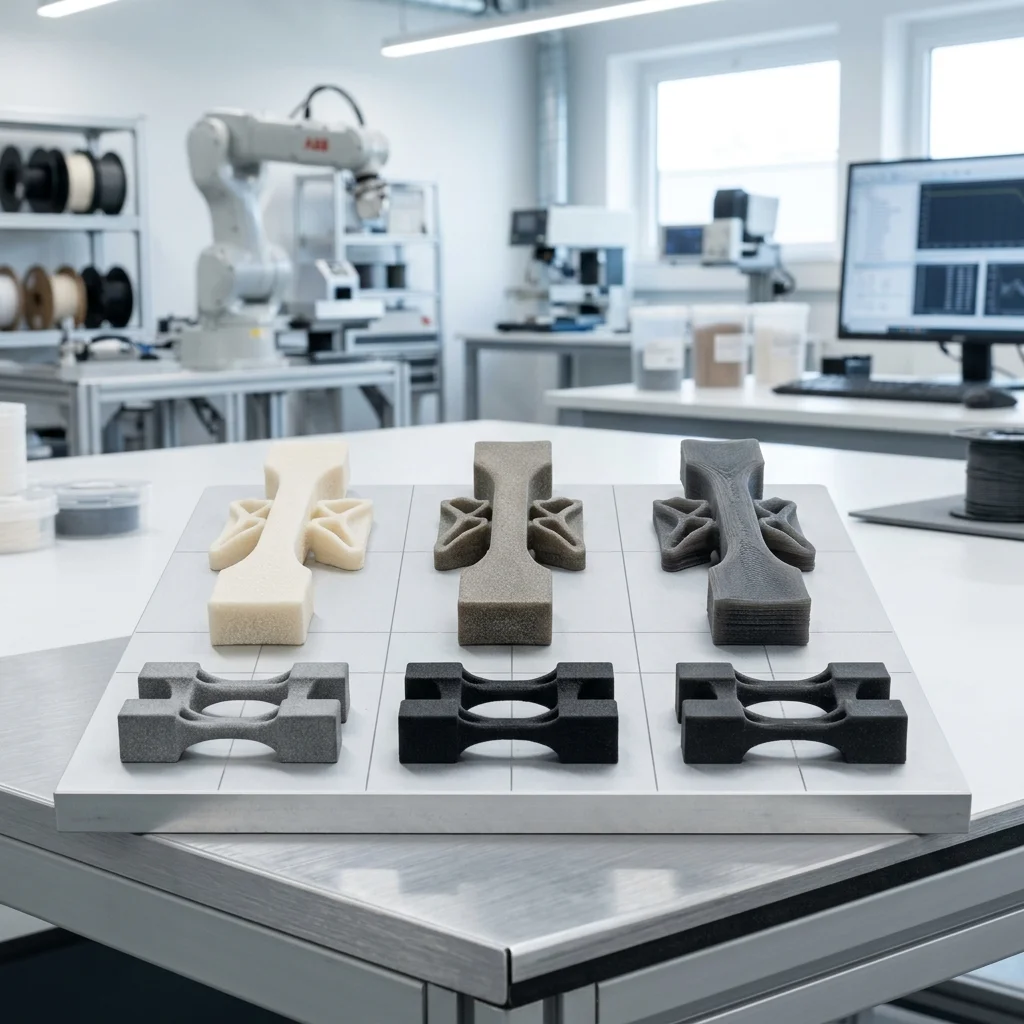
Multi Jet Fusion (MJF) by HP has revolutionized industrial 3D printing by shifting the paradigm from rapid prototyping to true additive manufacturing at scale. However, the true potential of MJF is unlocked not just by the thermal fusion process itself, but by the highly engineered polymer powders it utilizes. Selecting the correct material is the critical intersection where mechanical engineering meets chemical resilience. In this deep dive, we compare the leading MJF materials (from the reliable PA12 to the highly flexible TPU) to help you engineer parts that perform flawlessly in the real world.
The Industry Standard: PA12 and PA12 Glass Beads
Polyamide 12 (PA12) is the undisputed workhorse of the MJF ecosystem. Offering a stellar balance of tensile strength, stiffness, and dimensional accuracy, PA12 is the go-to thermoplastic for functional prototypes and end-use parts. Its high density and low porosity make it ideal for complex geometries, watertight enclosures, and custom tooling. When pure PA12 isn't stiff enough, PA12 Glass Beads (PA12 GB) steps in. By reinforcing the polymer matrix with microscopic glass spheres, PA12 GB dramatically increases the flexural modulus and thermal stability. This makes it exceptional for rigid housings, structural components, and applications where resistance to deformation under load is non-negotiable. While PA12 GB sacrifices some impact resistance for rigidity, it provides a crucial bridge between standard polymers and metal-like stiffness.
Toughness and Chemical Resistance: PA11 and PP
For applications demanding superior impact resistance and ductility, Polyamide 11 (PA11) is the superior choice. Derived from renewable castor oil, PA11 is not only a bio-based alternative but structurally tougher than PA12. Its high elongation at break makes it perfect for snap-fits, living hinges, and sports equipment that must endure repeated stress without fracturing. On the other end of the chemical spectrum is Polypropylene (PP). A staple in traditional injection molding, MJF PP brings incredible chemical resistance and near-zero moisture absorption to additive manufacturing. It boasts high fatigue resistance, making it the premier choice for fluid handling systems, chemical containers, and automotive interior components. Furthermore, MJF PP parts can be welded with traditional PP components, allowing hybrid manufacturing strategies.
The Elastomeric Breakthrough: TPU in MJF
Thermoplastic Polyurethane (TPU) introduces true elastomeric capabilities to the MJF platform. Historically, printing highly flexible, durable parts was a bottleneck in powder-bed fusion. MJF TPU solves this by delivering rubber-like elasticity combined with phenomenal abrasion resistance and tear strength. It allows engineers to design energy-absorbing structures, custom gaskets, orthotics, and vibration dampers with complex internal lattices that would be impossible to mold. The ability to tune the shore hardness and dynamic response of a part simply by altering its lattice topology is a major advantage. TPU transforms MJF from a rigid-part production system into a versatile engine capable of producing soft-touch components and dynamic mechanical seals.
Engineering for the Right Application: How to Choose
Selecting the optimal MJF material requires a holistic evaluation of the mechanical, thermal, and environmental loads your part will face. If you need a versatile, cost-effective all-rounder for static loads, PA12 is your starting point. If the part must endure sudden impacts or repeated flexing, pivot to PA11. For high-rigidity structural elements, PA12 GB is unmatched in the polymer lineup. When dealing with harsh chemicals or fluid dynamics, PP is the logical choice. Finally, if the application requires energy absorption, elasticity, or soft-skin interaction, TPU is the only candidate. By aligning the material's molecular strengths with your mechanical requirements, you ensure that your MJF parts don't just mimic traditional manufacturing: they surpass it.
Conclusion
The Multi Jet Fusion material ecosystem has matured into a comprehensive suite of engineering-grade polymers. Whether you are producing aerospace brackets, medical orthotics, or automotive seals, understanding the nuances between PA11, PA12, PP, and TPU is the key to unlocking the true power of additive manufacturing.
The full picture
This article is one page from The Big Book of 3D Printing: 704 illustrated pages covering every technology, material and fix in one reference.
Read it on Kindle →Engineer, author of The Big Book of 3D Printing and additive manufacturing expert