

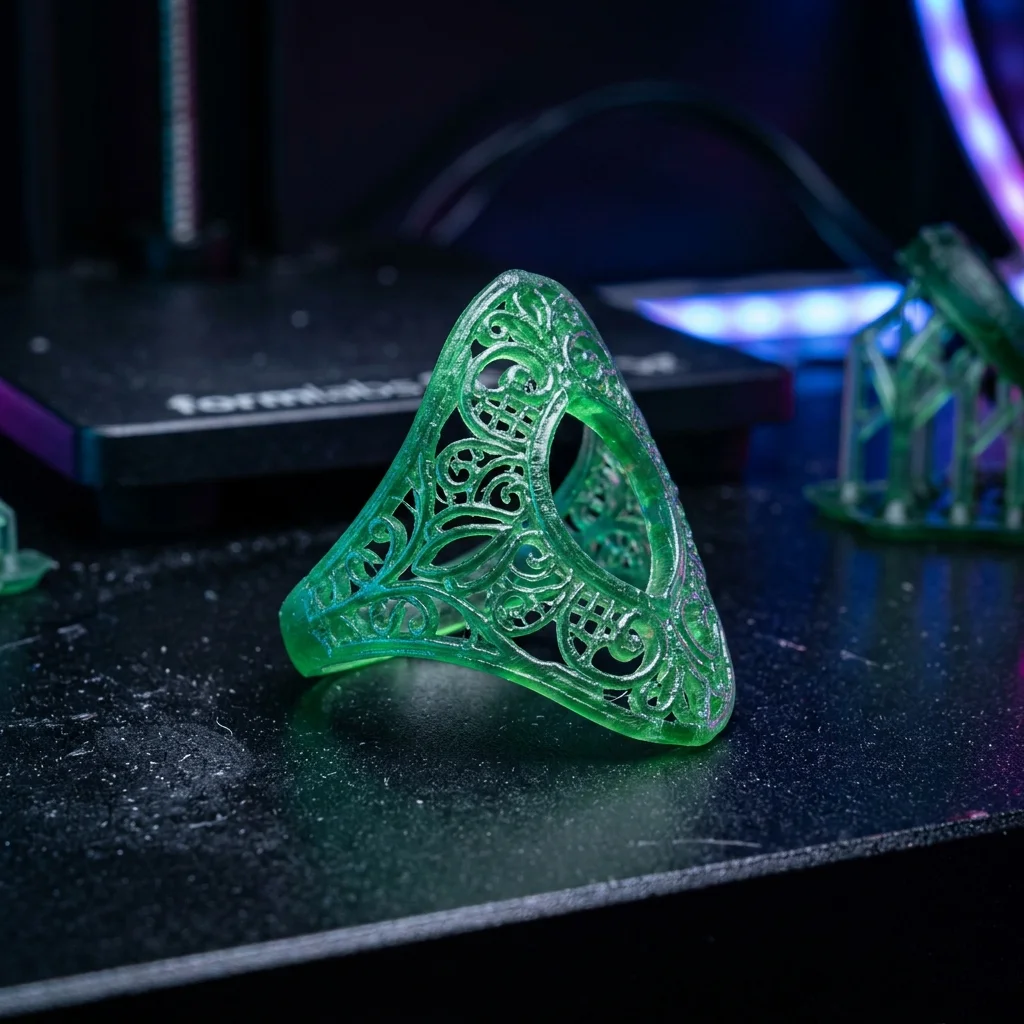
Castable resin (or “jewelry resin” or “investment casting resin”) is a specialized MSLA family designed for lost-wax casting workflow in jewelry and dental crowns. Unlike standard resin, castable burns cleanly in burnout oven: no residual carbon particles in investment mold, no compromise to metal casting quality. With 8K MSLA printer + right castable resin, a small jeweler can print intricate ring designs that would take 8-12 hours hand-carving in wax, in 20-30 minutes. This guide shows which printers, which resins, and the full workflow from CAD to finished gold ring.
Lost-wax casting workflow
The classic jewelry production chain:
- Design in CAD (Rhino + RhinoGold, Matrix, Fusion 360, ZBrush for organic forms).
- Export STL.
- Slice + add supports in Lychee Slicer or CHITUBOX.
- Print on MSLA in castable resin.
- Wash, cure (briefly: over-cure makes de-investment hard).
- Sprue + tree assembly (attaching multiple patterns to a wax tree).
- Investment: pour gypsum-based investment around the tree in flask.
- Burnout: heat flask to 730°C in kiln. Castable resin burns cleanly, leaving negative mold.
- Cast: pour molten gold/silver/platinum in hot mold (centrifugal or vacuum casting).
- Devest: break investment, recover metal casting.
- Polish, set stones, finish.
3D printing replaces steps 1-4 which previously took thousands of days (hand-carving wax) or expensive CNC milling. Custom designs ready for casting in under 1 hour.
Real cost example: small gold ring design, CAD design 2 hours, MSLA print 30 minutes, sprue pattern + burnout 4-5 hours, casting + polish 1 hour. Total: 8-9 hours for custom piece. Manual hand-carved equivalent: 16-24 hours.
Recommended MSLA printers for jewelry
Phrozen Sonic Mini 8K S (€430) (sweet spot for entry-level jewelry. 8K display gives 22 µm XY resolution) fine enough for prong setting details, filigree, fine engraving textures.
Anycubic Photon Mono M5s (€368): equivalent capability, marginally larger build. Both good for jewelry.
Prusa SL1S SPEED (€1979): premium pick with EU support contract, integrated cure-wash station option, designed-optimized for jewelry usability. Recommended for professional dental + jewelry labs.
Formlabs Form 4 (€4500+): SLA technology (laser, not LCD). Different artifacts pattern, but higher resin compatibility (specialized jewelry resins like Castable Wax 40 only fully supported on Formlabs).
Asiga Pico HD (€10,000+): industrial jewelry standard. 27 µm XY resolution, validated workflow for volume jewelry studios.
For small jeweler starting up: Sonic Mini 8K S (€430) + Wash & Cure Plus (€110) + 1L Castable resin (€90) = €630 complete setup. Pays back in 5-10 custom orders.
Recommended castable resin brands
Siraya Tech Cast (€60-€80/liter): popular hobby choice. Prints on most MSLA printers. Burnout at 730°C for 3-4 hours. Good for silver, bronze. For gold we recommend higher-end formulations.
Phrozen Wax-Like Castable (€70-€85/liter): Phrozen’s premium jewelry resin. Burns cleanly without residue. Recommended for professional silver and gold.
NextDent Cast (€120-€150/liter): dental-grade castable for crowns. Higher precision but specialized for dental, not jewelry. Compatible with Form 4 + selected MSLA.
Formlabs Castable Wax 40 (€250/liter): premium production-grade. 40% wax content for absolutely clean burnout. Formlabs Form 4 only.
Formlabs Castable Wax (€199/liter): Form 4 only. Industry standard for high-value jewelry production.
Siraya Tech Sculpt Ultra (€65/liter): combination tough + castable. For jewelry pieces with snap-fit prototypes during design phase.
Avoid: unbranded “Castable” resin under €40/liter, typically standard resin with changed color. Real castable requires specialized chemistry.
Optimal castable settings
Layer height: 0.025-0.030 mm (25-30 µm) for rings, fine pendants. 0.05 mm for larger pieces, statement jewelry.
Exposure time: castable resins typically need 30-50% longer than standard. Calibrate per resin per printer with RERF print.
Bottom exposure: 40-50 sec, 8-10 bottom layers. Castable resins don’t adhere well to FEP: need bottom layers for stability.
Lift speed: 40-50 mm/min (slow). Castable resin is more viscous: fast lift causes vacuum in vat.
Orientation: critical for jewelry. Ring shanks orient vertically (Z direction). Stone settings orient so setting orient nominally up. Lychee Slicer auto-orient has jewelry preset.
Supports: 0.2-0.3 mm tip diameter (smaller than gaming minis). Avoid supports on visible (after casting) surfaces. Master Support Position for minimum cleanup.
Hollowing: jewelry pieces typically NOT hollowed (need full density for casting properties). Exception: large hollow pendants for weight reduction.
Anti-aliasing: high (8 if supported). Surface finish critical for jewelry.
Post-processing + burnout
Wash: 2-3 minutes in IPA 99%, then 1 minute in fresh IPA. Castable doesn’t retain residue like tough.
Dry: 10 minutes air OR compressed air. Don’t cure wet!
Cure: CRITICAL, short cure ONLY for castable. 2-3 minutes per side at 405 nm. Over-cure makes castable harder to burnout cleanly: residual carbon in mold = bad casting.
Support removal: while leather-hard (after wash, before final cure). Sharp clippers + light filing.
Quality check: inspect under loupe. Any visible layer line on final piece (after casting + polish) will show on gold. Re-print if quality not acceptable.
Burnout schedule (typical for Siraya Cast on bronze + silver):
- 0°C → 150°C @ 3°C/min (50 minutes)
- Hold 150°C @ 60 minutes
- 150°C → 350°C @ 3°C/min (66 minutes)
- Hold 350°C @ 60 minutes
- 350°C → 730°C @ 5°C/min (76 minutes)
- Hold 730°C @ 120 minutes
- Cool to casting temp
Total burnout time: 6-7 hours. Specialized kiln required (€500-€2000).
Frequently Asked Questions (FAQ)
Msla With Castable Resin, For Jewelry And Wax Casting Patterns Exposure Calculator
Calculate optimal resin print time.
The full picture
This article is one page from The Big Book of 3D Printing: 704 illustrated pages covering every technology, material and fix in one reference.
Read it on Kindle →Engineer, author of The Big Book of 3D Printing and additive manufacturing expert