

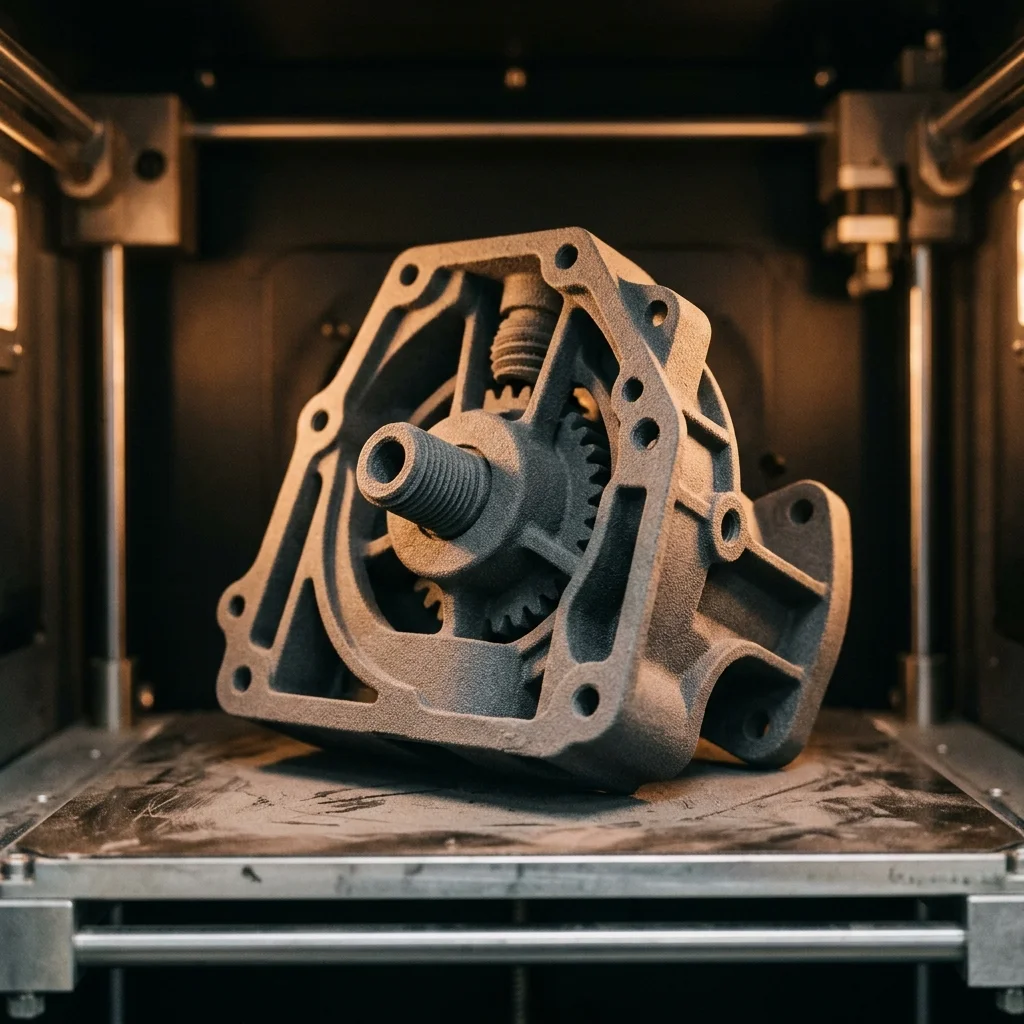
MJF (Multi Jet Fusion) is HP’s proprietary 3D printing technology that combines the powder bed principle of SLS with inkjet-style fusing agent deposition. Result: faster print speeds than SLS (2-3x), comparable mechanical properties, and slightly better surface finish. PA12 is the workhorse material: same chemistry as SLS PA12, but MJF’s fusion process gives slightly different layer adhesion characteristics. MJF is favored for medium-volume production (100-1000 units), where SLS was cost-prohibitive and injection molding not justified. This guide: what makes MJF different, which bureaus offer it, and when it’s a better choice than SLS.
How MJF works
MJF print process:
- Spread powder layer (PA12, 80 µm typical).
- Inkjet head deposits fusing agent on areas to be fused into the part.
- Inkjet head deposits detailing agent on edges for smoother boundaries.
- IR lamp passes over the layer, heating areas with fusing agent to fusion temperature (~190°C). Areas without agent stay powder (recyclable).
- New layer of powder, repeat.
- After all layers, part is removed from powder bed, cleaned with compressed air + sandblasting.
Key differences vs SLS:
SLS: single laser point scans across each layer. Time scales with part complexity + bed area. MJF: entire layer fuses simultaneously via fusing agent + IR lamp. Time scales only with layer count.
MJF speed advantage: 2-3x faster than SLS for typical batch. 10,000 cm³ build (medium production batch): SLS 12-14 hours, MJF 4-5 hours.
MJF detail advantage: detailing agent at boundaries gives sharper edges than SLS’s laser scan + thermal bleed.
MJF color: native gray/black (carbon-based fusing agent darkens part). SLS: natural off-white. For colored parts, both can be dyed post-process.
MJF surface: slightly more matte than SLS. Sandable to smooth.
MJF accuracy: ±0.2-0.3 mm. SLS: ±0.15-0.25 mm. Comparable, slight SLS edge on dimension accuracy.
EU bureaus offering MJF
Sculpteo (France): full MJF service. PA12, PA12-Glass Beads (stiffer), PA12-Carbon Fiber. Pricing similar to their SLS service, slightly faster lead time (4-6 days vs 5-7 for SLS).
Shapeways (Netherlands): MJF available. Better for prototype quantities than production volumes.
Protolabs (UK/Germany): premium MJF service. Express 24-48h available for urgent. Most expensive but fastest.
Materialise (Belgium): industrial MJF. Higher minimum order (€100+ typical), but best quality control.
HP Multi Jet Fusion Service Network: directly from HP partner list. Multiple options in Germany, UK, Netherlands.
iGo3D (Germany): has MJF capability for select customers.
For small businesses: Sculpteo direct MJF for cost balance. For volume production (100+ units): Protolabs or Materialise.
Bulgaria-direct MJF: as of 2026, no domestic MJF bureau. All ordered EU service.
Cost comparison MJF vs SLS
Per-part cost comparison at Sculpteo (representative EU pricing):
Small part (50×50×30mm, ~25 cm³):
- SLS PA12: €20
- MJF PA12: €18
- Difference: -10% MJF
Medium part (150×100×80mm, ~400 cm³):
- SLS PA12: €80
- MJF PA12: €68
- Difference: -15% MJF
Large part (300×200×150mm, ~3000 cm³):
- SLS PA12: €350
- MJF PA12: €290
- Difference: -17% MJF
Batch of 50 identical small parts:
- SLS PA12: €15/part × 50 = €750
- MJF PA12: €13/part × 50 = €650
- MJF +€100 saving on batch
Delivery time:
- SLS standard: 5-7 days
- MJF standard: 4-6 days
- MJF advantage: 1-2 days faster
Why MJF is cheaper at scale: bureaus process more parts per machine-hour. Cost savings passed to customer.
When MJF wins: medium-volume production (50+ identical parts), tight delivery deadlines.
When SLS still wins: highest possible dimensional accuracy, when natural off-white color preferred (skips dye step), when bureau availability dictates.
Applications for MJF PA12
Automotive: under-hood brackets, sensor mounts, custom HVAC routing, drone subsystems for automotive aftermarket. MJF favored for batches of 50-200 units.
Medical: surgical instrument cases, custom orthoses (with ISO 10993 grade PA12), prosthetic adapters. MJF preferred over SLS for production runs.
Industrial automation: vacuum end-effectors for pick-and-place robots, custom jigs & fixtures, conveyor system components. Production-grade reliability.
Consumer electronics: enclosures for prosumer devices, drone parts (DJI custom mods), specialty electronics housings. Native gray color matches branded products.
Aerospace tooling: hand-held assembly tools, GO/NO-GO gauges, calibration targets. Production-grade quality.
Functional prototypes: when prototypes need to BE the production part (early production batches), MJF gives quality identical to scale production.
Replacement parts: legacy equipment with broken OEM parts, MJF PA12 brackets, housings, gears. Single-unit cost €20-€50 typical.
Quality + post-processing for MJF
Default MJF surface (no post-process): matte gray, slightly grainy texture. Acceptable for industrial use, but visible for consumer-facing products.
Standard finish options at bureaus:
-
“As-printed” (€0 extra): default matte gray. Good for hidden mechanical parts.
-
Vapor smoothing (+€2-€5 per part): chemical vapor finish gives smoother, glossier surface. Improves clarity for consumer products.
-
Sanding (+€3-€10 per part): sequential 400-800-1200 grit. Smoother, but loses MJF’s characteristic edge crispness.
-
Dyeing (+€2-€8 per part): immerse in colored dye bath. MJF parts accept dye exceptionally well (their porosity). Black, navy blue, red, green common. Custom Pantone matching available (+30-50%).
-
Painting (+€5-€15 per part): primer + acrylic spray paint. Best for consumer products needing specific colors.
-
Polishing (+€5-€20 per part): full polish for glossy finish. Useful for medical or consumer-facing parts.
In-house post-process options:
- Light sanding (400-800 grit): adequate for most industrial uses, takes 2-5 minutes per part.
- Painting: primer (Vallejo Surface Primer), then color, then clear coat. 30-60 minutes per part for cosmetic finish.
- Heat-set inserts: drill or design holes for brass heat-set inserts. Excellent thread retention.
- Surface treatment (acetone vapor): NOT effective on PA12 (different chemistry from ABS). PA12 doesn’t dissolve in acetone.
Frequently Asked Questions (FAQ)
Mjf With Pa12, Hp Multi Jet Fusion Industrial Print Calculator
Interactive optimization calculator.
The full picture
This article is one page from The Big Book of 3D Printing: 704 illustrated pages covering every technology, material and fix in one reference.
Read it on Kindle →Engineer, author of The Big Book of 3D Printing and additive manufacturing expert