

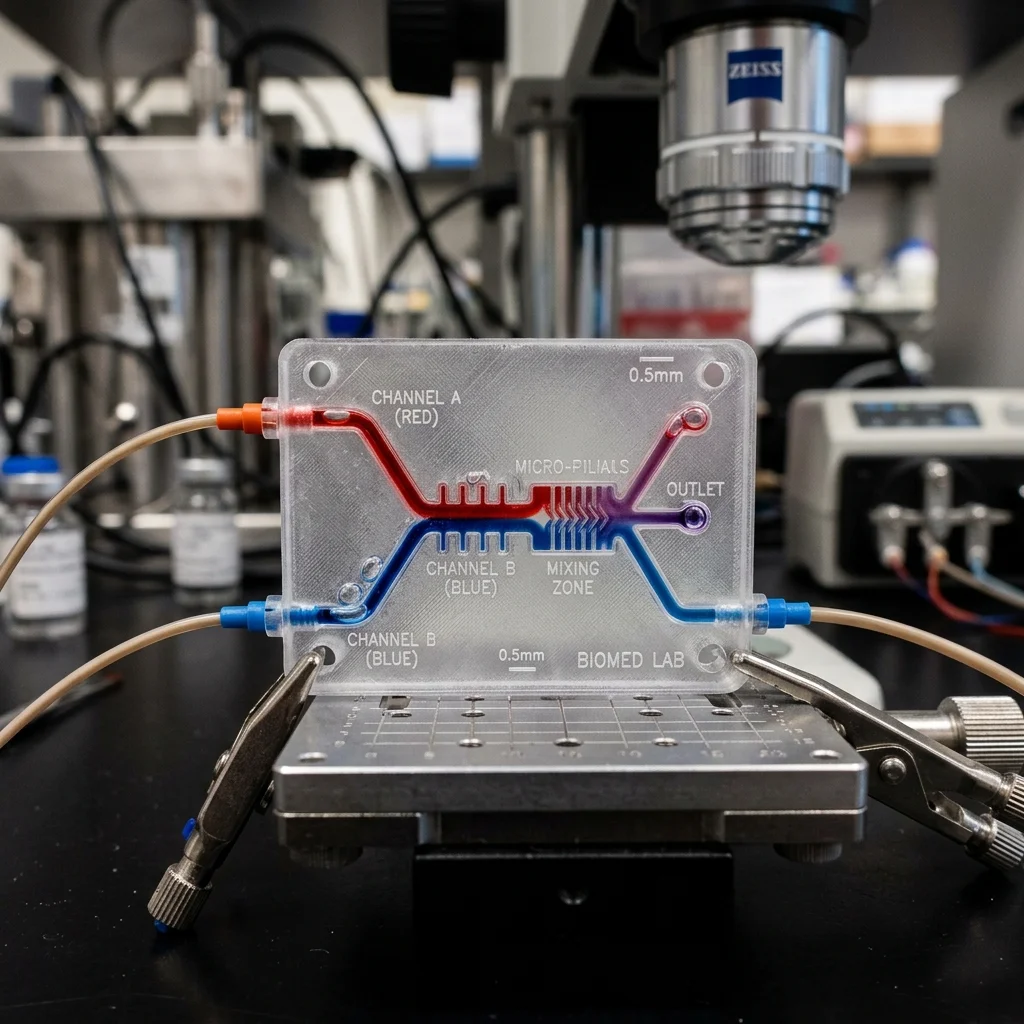
In 2025–2026, 3D printed microfluidic chips (Lab-on-a-Chip) with 10–500 μm channels simulate organ functions for drug testing without animal experiments.
| Method | Resolution | Material |
|---|---|---|
| Micro-SLA | 10–25 μm | Clear resin |
| 2PP | 0.1–1 μm | Specialized photoresists |
| DLP | 25–50 μm | Biocompatible resin |
Interactive Filament Selector
Answer 3 quick questions and find the optimal material for your project.
1. What are the mechanical requirements for the part?
2. What temperature will the part operate at?
3. Are there any specific environmental requirements?
Our recommendation:
PLA filament
Ideal for easy printing, model visualization and decorative parts.
Applications: Organ-on-a-Chip, Drug screening, Point-of-care diagnostics.
FAQ
Q:
Can 3D printing replace PDMS lithography?
A:
For prototyping: yes, hours vs days. For mass production: PDMS is cheaper at > 1000 chips.
Microfluidic Chips For Drug Testing: Lab-On-A-Chip Via 3D Printing Calculator
Interactive optimization calculator.
The full picture
This article is one page from The Big Book of 3D Printing: 704 illustrated pages covering every technology, material and fix in one reference.
Read it on Kindle →Engineer, author of The Big Book of 3D Printing and additive manufacturing expert