

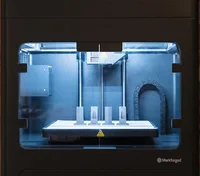
The Markforged Metal X is an industrial metal 3D printer based on ADAM (Atomic Diffusion Additive Manufacturing) – a process where metal powder is bound in a polymer matrix and extruded as filament, after which the part undergoes chemical debinding and sintering in a furnace. The machine brings metal additive manufacturing to a workshop or office environment – no loose powder, no laser, no specialized facilities.
What it is
ADAM (Atomic Diffusion Additive Manufacturing) is a process developed by Markforged in which metal powder is evenly distributed in a wax-polymer binder system and shaped into a filament (Markforged Metal Filament). The printer extrudes this filament in an FFF-like manner, producing a so-called green part. After printing, the part is placed in a chemical debinding station (Wash-1), where the binder is partially removed with solvent, and then sintered in a furnace (Sinter-1/2) at a temperature close to the melting point of the metal. During sintering the metal particles fuse together, material density rises to approximately 95–98 % of the theoretical maximum, and the part achieves its final mechanical properties. The advantages over LPBF (SLM/DMLS) are: office-safe operation without protective gas or loose powder, a lower entry price, and a simpler workflow; the trade-offs are a lower maximum density, anisotropy limits in thin-walled geometries, and a mandatory three-step post-process.
Technical specifications
| Technology | ADAM – Bound Metal FFF + chemical debinding + sintering |
|---|---|
| Build volume | 300 × 220 × 180 mm |
| Post-process | Wash-1 (debinding) → Sinter-1 or Sinter-2 (furnace) |
| Sintering shrinkage | ≈ 17–21 % (auto-compensated by Eiger) |
| Achieved density | 95–98 % of theoretical maximum |
| Software | Eiger (Markforged cloud slicer) |
| Class / Price | Industrial · ≈ €100,000 |
Applications and industries
- Tooling and fixtures – Manufacturing custom metal fixtures, jigs and assembly aids for production lines – with the full hardness and wear resistance of tool steel, at significantly shorter lead times than CNC machining. (Automotive and manufacturing)
- Spare parts on demand – Production of small batches of metal spare parts – brackets, fittings, clips – directly on the shop floor, without long lead times or stocking slow-moving inventory. (Industrial maintenance and OEM)
- Functional metal part prototypes – Rapid design iteration by producing fully functional metal prototypes for physical testing and validation – without the minimum order quantities and cost burden of casting or CNC. (R&D and engineering design)
Production workflow
- Prepare the CAD model in Eiger: set material, layer thickness and part orientation, keeping in mind that Eiger automatically compensates for sintering shrinkage (~17–21 %). The sliced file accounts for the scaled-up green part dimensions so the final sintered part matches nominal dimensions.
- Print the green part on the Metal X: the ADAM process deposits the metal filament layer by layer together with a wax support structure. Check platform adhesion and wall integrity after printing is complete. The green part is robust but hand-workable – it contains the full volume of metal powder held by the polymer binder system.
- Place the green part in Wash-1 for chemical debinding: the solvent removes most of the polymer matrix, leaving a so-called brown part with sufficient structural integrity to be transferred to the furnace. The brown part is porous and fragile – it must be handled carefully during transfer to the Sinter furnace without impacts or loads.
- Sinter the brown part in Sinter-1 or Sinter-2: the furnace follows a controlled thermal profile to burn off residual binder, then fuses the metal particles at a temperature near the alloy melting point. The final metal part reaches 95–98 % of theoretical density with mechanical properties comparable to a wrought or CNC-machined equivalent, and dimensions reduced by 17–21 % relative to the green part.
Key considerations
Materials and applications
Pick a material/alloy this machine processes to see its properties and typical applications:
Conclusion
The Markforged Metal X is the machine that makes metal additive manufacturing accessible to a workshop or office without requirements for protective gas, specialized facilities or loose-powder management. The ADAM process offers a realistic trade-off: it does not reach the density and precision of LPBF, but delivers fully functional metal parts in tool steels and specialty alloys in three clear steps – print, debind, sinter. For small to medium runs of tooling, spare parts and functional prototypes, the Metal X provides speed and flexibility unattainable with conventional manufacturing methods.
The full picture
This article is one page from The Big Book of 3D Printing: 704 illustrated pages covering every technology, material and fix in one reference.
Read it on Kindle →Engineer, author of The Big Book of 3D Printing and additive manufacturing expert