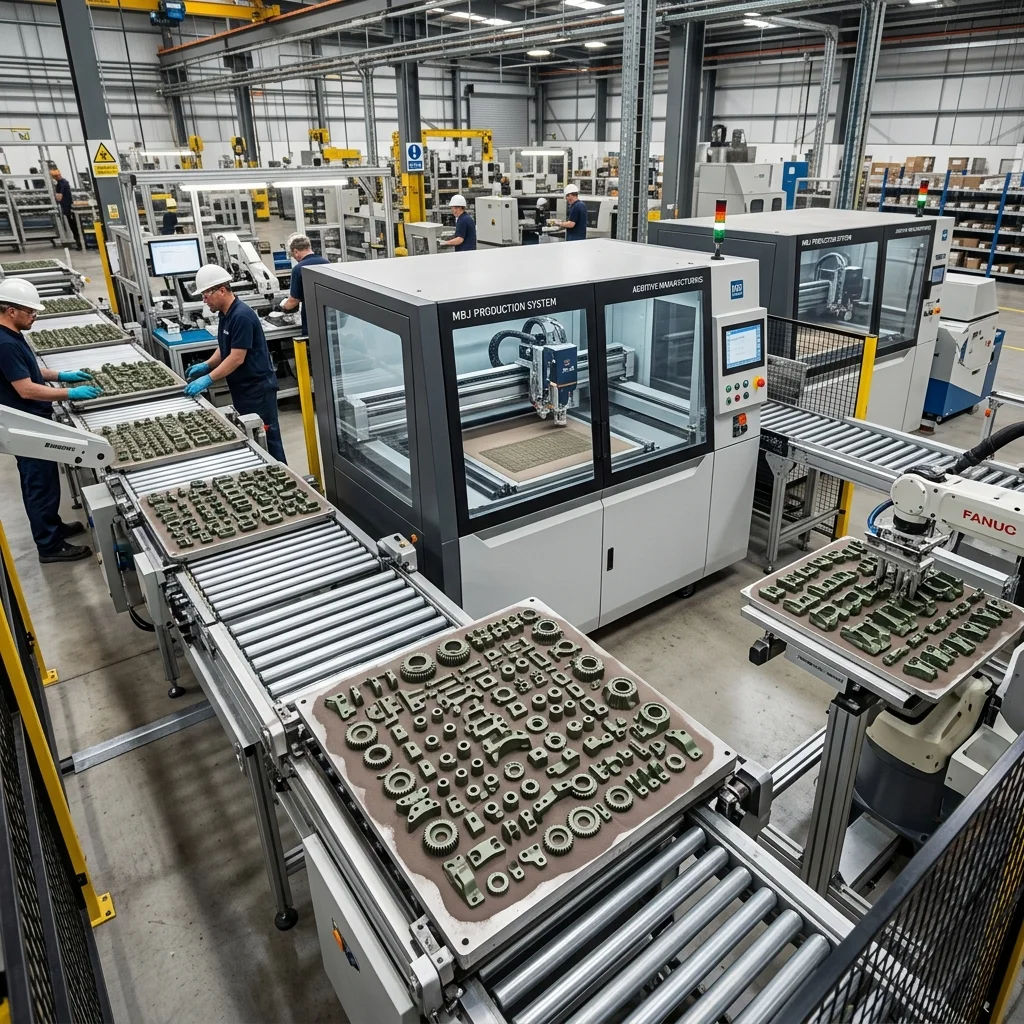
In 2025–2026, Metal Binder Jetting (MBJ) has positioned itself as the technology most likely to bring metal additive manufacturing to automotive-scale production volumes. Unlike laser-based PBF, MBJ uses inkjet printheads to deposit organic binder onto metal powder, followed by furnace sintering: eliminating the need for expensive lasers and inert gas atmospheres.
Operating Principle: Print → Cure → Depowder → Sinter
1. Powder Spreading
A recoater (roller or blade) deposits a thin layer of metal powder (layer = 30–100 μm) onto the build platform.
2. Binder Jetting
Industrial inkjet printheads (hundreds of nozzles) selectively spray an organic binder (polymer solution) onto the powder bed.
3. Layer Repeat
The process repeats layer by layer. Speed is very high because the inkjet head covers the entire build area in seconds (not minutes as with laser scanning).
4. Curing
The green body is heated to 150°C–200°C to polymerize the binder for handling strength.
5. Depowdering
The green part is extracted from the powder bed. Unbound powder is recycled.
6. Sintering
The part is sintered at 1250°C–1400°C (for steel). The binder burns off and metal particles fuse through atomic diffusion. Linear shrinkage is 15%–20%, pre-compensated in software.
Interactive Filament Selector
Answer 3 quick questions and find the optimal material for your project.
1. What are the mechanical requirements for the part?
2. What temperature will the part operate at?
3. Are there any specific environmental requirements?
Our recommendation:
PLA filament
Ideal for easy printing, model visualization and decorative parts.
Why the Automotive Industry?
| Factor | MBJ Advantage |
|---|---|
| Production Volume | 1,000–100,000 parts/year (bridge between prototyping and mass casting) |
| Unit Cost | Lower than PBF at volumes > 1,000 (no laser, no inert gas) |
| Material Efficiency | Up to 98% recycling of unbound powder |
| Geometric Freedom | Internal channels, lattices, and complex shapes at no additional cost |
| Rapid Iteration | Design changes without new molds (unlike casting/forging) |
Automotive Applications
- Brackets and Mounting Elements: Steel brackets for suspension and chassis.
- Turbo Components: Turbocharger housings from Inconel or 316L stainless steel.
- Gears and Synchronizers: Complex geometries from sintered 17-4PH steel.
- Weight Reduction: Lattice structures in structural elements.
- Tooling: Mold inserts and die casting dies.
Mechanical Properties (MBJ 316L Stainless Steel)
| Property | MBJ 316L (Sintered) | Conventional 316L | MIM 316L |
|---|---|---|---|
| Ultimate Tensile Strength | 520 – 560 MPa | 515 – 620 MPa | 480 – 520 MPa |
| Yield Strength | 175 – 210 MPa | 205 – 310 MPa | 170 – 200 MPa |
| Elongation | 50% – 60% | 40% – 60% | 30% – 50% |
| Density | 96% – 99% | 100% | 95% – 98% |
| Surface Roughness (As-sintered) | Ra 3 – 6 μm | N/A | Ra 3 – 5 μm |
Leading MBJ Platforms
| Manufacturer | Platform | Build Volume | Key Advantage |
|---|---|---|---|
| Desktop Metal | Production System P-50 | 490×380×260 mm | Fastest MBJ machine (up to 12,000 cm³/hr) |
| HP | Metal Jet S100 | 430×309×200 mm | HP inkjet technology, low unit cost |
| ExOne (Desktop Metal) | InnoventPro | 160×65×65 mm | R&D platform for new materials |
| Markforged | PX100 | 200×200×150 mm | Accessible price for mid-market |
Pros and Cons
Pros:
- No Laser: Eliminates the most expensive component in PBF systems.
- High Throughput: Dozens of parts printed simultaneously across the full powder bed.
- Low Residual Stress: Absence of laser remelting eliminates thermal stress issues.
- Mass Production: Ideal for runs of 1,000–100,000 parts.
Cons:
- Sintering Required: Requires an expensive high-temperature sintering furnace.
- Shrinkage: 15–20% linear shrinkage, requires precise compensation and expertise.
- Porosity: Typical density of 96–99% (PBF achieves > 99.5%).
- Limited Materials: Primarily steels (316L, 17-4PH), copper, and some superalloys. Aluminum remains challenging.
Frequently Asked Questions (FAQ)
Metal Binder Jetting For Automotive Mass Production Calculator
Interactive optimization calculator.
The full picture
This article is one page from The Big Book of 3D Printing: 704 illustrated pages covering every technology, material and fix in one reference.
Read it on Kindle →Engineer, author of The Big Book of 3D Printing and additive manufacturing expert
Updated on 11 September 2026
This article was written with AI assistance; the facts were checked against the sources on 11 September 2026.