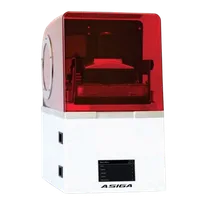
The Asiga MAX UV is a compact industrial DLP printer with a fully open material system, designed for dental laboratories, jewellery workshops and audiology applications. With a 119 × 67 × 200 mm build volume, precision UV-LED projection and the proprietary SPS quality-control system, the MAX UV prints high-accuracy resins from any manufacturer.
What it is
The MAX UV is a DLP (Digital Light Processing) printer in which an entire resin layer is cured simultaneously by a UV-LED projector from below, without a moving laser head. The critical difference from most competitors is its open material system: the machine accepts any compatible photopolymer from third-party suppliers, not only branded cartridges. The built-in SPS (Slide-and-Pull Separation) mechanism manages the delicate separation of each layer to prevent deformation. The printer targets dental laboratories, lost-wax jewellery casting, audiology and precision industrial prototyping where accuracy outweighs speed.
Technical specifications
| Technology | DLP (UV-LED projector, bottom-up) |
|---|---|
| Build volume | 119 × 67 × 200 mm |
| Material system | OPEN: any third-party photopolymer |
| XY resolution | down to 62 µm pixel (Full HD projector) |
| Quality control | SPS (Slide-and-Pull Separation) |
| Layer thickness | 25 – 200 µm (configurable) |
| Class / Price | Industrial · ~€6,000 |
Applications and industries
- Dental appliances and splints: production of surgical guides, temporary crowns, orthodontic splints and digitised prosthetic bases using clinically approved biocompatible resins (Dental medicine)
- Lost-wax jewellery casting (precision castable wax models for casting gold, silver and platinum) with details below 100 µm and near-zero ash residue on burnout (Jewellery manufacturing)
- Ear moulds and audiological devices – custom ear moulds and hearing aid shells in biocompatible resins meeting ISO 10993 (Audiology and medical devices)
Production workflow
- Select a third-party resin and enter or create its exposure profile in Asiga Composer software. Correct UV exposure parameters for the specific photopolymer: the foundation for dimensional accuracy.
- Level and zero the Z-platform against the FEP/silicone vat bottom. Uniform first-layer thickness across the full area: prevents model detachment.
- Start the DLP print with SPS mode active; adjust the pull speed layer by layer if needed. Controlled separation reduces stress on the model and prevents warping of thin features.
- After printing, wash the part in IPA or a dedicated solvent, then post-cure in a calibrated UV station. Full polymerisation for final mechanical properties and biocompatibility per the resin specification.
Key considerations
Materials and applications
Pick a material/alloy this machine processes to see its properties and typical applications:
Conclusion
The Asiga MAX UV is a specialist tool for applications where precision is an absolute requirement: dental medicine, jewellery casting and audiology. The open material system gives you the freedom to use hundreds of certified and custom-profiled resins, while the SPS mechanism protects delicate features at every layer separation. The ~€6,000 price is justified for laboratories where accuracy directly impacts the clinical or production outcome.
The full picture
This article is one page from The Big Book of 3D Printing: 704 illustrated pages covering every technology, material and fix in one reference.
Read it on Kindle →Engineer, author of The Big Book of 3D Printing and additive manufacturing expert
Updated on 11 September 2026
This article was written with AI assistance; the facts were checked against the sources on 11 September 2026.