

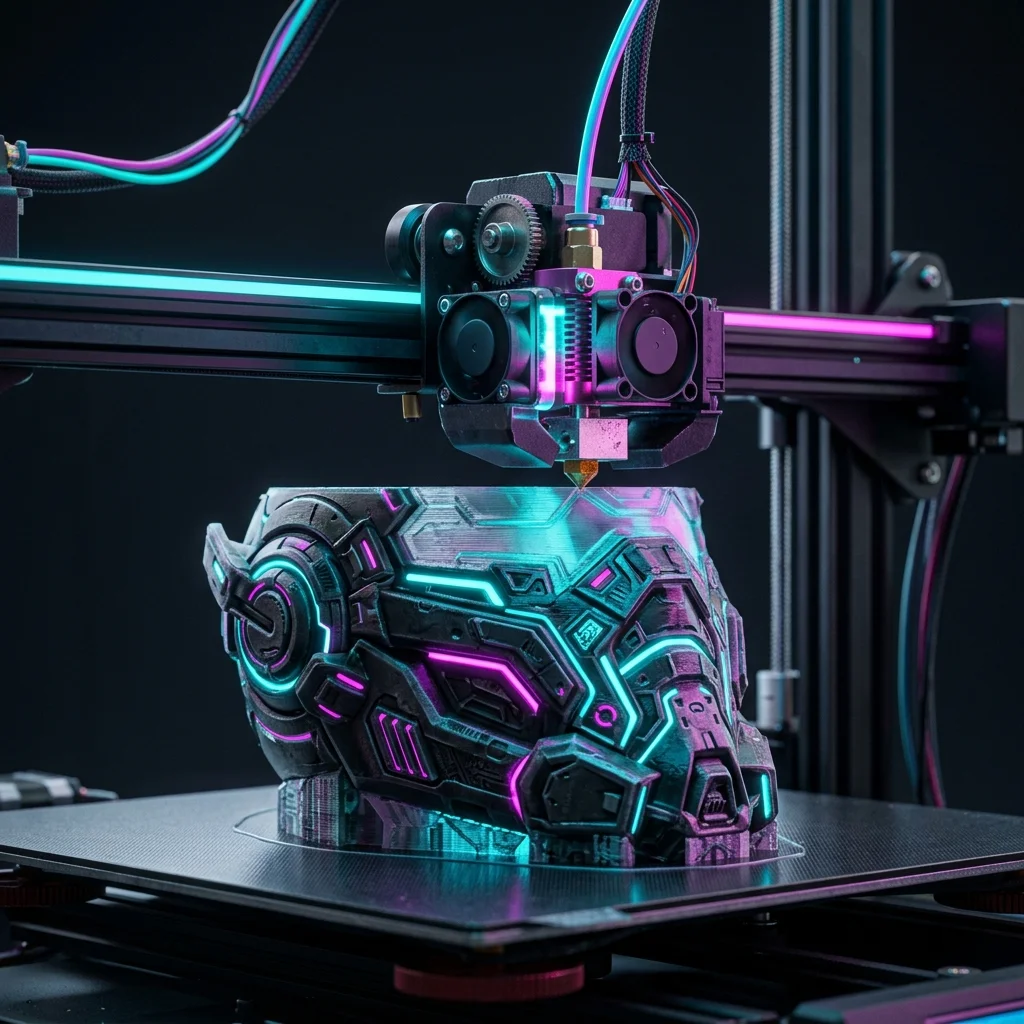
The cosplay community is growing every year: conventions worldwide attract thousands of participants in costumes from anime, video games, and films. 3D printing is revolutionary for cosplay, before it, making an Iron Man helmet, a No Face mask, or a Final Fantasy sword required months of hand-building with EVA foam, plaster, fiberglass. Now, a full helmet prints in 2-3 days on a standard FDM printer, processes in a week, and is ready for the convention. In this guide we cover materials, smooth-surface techniques, painting, multi-segment assembly of large objects, and examples from the cosplay community.
What can and cannot be printed
Suitable for 3D printing in cosplay:
- Helmets and headgear (Iron Man, Storm Trooper, Spartan): print in several segments and assemble. Ideal application.
- Masks and face plates (No Face, Predator, Frankenstein): one or two segments in FDM, excellent for fine details in MSLA.
- Weapons and accessories (swords, guns, staffs): print in segments, assemble with screw or magnetic connection.
- Armor (chest, shoulder, knee plates): print in segments + sew to an EVA foam or fabric base for flexibility.
- Jewelry and amulets (Pendant, Crown, Ring): MSLA printer for fine details.
- Lighting effects (LEDs inside transparent resin shapes): combination of MSLA clear resin + electronics.
Unsuitable or complex:
- Clothing (robe, cloak, fabric): no. 3D printing makes solid objects. Clothing needs sewing.
- Flexible masks for facial movement: partially. TPU 3D printing can make flexible masks but not as elegant as silicone.
- Hair and beard: no. That’s a wigmaker’s job.
- Micro-details (eyelashes, armor lamellae): very fine details are often better hand-made or cast.
- Full body-encompassing costumes: usually a combination of 3D-printed outer layer + cloth base underneath for comfort.
Key rule for cosplay 3D printing: design for wearing, not display. The costume will move, will rub, will be hot during long wear. The design must account for this.
Recommended materials
PLA matte (€28-€35/kg): the cosplay standard. Polymaker PolyTerra, Bambu Lab PLA Matte. Easy to print, excellent surface without paint, safe for long wear (no fumes).
PLA WARNING: softens at 55-60°C. At a summer convention (35°C in shade, 60°C+ in a car without AC) PLA masks can deform. For summer conventions use PETG, ABS, or ASA.
PETG (€25-€35/kg): second after PLA in popularity. More heat-resistant (75-80°C), lighter, harder to break. Useful for summer conventions and props that may take impact.
ABS or ASA (€25-€35/kg), for outdoor costumes with UV exposure or high thermal load. ABS gives a more natural matte look; ASA is UV-resistant. Both require an enclosed body for quality printing.
TPU 95A (€50-€70/kg), for flexible masks that follow facial movement. Not for beginners (tricky setup), but enables unique designs.
Carbon Fiber composites (€70-€90/kg), for light and strong props (swords, weapons that will be swung). PolyMide PA6-CF or PolyLite PLA-CF. Prints on an all-metal hotend.
MSLA resin (€25-€60/liter), for jewelry amulets, fine details. Anycubic, Phrozen standard or tough resin.
Wood PLA or Metal PLA composites, for themed costumes that should look like wood or metal. Fillamentum Timberfill (wood texture), eSUN Bronze (metal look).
Clear PETG or MSLA, for masks with integrated light (LEDs glowing from inside outward).
Recommended printers for cosplay
For a beginner cosplayer:
- Bambu Lab A1 (€420): excellent for PLA, easy interface, AMS lite for multi-color prints. 256×256×256 mm build volume is enough for most masks and helmets in segments.
- Anycubic Kobra 3 Combo (€430): alternative with auto-leveling.
- Creality K1 (€450): budget larger volume.
For an experienced cosplayer doing complex projects:
- Bambu Lab X1-Carbon (€1449): enclosed body for ABS, ASA, CF composites. Multi-color AMS for multi-color prints.
- Prusa MK4S with Enclosure (€999 + €330): European quality, all upgradable.
- Anycubic Kobra 2 Max (€500), for larger projects (420×420×500 mm volume).
For a cosplayer-producer (sells finished costumes):
- Multiple Bambu Lab P1S (€700 × 2-3): enclosed body, mid-volume, ROI through parallel printing.
- Bambu Lab X1-Carbon + Anycubic Photon Mono M5s: FDM + MSLA combination for full coverage.
- Prusa XL with 5 heads (€3500), for multi-color helmets and small masks in a single print without assembly.
For fine and detailed objects (jewelry, amulets, crowns):
- Anycubic Photon Mono M5s (€368) or Elegoo Saturn 3 Ultra (€420): MSLA printer for fine details.
- Phrozen Sonic Mighty 8K (€420): alternative with slightly larger volume.
For cosplay convention discussions, we recommend Bambu Lab A1 + Anycubic Photon Mono M5s = €788. This combo enables almost any cosplay project.
Smooth surface and painting techniques
Standard FDM prints have visible 0.20 mm layers that aren’t acceptable in quality cosplay. So post-processing is critical.
Step 1: Preparation Remove supports carefully with a knife or pliers. File rough edges with 80 grit sandpaper.
Step 2: Primer Primer (Mr. Surfacer 1500, Vallejo Surface Primer, or budget (spray primer from a hardware store)) two coats with thinning for full coverage. Time: 30 minutes per coat + 24 hours drying.
Step 3: Sanding Start with 240 → 400 → 800 → 1500 → 2500 grit wet sandpaper. Wet the surface between coats. This is the most labor-intensive step: 3-8 hours per helmet. Removes layer lines and gives a ceramic-like surface.
Step 4: Additional filler (if lines still visible) Mr. Surfacer 500 for primer-filler, or cheap automotive Putty (from a hardware store). Fills pits and lines. After drying: sand again.
Step 5: Paints
Airbrush (recommended for quality projects):
- Vallejo Model Air acrylic paints (€3-€5 per 17 ml)
- AK Interactive for metallic effects (€4-€7)
- Citadel/Games Workshop (more expensive, top quality)
Airbrush + compressor: €150-€350 investment. After trying, significantly better results than spray or brush.
Spray paints (budget alternative):
- Montana Black for base colors
- Montana Gold for matte finish
- Local hardware-store universal spray paints (€7-€12 per can)
Brush (for fine details):
- Sable brushes 00, 0, 1 size
- Citadel or Vallejo paints for heavy focal effects
Step 6: Varnish Matt, satin or gloss varnish per style. Vallejo Polyurethane Varnish (€8-€15): excellent for protection.
Total time per helmet: 15-40 hours of labor after the print finishes.
The cosplay community and conventions
Comic Cons: the largest cosplay events worldwide. Annual events draw tens of thousands of visitors. Attractive cosplay contests with cash prizes (€500-€2000 for the grand prize).
Geek Festivals: geek culture festivals with cosplay contests. Held year-round in various cities.
Anime/Comics communities: monthly meet-ups, active Facebook groups with thousands of members.
Cosplay heroes (worldwide):
- Professional cosplayers: specialize in Final Fantasy and Diablo characters. Win prizes at international conventions.
- Hardsuit specialists: master Halo Spartan, Iron Man builds. Teach workshops at maker spaces.
- Star Wars specialists: 501st Legion members, droid builds.
3D designers for cosplay:
- Design studios: professional STL models of popular helmets and weapons. Price for one STL set: €15-€50.
- Many local designers sell STLs via CGTrader, Etsy, MyMiniFactory.
STL sources:
- GalaxyCosplay (paid platform, €5-€15 per model), for characters from popular franchises.
- MyMiniFactory: many free and paid STLs.
- Thingiverse: older platform, free, less professional models.
- Printables: Prusa-run platform, free, growing library.
- CGTrader: professional CAD model marketplace, more paid than free.
Service options:
- Maker spaces: monthly access €40-€80, access to Bambu X1, Prusa MK4, Phrozen MSLA + workshops.
- Smaller maker spaces: €30/month, smaller lab.
- Print centers: custom printing, €0.30-€0.80 per cm³ for PLA.
Frequently Asked Questions (FAQ)
Eco-Footprint of 3D Printing Masks And Cosplay Costumes, Materials, Assembly, Paints
Calculate saved CO2 emissions.
The full picture
This article is one page from The Big Book of 3D Printing: 704 illustrated pages covering every technology, material and fix in one reference.
Read it on Kindle →Engineer, author of The Big Book of 3D Printing and additive manufacturing expert