

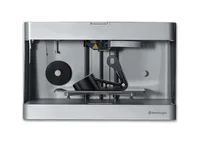
The Markforged Mark Two is an industrial FDM printer with Continuous Fiber Reinforcement (CFR) – embedding continuous strands of carbon fiber, Kevlar or fiberglass inside an Onyx nylon matrix to produce parts with the strength of aluminum, straight from the printer. Layer by layer, fiber is laid alongside the base material, making the Mark Two the benchmark for metal-replacement applications in aerospace, automotive and manufacturing.
What it is
The Mark Two is a dual-nozzle machine: one nozzle lays Onyx (nylon loaded with chopped carbon fiber) while the second deposits continuous reinforcing fibers along a user-defined path. The result is composite parts whose specific strength exceeds 6061 aluminum at significantly lower weight. The entire workflow is managed through the cloud-based Eiger slicer, where the engineer defines the number and orientation of reinforcing layers. The machine is a closed ecosystem – materials, slicer and printer all come from Markforged – guaranteeing predictable mechanical properties in series production.
Technical specifications
| Technology | FDM + Continuous Fiber Reinforcement (CFR) – dual nozzle |
|---|---|
| Build volume | 320 × 132 × 154 mm |
| Nozzles | 2 – Onyx (matrix) + continuous fiber |
| Base materials | Onyx, Nylon, Onyx FR |
| Reinforcing fibers | Continuous Carbon Fiber, Kevlar, Fiberglass, HSHT Fiberglass |
| Slicer | Eiger (cloud-based, closed ecosystem) |
| Class / Price | Industrial · ~€15 000 |
Applications and industries
- Metal-replacement jigs and fixtures – Manufacturing precision handling jigs, fixtures and tooling from Onyx+carbon that directly replace machined aluminum at a fraction of the weight and lead time. (Automotive and manufacturing)
- Strong functional end-use parts – Printing parts operated in real environments – brackets, load-bearing elements, housings – with mechanical properties previously achievable only through machining or hand lay-up carbon fiber lamination. (Industrial design and R&D)
- Lightweight aerospace and automotive tooling – Producing assembly templates, alignment guides and lightweight structural brackets for aircraft assembly lines and motorsport chassis, where every gram of weight has performance or regulatory implications. (Aerospace and motorsport)
Production workflow
- Design the model in CAD and import it into Eiger; define the number and orientation of reinforcing fiber layers according to the expected load direction. Optimal fiber distribution along principal stress directions – maximum strength at minimum material cost.
- Start the dual-nozzle print: the Onyx nozzle builds the matrix and walls while the fiber nozzle lays continuous reinforcing strands on the defined layers. Smooth and predictable composite stack with no stress-concentration zones at the matrix-to-fiber transition.
- Print support-free wherever the geometry allows; use soluble supports (if needed) only for critically overhanging sections. Clean surfaces free of support marks, reduced post-print machining.
- Apply post-processing as required: drilling, tapping threads, grinding contact surfaces, or applying a moisture-barrier coating. Assembly-ready functional part with accurate dimensions at fit and mounting zones.
Key considerations
Materials and applications
Pick a material/alloy this machine processes to see its properties and typical applications:
Conclusion
The Mark Two is a machine for engineers who need metal-replacement parts without a machining line. The closed Eiger ecosystem and dual-nozzle technology turn fiber reinforcement design into a manageable engineering process, and the result – Onyx+carbon parts with aluminum-class strength – unlocks applications out of reach for any standard FDM printer.
The full picture
This article is one page from The Big Book of 3D Printing: 704 illustrated pages covering every technology, material and fix in one reference.
Read it on Kindle →Engineer, author of The Big Book of 3D Printing and additive manufacturing expert