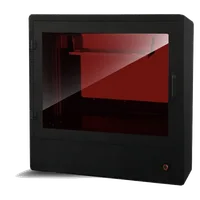
The Photocentric Liquid Crystal Pro is a large-format LCD/MSLA printer designed for series production and high-end applications. With a build volume of 450 × 280 × 300 mm and a large-scale LCD panel, it converts liquid resin into precision parts at throughput unattainable by desktop machines.
What it is
The Liquid Crystal Pro is Photocentric's flagship: a British manufacturer specialising in LCD-based resin technology. Unlike small MSLA printers, here the entire LCD panel illuminates the build platform with UV light simultaneously, regardless of how many parts are in the layer. This makes the machine exceptionally efficient for series production: instead of printing parts one by one, it fills the entire bed and prints them all at once. The model targets manufacturing companies, dental laboratories, investment casting foundries, and engineering teams seeking an industrial-class printer without the price tag of small-format SLA or DLP.
Technical specifications
| Technology | LCD / MSLA (Masked Stereolithography) |
|---|---|
| Build volume | 450 × 280 × 300 mm |
| LCD panel | large monochrome UV panel with high resolution |
| XY resolution | ~75 µm (pixel pitch) |
| Layer thickness | 25 – 100 µm |
| UV wavelength | 405 nm |
| Class / Price | Prosumer / Industrial · ~€4 500 |
Who it’s for
- Series resin production (filling the entire build volume with identical parts and curing the layer simultaneously) maximum parts per hour (Consumer goods and manufacturing)
- Dental and medical use: surgical guides, dental models, orthodontic devices and medical prototypes from biocompatible resins (Dental medicine and healthcare)
- Industrial precision prototypes: complex geometries with high detail for form, fit and functional verification prior to mass production (Mechanical engineering and R&D)
- Castable wax models for investment casting: series jewellery and technical castings with zero ash residue, ensuring clean cavities (Jewellery and investment casting)
Setup and calibration
- Check platform horizontality with a spirit level and tighten the locking bolts. A level platform means uniform first-layer adhesion across the full 450 × 280 mm area.
- Run an exposure time test using a test matrix of small cubes. You find the minimum working layer time without under-cure or detail blurring.
- Inspect and replace the FEP / nFEP release film when visible fogging or scratches appear. A cloudy or damaged film causes layers to stick to the vat instead of the platform.
- Maintain the resin level in the recommended range within the resin vat before and during printing. Too little resin → incomplete layer; too much → overflow and LCD contamination.
Common defects and fixes
Resin exposure helper
Pick a resin type for starting exposure values (typical for mono-LCD machines). These are STARTING points: always run an exposure test, because the exact seconds depend on your screen power and the specific resin:
Conclusion
The Photocentric Liquid Crystal Pro is a production-floor machine: not for hobbyists. Its large bed and simultaneous full-layer curing make it indispensable for series orders where FDM or small MSLA printers would lose hours per batch. Proper resin management, FEP film maintenance and support angle choices are the keys to predictable results at this build volume.
The full picture
This article is one page from The Big Book of 3D Printing: 704 illustrated pages covering every technology, material and fix in one reference.
Read it on Kindle →Engineer, author of The Big Book of 3D Printing and additive manufacturing expert
Updated on 11 September 2026
This article was written with AI assistance; the facts were checked against the sources on 11 September 2026.