

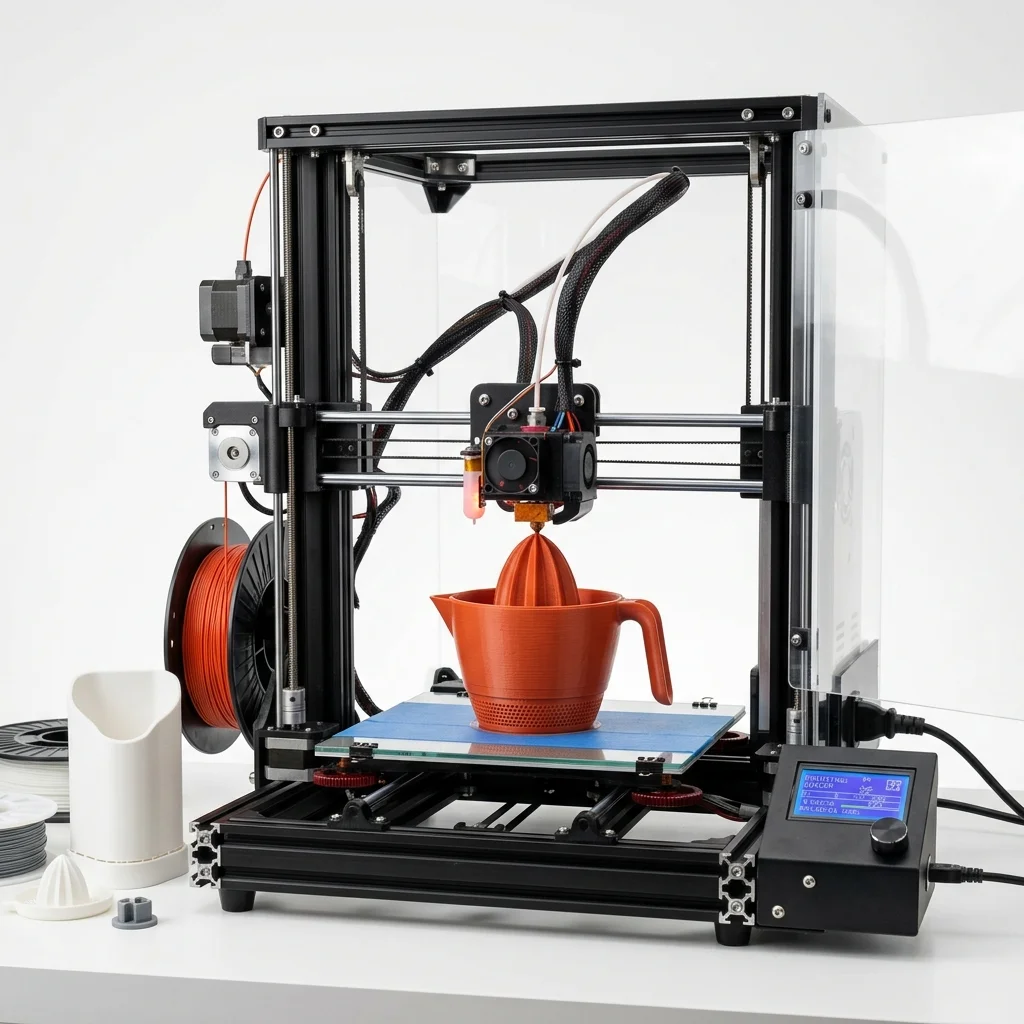
Kitchen working prototypes often require specific shapes and dimensions not easily found on the market. 3D printing allows you to create fully customized solutions for your kitchen, optimizing both space and functionality.
Advantages and Disadvantages
Pros:
- Full customization tailored to your specific kitchen needs
- Rapid manufacturing of unique and complex geometries
- Extremely low cost for single units or small batches
Cons:
- Requires additional coating (e.g., epoxy resin) for 100% food safety upon direct contact
- FDM layer lines can harbor moisture and bacteria if left untreated and unsealed
Workflow
Step 1: Design and 3D modeling based on your kitchen’s dimensions Step 2: Selecting the appropriate material (PETG or PP) and slicer preparation Step 3: 3D printing with optimal settings for mechanical strength Step 4: Post-processing (sanding and applying a food-safe sealing coating)
Financial Parameters (Cost Breakdown)
- FDM 3D printer investment: 1500
- Specialized filament costs: 100
- Post-processing supplies: 50
- Total: 1650
Frequently Asked Questions (FAQ)
Kitchen Working Prototypes Via 3D Printing Calculator
Interactive optimization calculator.
The full picture
This article is one page from The Big Book of 3D Printing: 704 illustrated pages covering every technology, material and fix in one reference.
Read it on Kindle →Engineer, author of The Big Book of 3D Printing and additive manufacturing expert