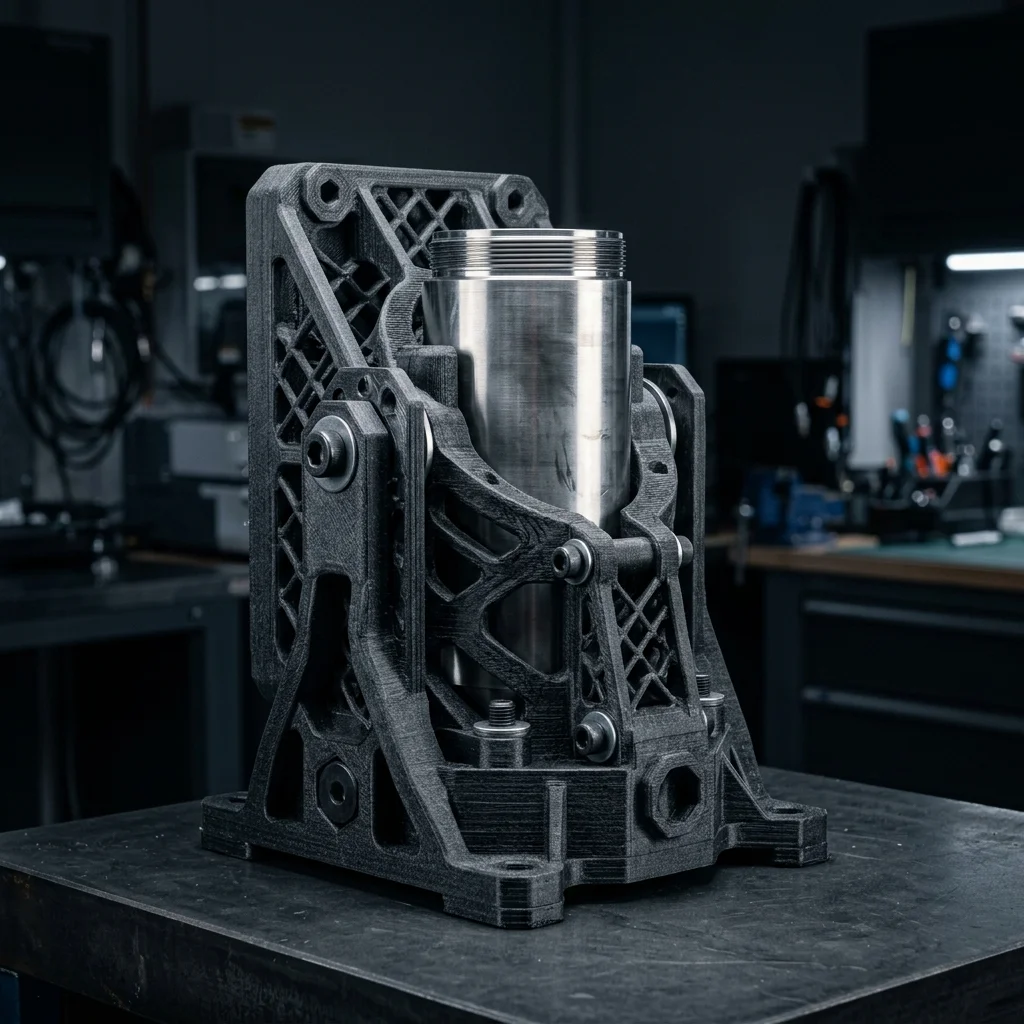
3D printing for Aerospace tools and jigs offers unprecedented flexibility and innovation in the manufacturing process. This technology is changing the way we design and create specialized components, providing speed, accuracy, and significant savings.
Pros and Cons of the Technology
Pros:
- Exceptional precision in manufacturing complex geometries.
- Reduced prototyping time from weeks to days.
- Ability to customize every single detail without additional tooling costs.
- Weight optimization through topological design.
Cons:
- Initial investment in industrial machines can be high.
- Need for specialized training for operators.
- Limitations in part size relative to the printer’s build volume.
Recommended Technologies and Materials
Choosing the right technology depends on the specific requirements of the end product. For Aerospace tools and jigs, we most often recommend Selective Laser Sintering (SLS) or Multi Jet Fusion (MJF) because of their excellent mechanical properties and surface quality.
Implementation Process
Step 1: Needs analysis and selection of suitable technology. Step 2: Designing or adapting existing 3D models for additive manufacturing. Step 3: Test printing and prototype validation. Step 4: Mass or batch production.
Cost Expectations (Example)
- Equipment Investment: 25000
- Staff Training: 1500
- Software Licenses: 3500
- Total: 30000
Frequently Asked Questions (FAQ)
3D Printing For Aerospace Tools And Jigs: Complete Guide Calculator
Interactive optimization calculator.
The full picture
This article is one page from The Big Book of 3D Printing: 704 illustrated pages covering every technology, material and fix in one reference.
Read it on Kindle →Engineer, author of The Big Book of 3D Printing and additive manufacturing expert
Updated on 5 August 2026
This article was written with AI assistance; the facts were checked against the sources on 5 August 2026.