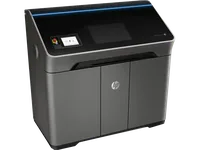
The HP Jet Fusion 580 is a compact industrial MJF machine built for R&D departments and small-series production that need functional polymer parts – not mere prototypes. With voxel-precise jetting, automatic nesting and a built-in coloring agent, the 580 delivers consistent isotropic mechanical properties without the post-processing headaches of FDM.
What it is
The Jet Fusion 580 is the entry-level machine in HP's MJF production line – compact and more accessible than the 5200/5600, yet identical in process physics. It operates on Multi Jet Fusion: a layer of PA12 (or PA11/PP/TPU) powder is spread, fusion and detailing agents are jetted with voxel precision, and infrared lamps cause selective sintering. The result is an isotropic, dense structure comparable to injection moulding in mechanical properties – something standard FDM cannot match. The 580 also carries a colour agent (CMYK) unique for this price class, making it attractive for functional colour printing as well.
Technical specifications
| Technology | MJF – Multi Jet Fusion (HP) |
|---|---|
| Build volume | 332 × 190 × 248 mm |
| Principle | Voxel-accurate jetting – fusion + detailing agent + IR lamps |
| Layer thickness | 0.08 mm (80 µm) |
| Colour | CMYK colour agent (up to ~16 million colours) |
| Post-processing | cooling → unpacking → bead blasting / tumbling |
| Class / Price | Industrial · ~€150 000 |
Applications and industries
- Functional prototypes – parts for real assembly, load-bearing and testing – MJF isotropic properties ensure behaviour close to the end product (Industrial design and mechanical engineering)
- Small-series production – HP Build Manager automatic nesting fills the full chamber volume and drives per-part cost down as batch size grows (Medical devices and consumer goods)
- R&D and rapid iteration – compact footprint and full automation enable overnight cycles – by morning engineers receive finished parts with zero manual intervention (Automotive and aerospace)
Production workflow
- Load and level the build unit; verify powder level in the supply reservoir. Build unit correctly seated – even powder layer distribution across the entire bed.
- Run the automatic Pre-Build Check in HP SmartStream 3D Build Manager (nesting, orientation, refresh rate estimate). Optimised part layout – maximised yield, minimised powder refresh cost.
- Start the MJF cycle: the machine automatically spreads layers, jets agents and activates the IR lamps. Autonomous printing without manual intervention – typical build 10–12 hours depending on volume.
- Wait for the cooling phase (Cooling Unit or natural cooling); unpack and send for bead blasting/tumbling. Parts with clean surface, ready for direct use or dyeing.
Key considerations
Materials and applications
Pick a material/alloy this machine processes to see its properties and typical applications:
Conclusion
The HP Jet Fusion 580 is a machine for those who need real parts, not display models. The MJF process delivers isotropic mechanical properties, automation eliminates the need for constant operator intervention, and the compact build volume makes it practical for R&D labs and OEM manufacturers running small series. The entry price is steep, but per-part cost at full build density is competitive with conventional manufacturing.
The full picture
This article is one page from The Big Book of 3D Printing: 704 illustrated pages covering every technology, material and fix in one reference.
Read it on Kindle →Engineer, author of The Big Book of 3D Printing and additive manufacturing expert
Updated on 5 August 2026
This article was written with AI assistance; the facts were checked against the sources on 5 August 2026.