

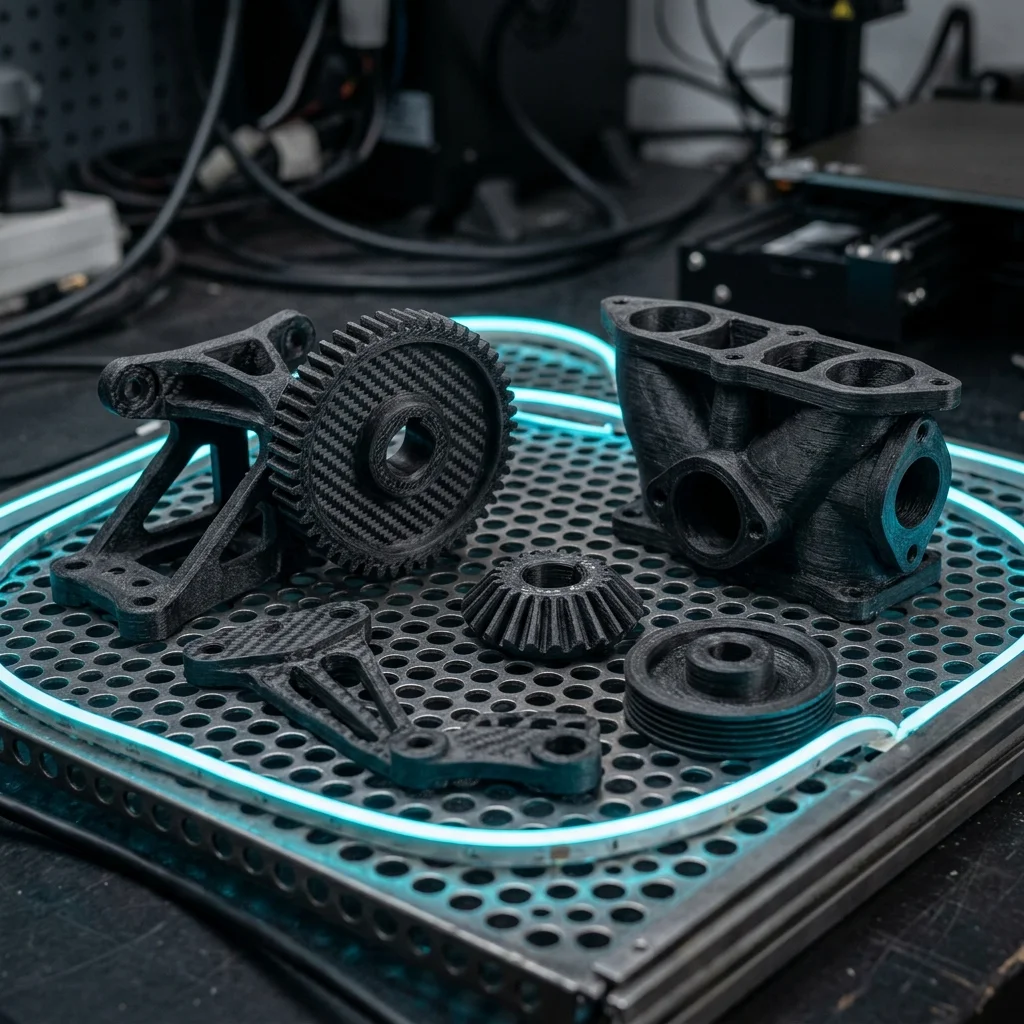
Engineering parts (gears, bearing housings, drone frames, replacements for industrial components, specialty tools, jigs & fixtures) are the strongest bridge between prototyping and real production. With the right tech (FDM with engineering filaments, SLS, or CFF) and material (Nylon, PA-CF, PEEK), 3D printed engineering parts withstand mechanical loads comparable to injection-molded ABS components. This guide shows which printers and materials we recommend for functional applications, when FDM is enough and when SLS or Markforged is needed, and how to evaluate cost vs alternatives.
When 3D print for engineering parts?
Three scenarios where 3D printing beats traditional production methods:
-
Small series (1-50 units): injection molding is economically impossible under 100-200 units. 3D print costs €5-€30/unit for an engineering part, vs €50-€200/unit for CNC machining or €5000+ setup cost for an injection mold.
-
Complex geometry: parts with internal channels (cooling fluids), gyroid infill (lightweight high-strength), organic structures (topology-optimized brackets), 3D printing achieves what CNC and injection molding can’t.
-
Rapid iteration: design → print → test → revise cycle in 2-4 hours vs weeks of traditional manufacturing. Critical for startups and R&D.
When traditional production wins: runs over 200 units (injection molding wins), parts under stress above 500 N/mm² (CNC milled steel/aluminum), food-safe materials in health-regulated markets.
Technologies for engineering parts
FDM with engineering filaments (PETG, ABS, Nylon, PA-CF): Bambu Lab X1-Carbon (€1449), Prusa MK4 with enclosure (€1329), Creality K1 Max (€800). Suitable for: brackets, housings, jigs, drone arms, replacement parts. Tensile strength up to 80 MPa (PA-CF). Cost: €5-€20 per functional part.
SLS (Selective Laser Sintering): EOS, 3D Systems sPro, HP Multi Jet Fusion (MJF). Prints PA12, PA11 powder without supports. Suitable for: production-ready end-use parts, small series (50-500 units). Tensile strength 48-55 MPa, isotropic (equal in every direction). Cost: €10-€40 per part. Hardware: €30,000+, typically outsourced.
CFF (Continuous Filament Fabrication): Markforged Mark Two/X7. Embedded continuous Kevlar/carbon/fiberglass during FDM print. Equivalent to CNC-machined aluminum in strength. Cost: €50-€300 per part. Hardware: €15,000+.
Metal 3D (SLM, DED, EBM): top-tier production: turbine blades, medical implants, aerospace. Not for hobbyists. Cost: €100-€2000 per part.
For most engineering needs: FDM with Bambu X1-Carbon + PA-CF filament is the sweet spot, production-ready at €1500 hardware investment + €70/kg filament.
Recommended materials by application
Gears: PA12 or PA-CF. PA12 for low-load (toys, kitchen mechanisms), PA-CF for industrial gearboxes. Avoid PLA (chips on impact), PETG (creeps under sustained load).
Bearing housings: PA12 for press-fits and tight assemblies. PA-CF when rigidity is critical (motor mounts).
Drone frames: PA-CF, stiffness near aluminum at 1/3 the weight. Specifically: Bambu PAHT-CF (€70/kg), Nanovia PA-CF (€80/kg), Markforged Onyx (Markforged only).
Replacement parts (for counter-strike or other tools): PETG for non-load-bearing, Nylon for load-bearing.
Jigs & fixtures (for CNC, assembly, paint masks): PETG for heat-sensitive, ABS for chemically-resistant, ASA for UV-resistant (outdoor jigs).
Threaded inserts: print with holes for heat-set inserts (Voxel, Yahboom), insert with soldering iron at 200°C. Resistant to thousands of mount/dismount cycles.
Food-contact: NO standard FDM plastics. Micro-pores trap bacteria. Only option: SLA with medical-grade resin + special coating.
Real examples, case studies
Drone arm replacement (DJI Phantom): PA-CF on Bambu X1-Carbon, 90-minute print, €4 material, replaces broken plastic arm versus €120 OEM parts.
Klipper printer accessories (mounts, fans): PA12 on Prusa MK4 with enclosure, 2-4 hour print, €2-€5 material, replaces laser-cut acrylic brackets.
Gearbox for DIY CNC: PA-CF gears (modulus 1.5, 30 teeth) on MK4, 6 hours per gear set, €20 material, equivalent to NEMA 17 stepper gearbox at €60.
Medical splints (custom orthoses): TPU 95A or nylon for wrist splints, prescribed by physiotherapist. NOT for consumer use, only with medical professional.
Industrial vacuum end-effectors: PA12 SLS or PA-CF FDM, custom shapes for specific palletizing robots. Production-ready, €30-€100 cost vs €500-€1500 metal CNC.
Replacement parts for vintage equipment (cars, motorcycles, kitchen appliances): PA-CF or ABS, reverse-engineered from broken part. €5-€50 cost vs unavailable OEM part.
Cost expectations + tips
FDM functional part:
- Filament cost: €0.20-€2 (10-100g typical)
- Printer amortization: €0.50-€2 per print hour
- Electricity: €0.05-€0.30
- Post-process labor: €5-€20
- Total: €5-€25 per part
SLS bureau print (Bulgaria): €15-€50 per part (no setup costs, small batches OK).
CFF (Markforged) outsourced: €50-€300 per part. Equivalent CNC-machined: €100-€500.
Quality tips:
- Always do 3-5 test prints before committing to a final part. 3D print tolerances vary ±0.1-0.3 mm.
- Use Cura/PrusaSlicer adaptive layers: 0.10 mm on details, 0.30 mm on body.
- Increase wall count on critical components to 5-6 perimeters (vs default 2-3).
- 100% infill only if really needed: 30% gyroid often is stronger than 100% rectilinear.
- Annealing PLA/PETG in oven at 80°C × 2 hours raises temperature resistance by 20-30°C.
Frequently Asked Questions (FAQ)
Interactive Analyzer for 3D Printing For Engineering And Functional Parts
Select a profile to view detailed analysis.
The full picture
This article is one page from The Big Book of 3D Printing: 704 illustrated pages covering every technology, material and fix in one reference.
Read it on Kindle →Engineer, author of The Big Book of 3D Printing and additive manufacturing expert