

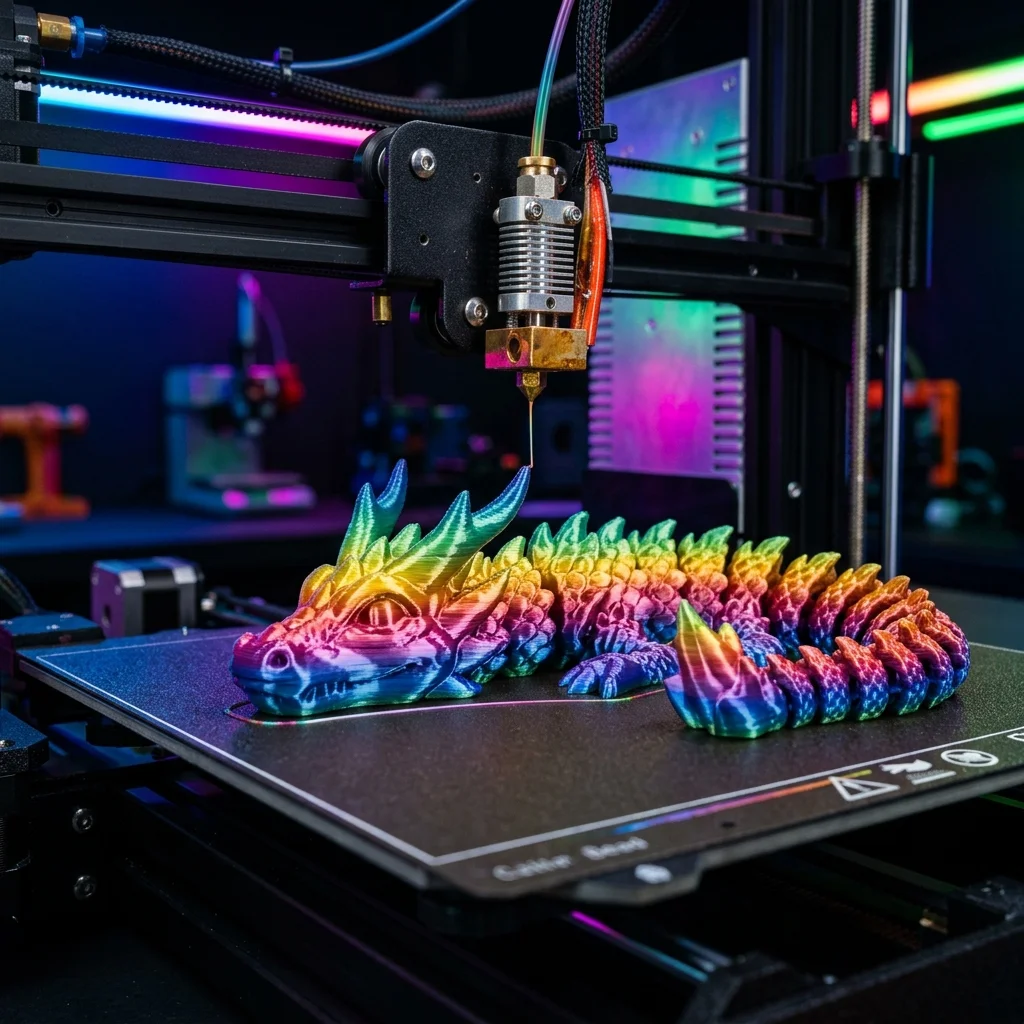
3D printing for toys and hobby use is growing fast, from parents making personalized toys for their kids to adult hobbyists collecting or selling miniatures in tabletop game stores. This application is one of the most welcoming for beginners: cheap printers, safe materials, simple projects, fast gratification. With €300-€500 you can get started and have your first printed toy within a week. In this guide we cover the safe materials for kids, which printers are most suitable for home use, how to make toys resistant to breaking, and what the legal requirements are if you decide to sell printed toys online.
Safe materials for children
Not every filament is safe in the hands of a child under 5. The EU toy standards (EN 71-3 for heavy metal migration) are strict – and not optimized for 3D-printed toys.
PLA: the safest standard filament. Made from corn starch, non-toxic, releases no harmful fumes during printing. The color pigments for toy-grade PLA must be certified (Polymaker PolyTerra PLA, Prusament PLA: guaranteed free of lead, cadmium, chromium). Cost: €25-€35/kg.
TPU 95A: flexible material for toys that kids chew on or throw. Doesn’t break easily, safe when in contact with the mouth (for occasional contact only, not food). Anycubic TPU and Polymaker PolyFlex: €40-€60/kg.
PETG (food-safe certified), for toys that might contact mouth or food (like toy cups, spoons). Only certified varieties: Polymaker PolyLite PETG Translucent, Prusament PETG in approved colors. WARNING: 3D-printed parts have micropores that can harbor bacteria. For truly safe chew toys, use injection-molded or cast pieces, not printed.
AVOID for toys for children under 5:
- ABS: releases styrene during printing, not recommended
- Nylon: may contain absorbed chemicals
- Carbon Fiber composites: small fragments can break off and become hazardous
- Resins: uncured UV residues are toxic; even after curing, not recommended for children under 6
Recommended home hobby printers
Bambu Lab A1 mini (€280): most suitable for beginner parents. Closed body for safety (kids can’t touch the hot end), auto-leveling, AMS lite for multi-color printing. Small 180×180×180 mm build volume is enough for most toys (figurines, Lego-like blocks).
Bambu Lab A1 (€420): next step up with a larger 256×256×256 mm build volume. Suitable for bigger toys like rockets, ships, castles.
Prusa MINI+ (€500): European quality with open source, everything easy to upgrade and repair. Small build area but extremely reliable.
Anycubic Kobra 3 Combo (€430): budget Bambu competitor with auto-leveling and a multi-color module.
Creality Ender 3 V3 KE (€330), for hobbyists who want a project that upgrades by hand. No closed body: not recommended for children under 8.
MSLA printer (Anycubic Photon Mono M5s (€368)) for more detailed toys and miniatures at high resolution. WARNING: resin is toxic before curing. NOT for kids under 14 without supervision.
For a home without a dedicated printer room: Bambu Lab A1 mini or A1 in a closed body in the living room is safe. MSLA printers require a separate ventilated room due to resin odor.
Designing durable toys
Toys for kids are in constant physical testing: falling from 1.5 m, being thrown, chewed, submerged in water. So they need a specific design.
Wall thickness: minimum 2 mm for toys for kids over 5, 3 mm for kids under 5. Below 2 mm: they break after the first drop.
Infill: 15-25% for miniatures (lower weight), 35-50% for toys for active play. Higher infill = more durable but heavier and more expensive.
Perimeters/walls: 3-4 for kid toys. This determines strength more than infill.
Edges and protrusions: avoid sharp angles. Round every edge with at least a 1 mm fillet. A child can be cut by a sharp edge on a 3D-printed part.
Small parts: if a toy has parts smaller than 25 mm in length (that could be swallowed), they must be structurally integrated (not removable) for kids under 3.
Colors: use filaments with toy-certified pigments. Electric (fluorescent) colors usually contain more pigment and should be avoided.
After printing: file all visible edges, wipe with a damp cloth, check for stray particles. Don’t hand a toy to a child without inspection.
Hobby modeling and collectibles
For adult hobbyists, 3D printing opens a new world of collecting. Active communities around Warhammer 40K, D&D, X-Wing, Star Wars Legion: all benefit from 3D-printed miniatures.
Warhammer 40K and similar tabletops: 28-32 mm miniatures. Recommended printer: MSLA (Anycubic Photon Mono M5s, Elegoo Saturn 3 Ultra). Resin: standard or tough resin. Print time: 2-4 hours for 5-10 miniatures in one build. Cost per miniature: €0.30-€0.80 in material (vs €10-€25 in store). WARNING: check local intellectual-property laws, Games Workshop has strict rules.
D&D miniatures and terrain: combination of FDM (for large terrains, bridges, towers) and MSLA (for figures). FDM 28 mm miniatures aren’t optimal: details blur. Better is MSLA for figures and FDM for bases.
RC modeling (cars, drones): FDM with PLA or PETG for bodies, MSLA for fine details (lights, sirens). See our separate page on 3D printing for RC models.
Doll houses and miniature scenes: FDM with PLA, scale 1:12 or 1:24. Standard FDM resolution (200 µm layer) is enough for most details.
Character collections: Pop! figurines, Funko-style, FDM with post-processing (primer, airbrush). See our separate page on 3D printing for art and design.
Legal requirements for selling printed toys
If you decide to sell 3D-printed toys as a small business online (Etsy, local marketplace), there are a few legal requirements.
1. CE marking: toys sold in the EU must have CE conformity certification under the Toy Safety Directive (2009/48/EC). This includes:
- Heavy metal migration testing (EN 71-3)
- Physical safety testing (EN 71-1)
- Flammability testing (EN 71-2)
Full testing cost: €1500-€4000 per product at a licensed lab (TÜV, SGS, Bureau Veritas).
2. Safety warnings, for toys for kids under 3, add a standard warning: ‘Warning! Not for children under 36 months. Choking hazard with small parts.’
3. Manufacturer identification: the toy must have a marking with the manufacturer’s name and address (or your online shop’s) and a batch number.
4. Registration, for regular commercial activity, register as a sole proprietor or LLC, report VAT/sales tax at the relevant local threshold.
Recommended strategy for beginners: sell as a hobby (below the local VAT-exempt threshold), do a few models with full CE testing, and build a reputation. Scale to full business after the first 50-100 orders.
Frequently Asked Questions (FAQ)
3D Printing For Toys And Hobby, Materials, Printers, Safety Calculator
Interactive optimization calculator.
The full picture
This article is one page from The Big Book of 3D Printing: 704 illustrated pages covering every technology, material and fix in one reference.
Read it on Kindle →Engineer, author of The Big Book of 3D Printing and additive manufacturing expert