

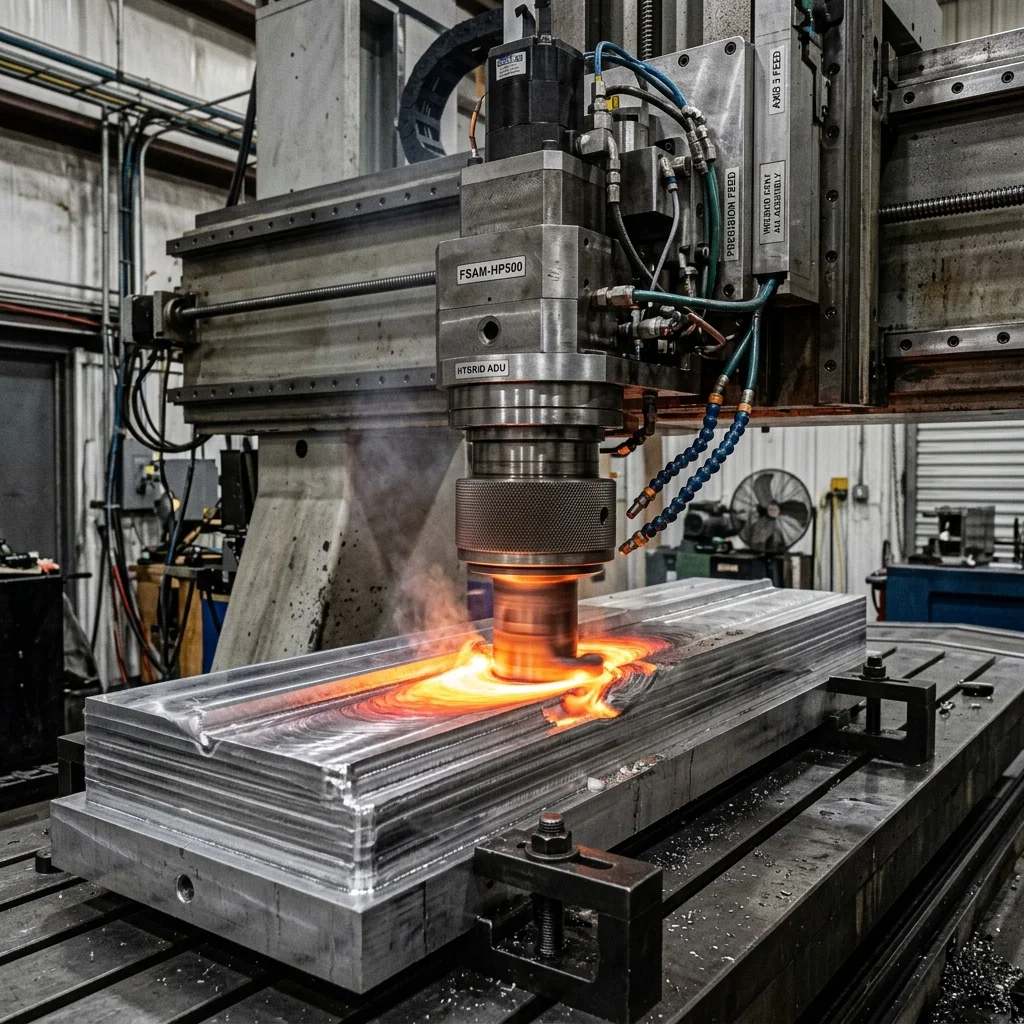
In 2025–2026, Friction Stir Additive Manufacturing (FSAM) combines the principles of friction stir welding (FSW) with layer-by-layer deposition to create large metal structures with excellent mechanical properties and zero porosity. Unlike laser or arc-based AM processes, FSAM bonds metal in the solid state: no melting, no gas pores, no hot cracking.
Operating Principle
- Rotating Tool: A hardened steel or tungsten tool with a shoulder surface and central pin rotates at 500–2000 RPM.
- Frictional Heating: Contact with a metal plate/strip generates temperatures of 70–90% of the melting point, sufficient for plasticization but not melting.
- Plastic Deformation and Mixing: Plasticized metal is “stirred” by the rotating tool, creating a metallurgical bond between layers.
- Layer-by-Layer Deposition: Metal strips or plates are stacked and bonded via FSAM, building volumetric structures.
Interactive Filament Selector
Answer 3 quick questions and find the optimal material for your project.
1. What are the mechanical requirements for the part?
2. What temperature will the part operate at?
3. Are there any specific environmental requirements?
Our recommendation:
PLA filament
Ideal for easy printing, model visualization and decorative parts.
Mechanical Properties
| Property | FSAM Al 6061-T6 | Conventional Al 6061-T6 |
|---|---|---|
| Ultimate Tensile Strength | 280 – 310 MPa | 310 MPa |
| Yield Strength | 240 – 270 MPa | 276 MPa |
| Elongation | 12% – 16% | 12% – 17% |
| Porosity | 0% (solid-state) | 0% |
Pros and Cons
Pros:
- Zero Porosity: Solid-state process eliminates gas pores.
- Excellent Properties: Comparable to conventional wrought alloys.
- No Shielding Gas: No inert atmosphere required.
Cons:
- Low Resolution: Minimum wall thickness ~5 mm.
- Limited Materials: Primarily aluminum, copper, and softer metals.
- Tool Wear: Rapid wear with harder materials.
FAQ
Friction Stir Additive Manufacturing (Fsam): Solid-State Metal Deposition Calculator
Interactive optimization calculator.
The full picture
This article is one page from The Big Book of 3D Printing: 704 illustrated pages covering every technology, material and fix in one reference.
Read it on Kindle →Engineer, author of The Big Book of 3D Printing and additive manufacturing expert