

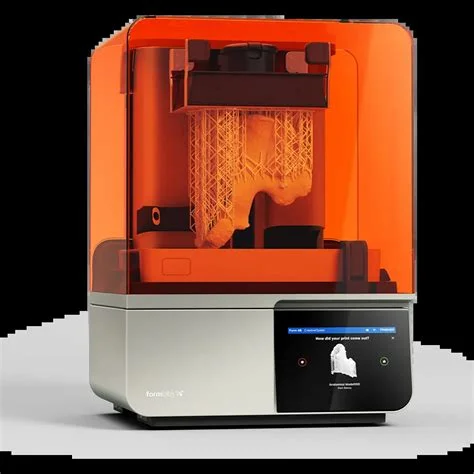
The Formlabs Form 4 is a professional MSLA/LFD printer with an LED panel that delivers up to 2× faster printing than its predecessor. The closed ecosystem with PreForm slicer and cartridge system automatically optimizes every print: no manual settings required. With a 200×125×210 mm build volume and an extensive library of engineering, biomedical and castable resins, the Form 4 is the benchmark for desktop professional resin printing.
What it is
The Form 4 uses Low Force Display (LFD) technology: an advanced MSLA architecture with a high-density LED panel and optimized optical stack that reduces peel forces and enables fast curing cycles. The machine operates entirely within a closed ecosystem: PreForm automatically reads material parameters directly from the cartridge and configures layers, exposure times and supports without user input. Finished parts require mandatory washing in the Form Wash and post-curing in the Form Cure. The Form 4 targets engineers, dental labs, jewelers and R&D teams that demand excellent precision, repeatability and a professional workflow.
Technical specifications
| Technology | MSLA / LFD (LED panel, closed ecosystem) |
|---|---|
| Build volume | 200 × 125 × 210 mm |
| Light source | High-density LED panel (LFD optical stack) |
| Print speed | up to ~2× faster than Form 3: typically 3–4 cm/h |
| Material system | cartridge-based (PreForm reads parameters automatically) |
| Slicer | PreForm (automatic optimization, no manual settings) |
| Class / Price | Professional · ~€4,200 |
Applications and industries
- Engineering prototypes and functional parts: fast iteration of form, fit and mechanical function using engineering resins (Tough 2000, Rigid 10K, Durable) with sub-0.1 mm detail (Industrial design and R&D)
- Dental and medical: surgical guides, dental models, splints and orthodontic devices from biocompatible and BioMed resins approved for clinical use (Dental and medical industry)
- Jewelry and castable models (precise wax and castable models for direct lost-wax casting) no surface finishing required (Jewelry and casting)
Production workflow
- Insert the resin cartridge and tank: PreForm reads the material parameters automatically. Correct exposure and layer settings with no manual input.
- Send the model to the Form 4 via PreForm: the slicer automatically generates supports and distributes layers. Optimized supports and minimal post-processing.
- After printing, wash parts in the Form Wash with isopropyl alcohol (IPA) for the resin-specific recommended time. Uncured resin removed for safe and accurate surfaces.
- Post-cure in the Form Cure at the material-specific temperature and duration. Full polymerization achieved: maximum strength and mechanical properties reached.
Key considerations
Materials and applications
Pick a material/alloy this machine processes to see its properties and typical applications:
Conclusion
The Form 4 is the right choice when precision, repeatability and a broad library of certified materials matter more than consumable cost. The closed ecosystem eliminates manual settings and makes the machine reliable in a production environment, from engineering prototypes to dental laboratories. If you need the flexibility of third-party resins or a lower material spend, consider open-source MSLA alternatives; if you want “press print and get clinical-grade quality”: the Form 4 is the benchmark.
The full picture
This article is one page from The Big Book of 3D Printing: 704 illustrated pages covering every technology, material and fix in one reference.
Read it on Kindle →Engineer, author of The Big Book of 3D Printing and additive manufacturing expert