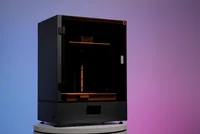
The Peopoly Forge is a powerful industrial-grade MSLA/LCD printer with an open ecosystem, engineered for production environments demanding high accuracy and reliability. With a 330 × 185 × 400 mm build volume, a mono 4K LCD screen and compatibility with a wide range of third-party resins, the Forge is built to serve dental labs, jewellery studios and engineering teams without compromise.
What it is
The Forge is Peopoly's flagship MSLA printer: a company with a long history in SLA/MSLA technology and an open approach to materials. Unlike mass-market consumer resin printers, the Forge is built on an industrial frame, with a high-power UV LED array and a rigid Z-axis mechanism for repeatable production runs. The "open ecosystem" means the machine works with any 405 nm resin without locking users to a single brand: a critical advantage for labs optimising materials for specific properties. The machine targets dental clinics, jewellery casting studios, engineering prototyping departments and small-batch manufacturers requiring repeatability within ±0.05 mm.
Technical specifications
| Technology | MSLA / Mono LCD (405 nm UV) |
|---|---|
| Build volume | 330 × 185 × 400 mm |
| LCD screen | mono 4K, 10 inch |
| XY resolution | ≤ 50 µm |
| Z resolution (layer) | 25 – 200 µm |
| Resin compatibility | open: any 405 nm resin |
| Class / Price | Industrial · ~€15 000 |
Who it’s for
- High-detail industrial prototypes (verification of form, fit and aesthetics at sub-50 µm resolution) detail levels impossible with FDM (Product design and R&D)
- Dental appliances: surgical guides, crown-and-bridge models, temporary prosthetics from biocompatible dental resins (Dentistry)
- Jewellery and lost-wax casting: wax or castable resin masters for precision casting of gold, silver and platinum (Jewellery industry)
- Engineering parts from functional resins: functional components from ABS-like, tough or heat-resistant resins for mechanical loading (Mechanical engineering and aerospace)
Setup and calibration
- Level the build plate manually or using the built-in procedure: paper test at all 4 corners. Uniform gap between the plate and FEP/nFEP film ensures first-layer adhesion.
- Run an exposure validation test (Exposure Validation Matrix or R_E_R_F test) for the specific resin. Optimal Base Exposure Time found: no under-curing or loss of detail from over-exposure.
- Inspect the FEP/nFEP film for fogging, scratches or punctures: replace if needed. A clean transparent film ensures even UV transmission and easy layer release.
- Check the resin level in the vat: top up to the recommended minimum before starting. Adequate resin prevents dry layers and the print sticking to the film.
Common defects and fixes
Resin exposure helper
Pick a resin type for starting exposure values (typical for mono-LCD machines). These are STARTING points: always run an exposure test, because the exact seconds depend on your screen power and the specific resin:
Conclusion
The Peopoly Forge is the choice for organisations where accuracy and repeatability are production requirements, not bonuses. The open resin ecosystem gives freedom to optimise the material for the application, while the industrial build handles multi-shift operation. If the budget allows for industrial class and the tasks are dental, casting or precision engineering parts: the Forge is justified.
The full picture
This article is one page from The Big Book of 3D Printing: 704 illustrated pages covering every technology, material and fix in one reference.
Read it on Kindle →Engineer, author of The Big Book of 3D Printing and additive manufacturing expert
Updated on 11 September 2026
This article was written with AI assistance; the facts were checked against the sources on 11 September 2026.