

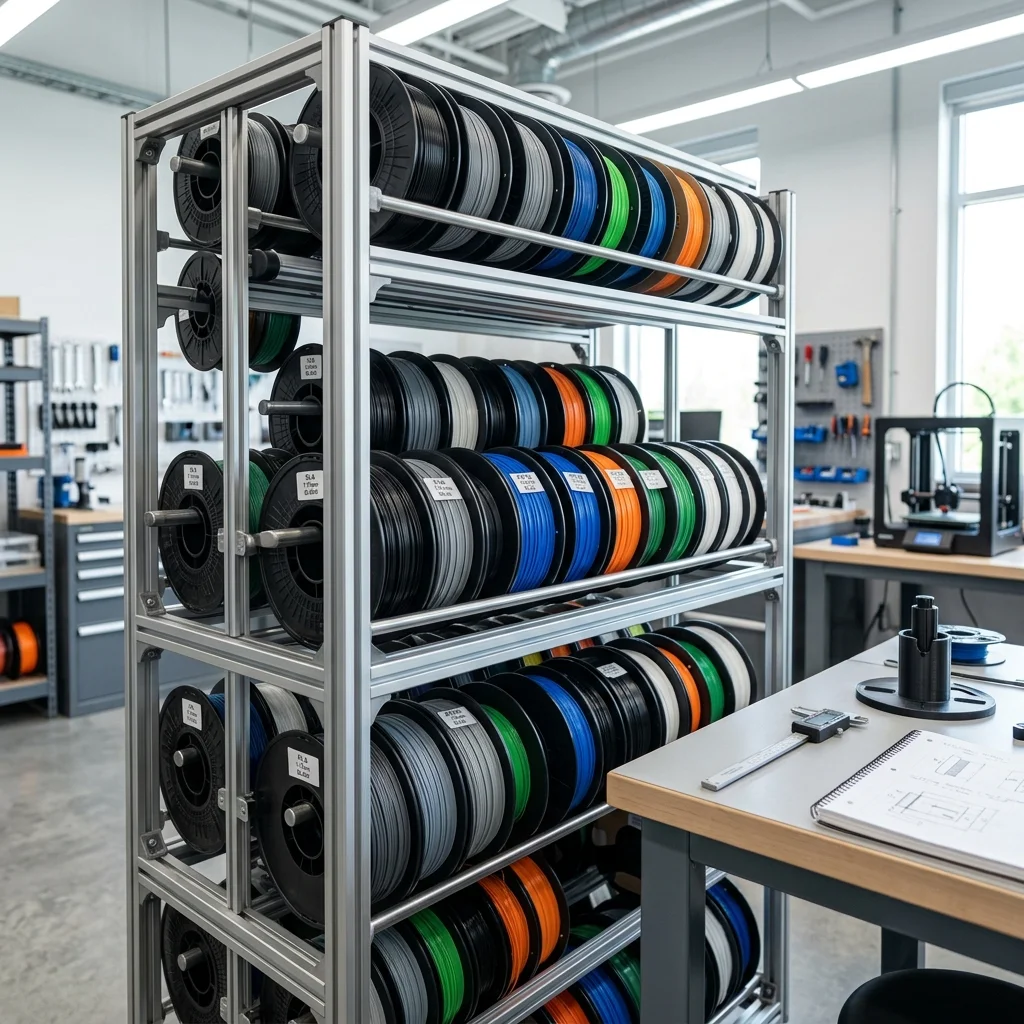
In the world of additive manufacturing, we often fixate on machine kinematics, software algorithms, and hardware modifications. Yet, one of the greatest saboteurs of print quality remains entirely invisible: moisture. Filament storage is not merely a logistical chore; it is a fundamental physicochemical process that underpins the success or failure of any precision-printed part.
At EduFacturing, we believe that understanding micro-level processes is the key to unlocking industrial-grade quality. When we leave polymers to the mercy of atmospheric conditions, we are actively allowing their chemical properties to degrade. In this article, we will dissect the science behind material degradation and architect a storage strategy worthy of any high-tech laboratory.
The Invisible Enemy: Understanding Polymer Hygroscopy
Most FDM/FFF thermoplastics are hygroscopic: they actively absorb water molecules from their environment. With engineering materials like Nylon (PA), TPU, and Polycarbonate (PC), moisture penetrates deep into the polymer matrix. When this water-logged material reaches the hotend (typically between 200°C and 300°C), the trapped water vaporises instantly. This triggers micro-explosions (the 'popping' phenomenon), leading to internal voids, severe surface pitting, and inconsistent extrusion. Even more destructive is hydrolysis. Under prolonged exposure to moisture, water molecules can physically sever polymer chains. This chemical degradation dramatically reduces material strength, increases brittleness (even in seemingly benign PLA), and lowers the glass transition temperature (Tg). The result is a part that fundamentally fails to meet its engineering specifications.
Storage Architecture: Active vs. Passive Systems
To preserve the structural integrity of your filaments, the ambient Relative Humidity (RH) must be strictly maintained below 20%. We achieve this through two main architectural approaches: passive and active systems. Passive systems rely on airtight containers equipped with desiccants or vacuum-sealed bags. These are excellent for long-term archival of unused spools. Active systems, however, utilize thermal control and continuous air circulation. For advanced engineering polymers, utilizing an active dry box that feeds filament directly into the extruder during printing is not a luxury: it is a necessity. Without it, a perfectly dried spool of Nylon can absorb a critical threshold of moisture within mere hours in an open room environment.
The Desiccant Hierarchy: Beyond Silica Gel
We are all familiar with classic silica gel: the industry standard that is inexpensive, easily regenerated, and highly effective. (Pro tip: always opt for orange color-indicating gel, as the blue variant contains toxic cobalt chloride). But for uncompromised quality, we must look toward industrial-grade alternatives. Molecular Sieves are synthetic zeolites with microscopic, precisely tuned pores that can drive humidity down to <1% RH. They perform exceptionally well at higher temperatures and, though requiring intense heat for regeneration, offer unmatched absorption capabilities. Activated Alumina is another powerhouse; its highly porous structure allows it to absorb up to 20% of its own weight in water, making it the premier choice for specialized deep-drying cabinets.
Workflow Integration for Zero Defect Manufacturing
An industrial mindset demands rigorous protocols. It is a misconception that factory-sealed filament is dry: vacuum packaging often merely locks existing manufacturing moisture inside. Therefore, the first step in any serious facility is the preemptive thermal dehydration of new spools using a dedicated filament dryer or modified food dehydrator. Integrate digital hygrometers into every storage module to establish continuous microclimate monitoring. Adopt a strict FIFO (First-In-First-Out) inventory system, clearly logging the 'open date' of every spool. Couple this with inline filament dust filters, and you will effectively eliminate 90% of the variables responsible for nozzle clogs, layer adhesion failures, and structural defects.
Conclusion
Total control over your operating environment is the defining line between a hobbyist endeavor and professional additive manufacturing. Optimizing your filament storage is an investment in predictability, repeatability, and ultimate part quality. At EduFacturing, we will continue to provide the 'picks and shovels': the deep technical knowledge you need to build the next generation of hardware innovation.
The full picture
This article is one page from The Big Book of 3D Printing: 704 illustrated pages covering every technology, material and fix in one reference.
Read it on Kindle →Engineer, author of The Big Book of 3D Printing and additive manufacturing expert