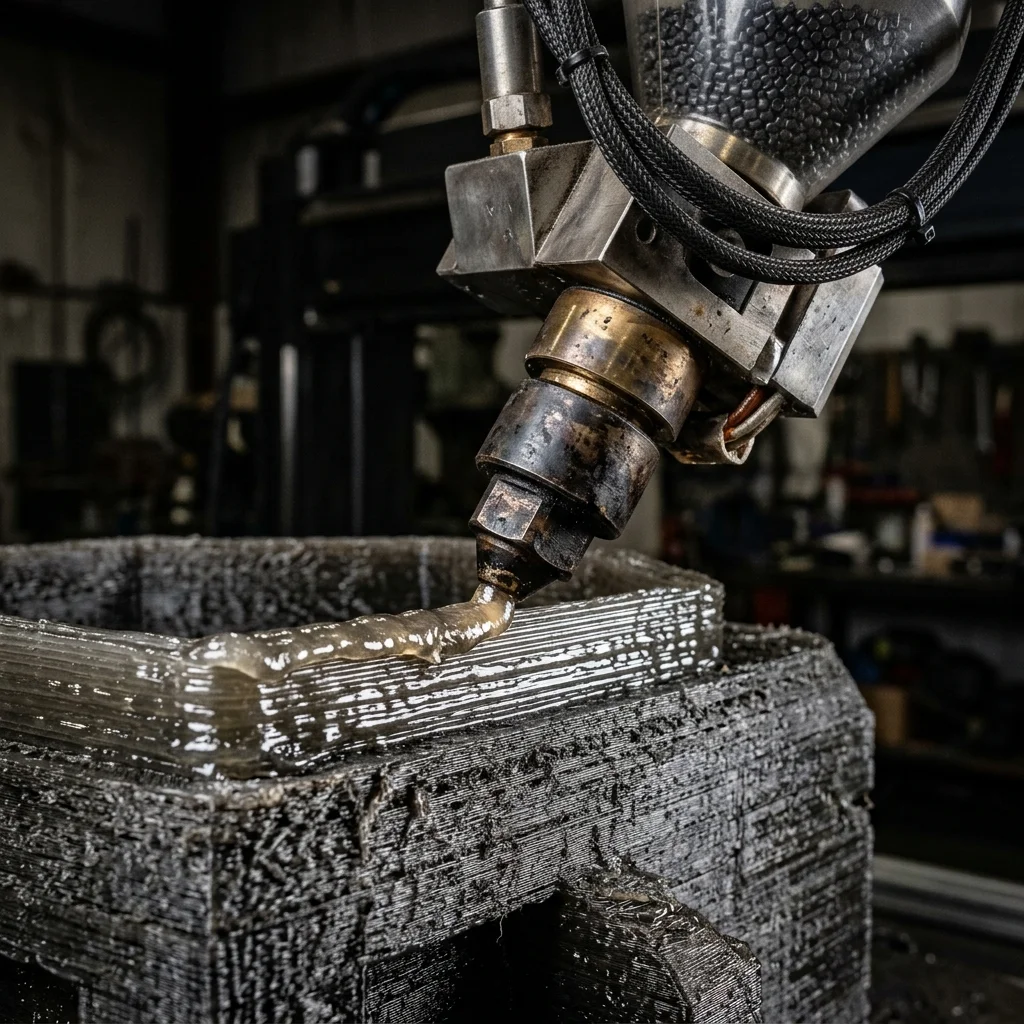
Fused Granular Fabrication (FGF) technology opens the door to fast and economical manufacturing of large-scale parts using plastic pellets. PETG (Polyethylene Terephthalate Glycol) is an exceptionally popular choice for this process.
PETG combines the ease of printing found in PLA with the strength and durability of ABS. It offers excellent chemical resistance, good thermal durability, and minimal warping, making it ideal for large industrial components.
In this guide, we will explore the specifics of FGF printing with PETG, recommend the best printers and material brands, and show you how to optimize the process.
Why PETG is an Excellent Choice for FGF Technology
FGF (Fused Granular Fabrication) allows the extrusion of massive amounts of melted plastic in a short time. PETG pellets are perfect for this process as they have a wide processing temperature window and excellent flowability.
In large-scale printing, interlayer adhesion is critical. PETG is renowned for its incredible layer bonding, ensuring that massive parts are exceptionally strong and watertight.
Furthermore, the material does not emit unpleasant odors or toxic fumes during melting, which eases ventilation requirements in the manufacturing facility.
-
Exceptional Strength: PETG components are resistant to impact and mechanical stress, making them suitable for functional parts.
-
Chemical Resistance: The material withstands contact with oils, acids, and bases, ideal for industrial containers.
-
Minimal Warping: Unlike ABS, PETG does not require a highly heated chamber and resists warping even in large formats.
Recommended 3D Printers for FGF with PETG
To successfully print PETG pellets, you need a reliable system with a powerful extruder and a stable heated bed. Here are some of the best machines on the market:
-
CEAD AM Flexbot: An industrial robotic printer that offers immense freedom of movement, perfect for large-scale PETG parts.
-
3D Systems (Titan) Titan Atlas 3.6: Offers superb extrusion control and an enclosed chamber, which further improves the quality of PETG prints.
-
Pollen AM Pam Series P: A high-precision system capable of processing industrial pellets with extraordinary accuracy and repeatability.
Recommended Material Brands and Processing Parameters
Although FGF printers can work with standard injection-molding pellets, choosing specialized 3D printing granules guarantees higher quality and absence of impurities.
The following brands have proven their quality in producing high-grade PETG materials:
-
Prusa Research Prusament PETG: Known for strict quality control and consistency in melting parameters.
-
Fiberlogy Fiberlogy PETG: Offers excellent transparency and high strength, ideal for technical applications.
-
Sunlu Sunlu PETG: A budget-friendly option that provides excellent flowability and ease of printing.
Key parameters for printing with PETG pellets:
Extruder Temperature: 230°C – 250°C
Bed Temperature: 70°C – 90°C
Recommended Speed: 40 – 120 mm/s
Cooling: 30% – 50% (or off for maximum strength)
Applications, Challenges, and Cost Estimates
PETG pellets are favored for producing custom containers, protective housings, robotic grippers, and large functional prototypes. Their watertight nature also makes them suitable for outdoor applications.
The main challenge with PETG is its tendency to absorb moisture (hygroscopy). Wet pellets lead to poor surface quality, stringing, and brittle parts. It is mandatory to dry the pellets before processing.
Additionally, PETG can adhere too strongly to certain build surfaces like glass. Use a release agent (such as glue stick) to avoid damaging the print bed.
-
Functional Prototypes: Parts requiring durability and flexibility prior to mass production.
-
Industrial Containers: Tanks and trays requiring chemical resistance.
-
Tooling: Production of manufacturing jigs and fixtures for assembly lines.
Frequently Asked Questions (FAQ)
Fgf 3D Printing With Petg | Granular Thermoplastics Guide Calculator
Interactive optimization calculator.
The full picture
This article is one page from The Big Book of 3D Printing: 704 illustrated pages covering every technology, material and fix in one reference.
Read it on Kindle →Engineer, author of The Big Book of 3D Printing and additive manufacturing expert
Updated on 27 June 2026
This article was written with AI assistance; the facts were checked against the sources on 27 June 2026.