

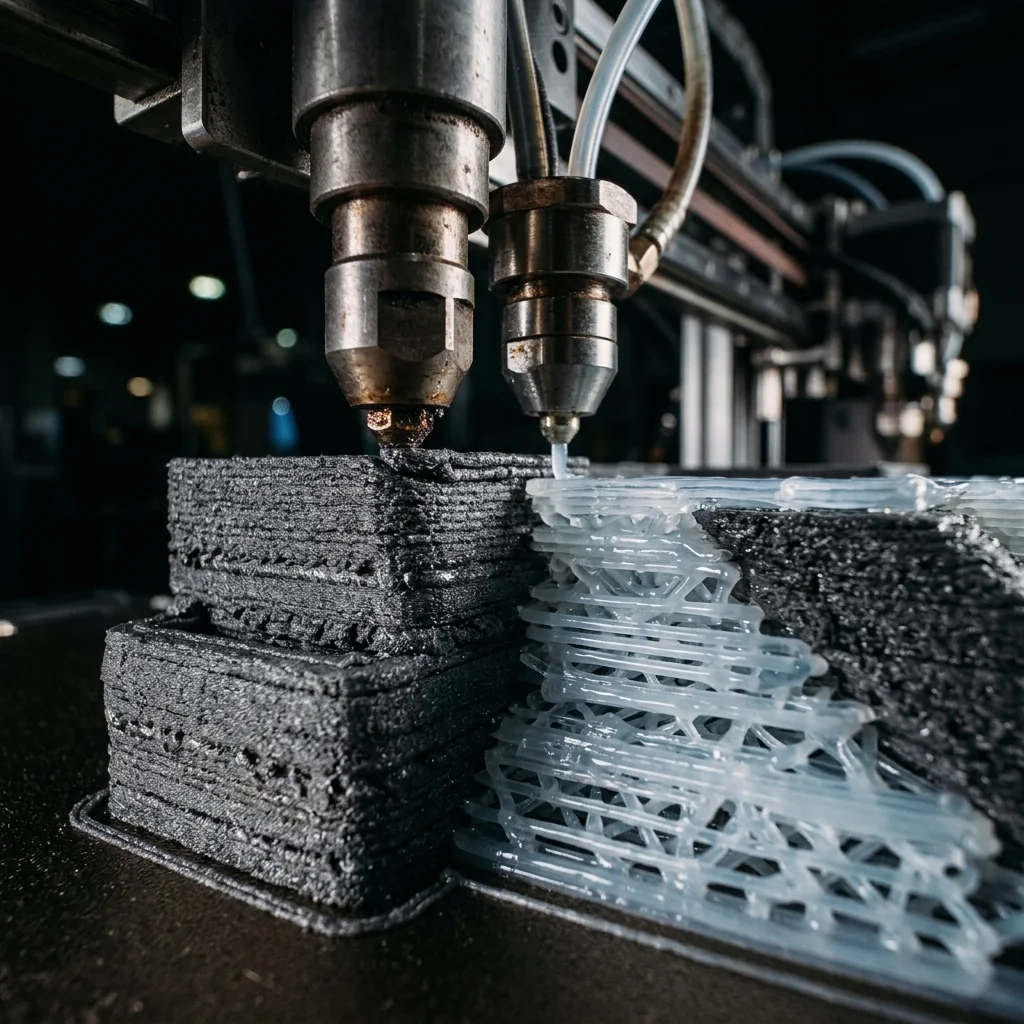
FGF (Fused Granular Fabrication) technology offers a revolutionary approach to large-scale 3D printing. By directly extruding polymer granules instead of traditional filament, much higher build speeds are achieved at significantly lower material costs. This article explores how combining FGF with soluble support materials like HIPS and PVA opens new possibilities for creating complex geometries in massive parts.
Understanding FGF Technology
FGF utilizes a system with a feeding hopper and a specialized screw that directly melts and extrudes thermoplastic granules. This method bypasses the filament manufacturing process, reducing costs and allowing the use of industrial-grade polymers.
When we combine the power of FGF with soluble materials like HIPS (High Impact Polystyrene) and PVA (Polyvinyl Alcohol), we can build support structures that enable the printing of overhangs, internal channels, and complex assemblies.
Why HIPS and PVA Fit This Technology Perfectly
-
Easy Removal: HIPS dissolves in D-Limonene (a citrus solvent), and PVA is completely water-soluble. This eliminates the laborious and sometimes risky mechanical removal of supports.
-
Perfect Compatibility: HIPS is an excellent support material for ABS, as both polymers share similar melting temperatures. On the other hand, PVA is an ideal partner for PLA and other low-temperature materials.
-
Smooth Contact Surface: Dissolving the supports leaves the surface of the main model exceptionally smooth, reducing the need for extensive post-processing.
Recommended FGF Printers for HIPS and PVA
To print a successful model with soluble supports, a dual-extrusion FGF system or a robotic arm with fast tool changing is required.
-
CEAD AM Flexbot: An industrial system based on a Comau robotic arm. It offers incredible flexibility and can be configured to operate multiple extruders simultaneously.
-
3D Systems (Titan) Titan Atlas 3.6: A massive industrial platform with a large build volume (up to 1.2 x 1.2 x 1.2 meters) that supports simultaneous printing with pellets and filament.
-
Pollen AM Pam Series P: Offers precise dosing of different materials. The Pam system is known for its ability to extrude up to four different materials (in pellet form) into a single part.
Recommended Material Brands
Although the materials are supplied as granules, market leaders offer high-quality soluble solutions.
-
UltiMaker PVA+: A premium water-soluble material optimized for stable adhesion to various polymers and rapid dissolution.
-
Zortrax HIPS: Excellent dimensional stability and guaranteed easy dissolution in D-Limonene. Suitable for industrial components.
-
Formfutura AquaSolve PVA: A versatile PVA material that performs reliably in large-scale projects and offers good thermal stability.
Typical Applications and Use Cases
The ability to print large parts with complex internal structures makes FGF perfect for various industries.
-
Complex Casting Molds: Producing molds with integrated cooling channels that are later dissolved and removed.
-
Architectural Models and Sculptures: Building massive structures with large overhangs without the risk of collapsing during printing.
-
Functional Assemblies: Printing fully functional mechanisms ‘in place’, where the supports between moving parts are simply washed away post-print.
Common Pitfalls and Best Practices
-
Moisture Management: PVA is highly hygroscopic (absorbs moisture from the air). Always store the granules in specialized drying systems.
-
Nozzle Clogging: Avoid prolonged heating of PVA material in the nozzle when not extruding. It can easily carbonize and block the screw.
-
Temperature Control: When working with HIPS and ABS, ensure a well-heated closed printer chamber to prevent uneven shrinkage and layer delamination.
Technical Specifications and Cost Estimate
Printing Temperature (PVA): 190 – 210 °C
Printing Temperature (HIPS): 230 – 250 °C
Bed Temperature: 60 – 110 °C (depending on the base material)
PVA Granules Price: 40 – 80 EUR/kg
HIPS Granules Price: 15 – 30 EUR/kg
Frequently Asked Questions (FAQ)
Fgf 3D Printing With Hips And Pva: A Complete Guide Calculator
Interactive optimization calculator.
The full picture
This article is one page from The Big Book of 3D Printing: 704 illustrated pages covering every technology, material and fix in one reference.
Read it on Kindle →Engineer, author of The Big Book of 3D Printing and additive manufacturing expert