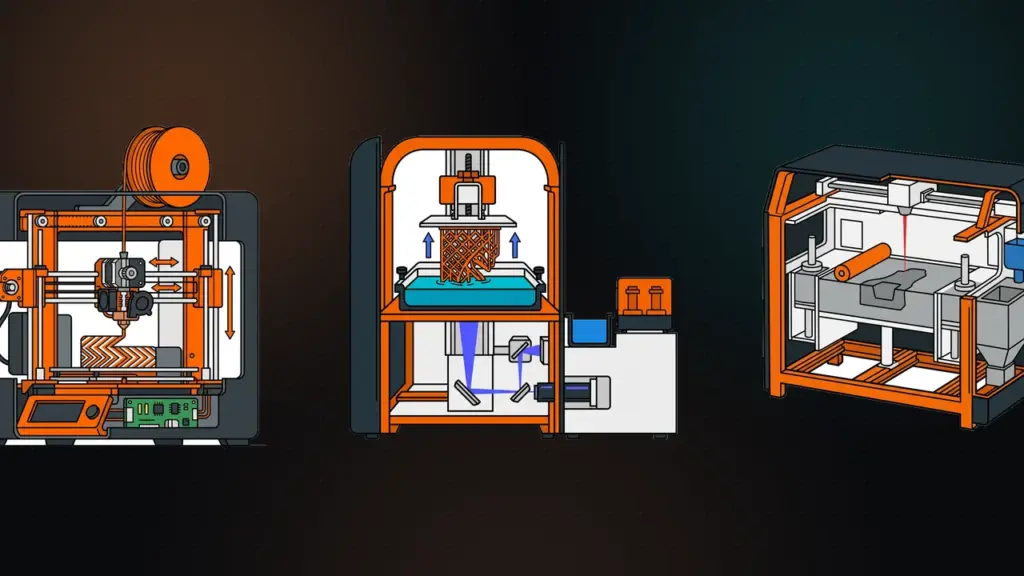
FDM, SLA and SLS are the three most common 3D printing technologies – all three build layer by layer, but in entirely different ways. The choice between them determines the detail, strength, cost and complexity of the final part. This comparison will help you decide which is right for your specific project.
How each technology works
FDM
A heated nozzle melts thermoplastic filament and deposits it layer by layer. A simple, reliable and cheap principle.
SLA
UV light (a laser) cures liquid resin point by point. Exceptional precision and a smooth surface.
SLS
A laser sinters powdered nylon. The powder itself supports the part – no supports needed.
Detail and surface
SLA wins convincingly – resin prints have the finest detail and smoothest surface, ideal for miniatures and precise models. SLS gives good detail with a slightly grainy surface. FDM shows visible layers but is perfectly sufficient for functional parts.
Strength and functionality
Here the picture flips. SLS parts are the strongest and isotropic (equally strong in all directions). FDM is strong along the layers but weaker between them. Standard SLA resins are more brittle, although tough engineering resins exist too.
Cost and accessibility
- FDM – cheapest for machine and material; minimal post-processing.
- SLA – affordable machines, but requires washing and post-cure UV; handling liquid resin.
- SLS – industrial machine price, but no supports and high throughput for series.
Quick decision rule
Need a strong functional part at low cost → FDM. Need maximum detail (miniatures, dental, jewellery) → SLA. Need complex shapes or a series of tens/hundreds of parts → SLS.
When to use which
Choose FDM if…
Prototypes, enclosures, brackets, mechanical parts, hobby, education, budget first.
Choose SLA if…
Miniatures, jewellery, dental models, presentation prototypes, fine detail.
Choose SLS if…
Complex geometries, moving assemblies, durable functional parts, small series.
Next step
Now that you know the differences, browse real machines by technology in the printer catalog and compatible materials. For a full overview of all methods see the types of 3D printing technologies, and for beginners – FDM for beginners. If you need a part in a specific technology without a machine – our services cover FDM and SLA, with metal on request.
The full picture
This article is one page from The Big Book of 3D Printing: 704 illustrated pages covering every technology, material and fix in one reference.
Read it on Kindle →Frequently asked questions
What is the difference between FDM, SLA, and SLS 3D printing?
Which 3D printing technology produces the best surface finish and detail?
Which 3D printing technology is strongest?
Which 3D printing technology should I choose for my project?
Engineer, author of The Big Book of 3D Printing and additive manufacturing expert
Updated on 30 May 2026
This article was written with AI assistance; the facts were checked against the sources on 30 May 2026.