

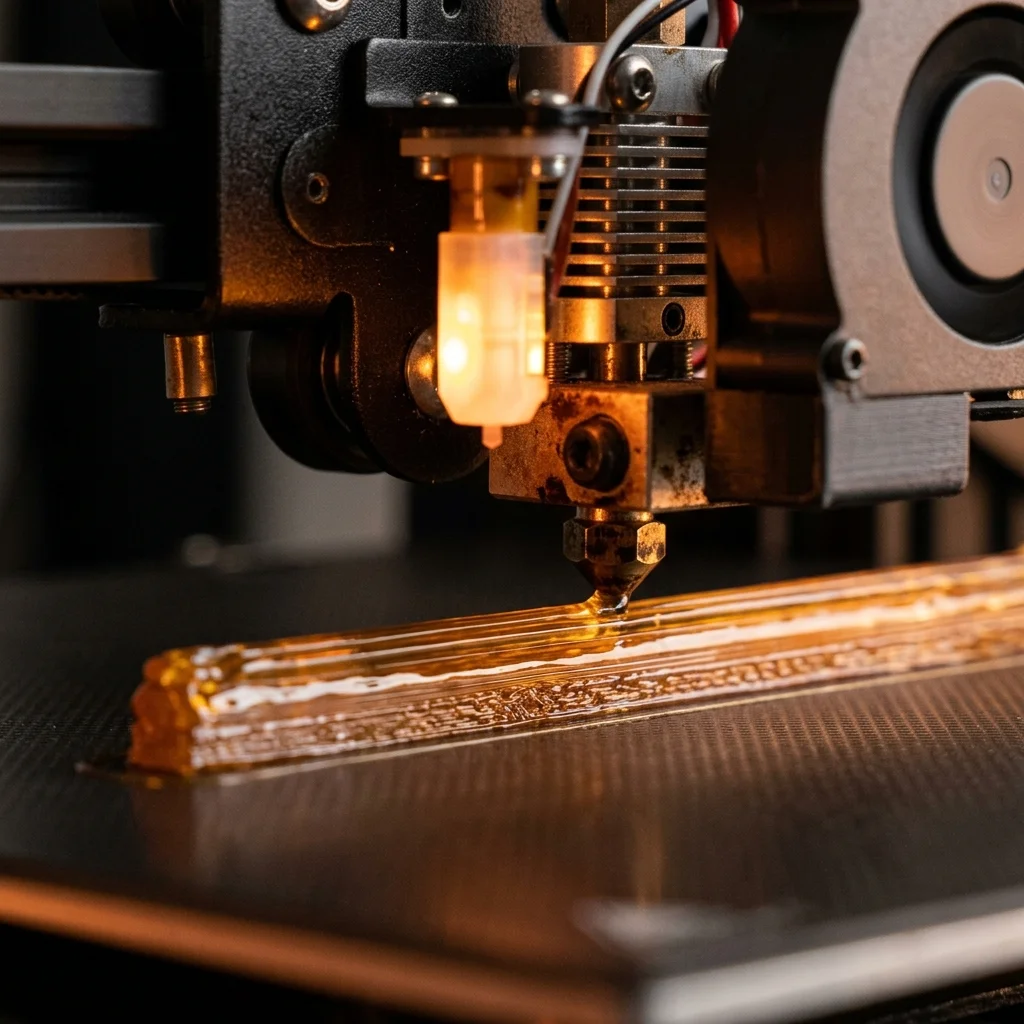
PETG (polyethylene terephthalate glycol) is the material most FDM owners try after their first PLA projects. It’s tougher, more heat-resistant, doesn’t crack at sharp corners, and is almost as easy to print as PLA. PETG is the standard for functional parts that will live in real environments: electronics enclosures, brackets, fittings for fluids, even food-safe containers (food-safe grades). This guide compares PETG to PLA and ABS, shows optimal settings, and recommends specific printers and brands.
Why PETG over PLA or ABS
PLA is easy but brittle and softens at 55-60°C. ABS is tough but needs an enclosure, emits fumes, and warps dramatically. PETG is the middle ground: heat deflection around 75-80°C, toughness close to ABS, impact-resistant, and prints cleanly on a decent printer with minimal prep.
When to prefer PETG: functional parts in a car (under the dashboard, not the window), electronics enclosures, tool holders, threaded fasteners, food-contact items (food-safe certified PETG only), screwdrivers, handles, and any part that will experience physical loads beyond a decorative model.
When NOT to prefer PETG: miniatures and parts with fine features (PLA is better for resolution), parts with extensive support material (PETG sticks too well to its own supports), very small features with overhangs without cooling.
Numerical comparison: PETG tensile strength around 50 MPa, PLA 65 MPa (higher on paper but brittle), ABS 40 MPa. Impact resistance: PETG is 5x PLA’s. UV resistance: PETG significantly better than PLA.
Recommended FDM printers for PETG
Bambu Lab X1-Carbon (€1449): excellent for PETG thanks to enclosed chamber stabilizing temperature. AMS multimaterial handles PETG rolls flawlessly. Recommended for production use.
Prusa i3 MK4 with Prusa Enclosure (€999 + €330): open-source choice, no-compromise quality. Without enclosure it still prints PETG, but for large parts (>150 mm) the enclosure dramatically reduces warping.
Bambu A1 (€420): great budget choice for PETG. Open frame design, for larger parts rely on brim and slower print first 5 layers.
For DIY enthusiasts, Creality Ender 3 V3 KE upgraded with an all-metal hotend prints PETG reliably. Without upgrading the stock Bowden setup, PETG often clogs.
For production farms: Bambu X1-Carbon, Prusa MK4 racks, Creality K1 Max (€800) with enclosed chamber.
Recommended PETG brands
Polymaker PolyLite PETG: balance of price and quality. €25-€30/kg. Transparent and opaque options, clean colors, reliable.
Prusament PETG: Prusa premium PETG. Diameter tolerance ±0.02 mm, exceptional layer adhesion. €30-€35/kg. Recommended for functional parts under mechanical load.
Bambu Lab PETG-HF (High Flow): optimized for high speed on Bambu printers. Prints cleanly at 250-300 mm/s. €28/kg.
Fiberlogy Easy PETG: Polish brand, good quality at affordable price, especially for housewares and large battery housings.
For special applications: PETG-CF (carbon-fiber filled, tougher but abrasive to nozzles), PETG-ESD (anti-static, for electronics), PETG transparent (for visual prototypes).
Optimal PETG settings
Nozzle temperature: 230-250°C. Start at 240°C. High-quality PETG sometimes needs only 225°C, cheap PETG can demand 250°C.
Bed temperature: 75-85°C. Hotter bed helps adhesion but also causes elephant foot. We recommend 80°C.
Print speed: 40-80 mm/s standard. High-speed printers like Bambu X1 print PETG cleanly up to 200 mm/s, but on a standard printer slower is cleaner.
Retraction: PETG likes higher retraction than PLA. Direct Drive 1.5-3 mm, Bowden 5-7 mm. Speed 25-30 mm/s (slower than PLA).
Cooling: 30-50% (not full like PLA). PETG likes gradual cooling for good layer adhesion. First 2-3 layers: no cooling.
Layer height: 0.20 mm standard. PETG doesn’t print as cleanly at 0.10 mm as PLA: go to 0.16 mm for fine details.
First layer: low Z-offset (around 0.15 mm), hot bed, slow first layer (20 mm/s). PETG over-sticks: we recommend PEI sheet with light glue stick layer for easy removal.
Common problems and solutions
PETG won’t release from bed: this is the most common PETG “problem”. The real fix: glue stick or hairspray before printing. Without this layer, PETG sticks so well to PEI/glass that removal can chip the bed surface.
Stringing (more than PLA): PETG is known for stringing. Lower temperature by 5-10°C, increase retraction, enable coasting in slicer. Dry filament is critical: wet PETG strings extremely.
Large-part warping: raise bed by 5°C, add brim, or switch to enclosed printer. Bambu X1 or Prusa with enclosure solves it.
Layer separation: raise nozzle by 5°C, lower cooling from 50% to 30%, check belt tension and V-slot wheels.
Grainy surface (under-extrusion): PETG is more viscous than PLA. Increase flow rate to 102-105%, raise nozzle by 5°C, slow print by 10%.
Frequently Asked Questions (FAQ)
Interactive Analyzer for Fdm With Petg, The Tough Choice For Real Parts
Select a profile to view detailed analysis.
The full picture
This article is one page from The Big Book of 3D Printing: 704 illustrated pages covering every technology, material and fix in one reference.
Read it on Kindle →Engineer, author of The Big Book of 3D Printing and additive manufacturing expert