

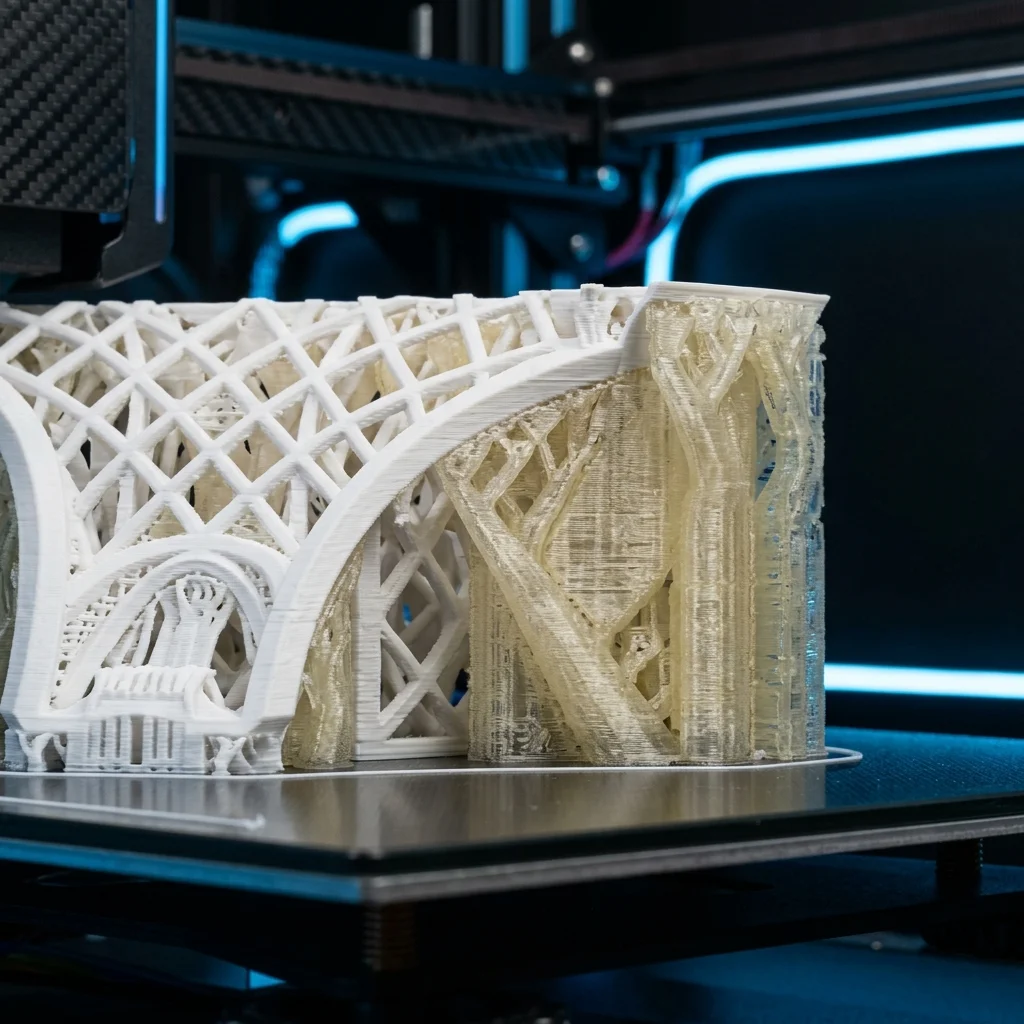
When creating complex geometric shapes with extreme overhangs or internal cavities, standard support structures are often difficult, risky, or even completely impossible to remove. Snapping off rigid supports can scar the surface of the part or break delicate features. This is where soluble materials like PVA (Polyvinyl Alcohol) and HIPS (High-Impact Polystyrene) come to the rescue. They completely eliminate the need to design around gravity, allowing the creation of functional ‘print-in-place’ mechanisms through simple chemical dissolution.
Chemistry and Material Specifics
Although both materials serve the same purpose (to be dissolved after printing), they have fundamentally different chemical properties and are used in completely different scenarios.
PVA (Polyvinyl Alcohol): This is a water-soluble synthetic polymer. It dissolves in regular warm tap water (preferably around 40-50°C). PVA bonds exceptionally well with the most popular FDM filaments – PLA, PETG, and Nylon (PA). The biggest challenge when working with PVA is its hygroscopicity. It absorbs moisture from the surrounding air so quickly that within just a few hours in the open, it can become unprintable, causing nozzle clogs and poor layer adhesion.
HIPS (High-Impact Polystyrene): Unlike PVA, HIPS does not dissolve in water. Dissolving it requires a special citrus-based chemical called D-Limonene. HIPS is used exclusively as a support material for ABS and ASA. The reason is that ABS and ASA require very high bed temperatures (over 100°C) and an enclosed chamber, conditions under which PVA would simply melt or deform. HIPS shares almost identical thermal properties with ABS, making it the perfect partner for high-temperature printing.
Applications: When are they absolutely mandatory?
Soluble supports are not used for every print due to their high cost and the slower manufacturing time. However, they are indispensable in the following scenarios:
‘Print-in-place’ Mechanisms: Creating moving parts, hinges, gearboxes, or ball joints in a single print job. In these models, the clearance between moving parts is fractions of a millimeter, and mechanically cleaning supports inside the assembly is impossible.
Complex Internal Channels: Designing cooling manifolds, pneumatic systems, or casting molds where the supports are deeply trapped within the part’s geometry and a tool cannot reach them.
Perfect Contact Surface (Interface Layers): Even when using standard mechanical supports (e.g., made of the same PLA material) for the bulk of the model, you can configure the slicer to use PVA only for the last 2-3 layers that actually touch the part. This ensures that the bottom of the overhang will be perfectly smooth, as if printed on glass, while saving expensive soluble material.
Hardware Requirements for the 3D Printer
To effectively use PVA and HIPS, your printer must have the ability to extrude two different materials during a single print.
Independent Dual Extruder Systems (IDEX): Printers like the BCN3D Sigma or Flashforge Creator are perfect for this purpose. Because the two extruders are independent, while one is printing, the other can be parked in standby mode outside the build area. This prevents material from oozing onto the part.
Dual Nozzle Printers (Dual Extrusion): Systems like the UltiMaker S5/S7 have two nozzles on the same print head. UltiMaker solves the oozing problem by physically lifting the inactive nozzle out of the way.
Multi-material Systems (AMS/MMU): Printers like the Bambu Lab X1-Carbon (with AMS) or Prusa MK4 (with MMU3) use a single nozzle. They physically pull back the primary material, load the soluble one, purge the nozzle in a special ‘purge tower’, and only then continue printing. This process works but extends print time significantly and wastes a large amount of material during frequent layer changes.
Expert Tips for a Successful Process
Working with hygroscopic and temperature-sensitive materials requires discipline in the workspace.
Storage and Drying: PVA must always be stored in an airtight box with silica gel (dry-box), even while printing. If you hear a ‘popping’ sound during extrusion, that is boiling moisture – the material must be dried in an oven or a specialized dehydrator at 50°C for at least 12 hours.
Preventing Carbonization: Never leave PVA in a heated nozzle (above 200°C) when the printer is idle or paused. PVA degrades thermally very rapidly, turning into a hard, coal-like substance that can permanently clog your hotend.
Environmentally Friendly Disposal: D-Limonene (used for HIPS) is a highly flammable solvent and must be disposed of according to local hazardous chemical regulations. Water-dissolved PVA, on the other hand, is biodegradable and can generally be safely poured down the drain, provided it is diluted with sufficient warm water.
Working With Soluble Supports: A Complete Guide To Hips And Pva In Fdm Calculator
Interactive optimization calculator.
The full picture
This article is one page from The Big Book of 3D Printing: 704 illustrated pages covering every technology, material and fix in one reference.
Read it on Kindle →Engineer, author of The Big Book of 3D Printing and additive manufacturing expert