

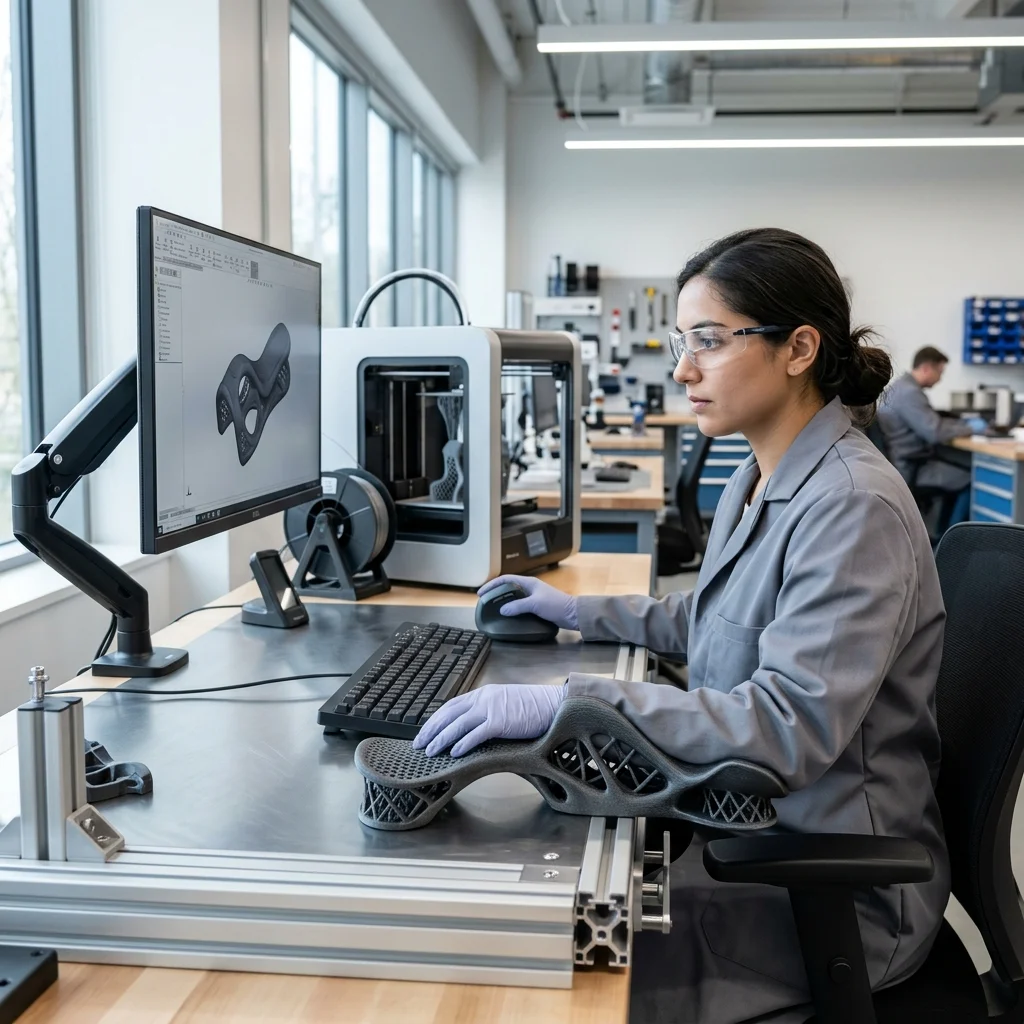
In the era of digital work, standard off-the-shelf ergonomic solutions often fail to accommodate the unique biomechanics of each individual. One-size-fits-all chairs and desks are compromises that ultimately lead to long-term discomfort and reduced productivity. This is where 3D printing steps in: a technology that allows us to transition from mass production to mass personalization. By leveraging parametric CAD design and advanced polymers, we can now engineer a workspace literally molded to our own dimensions. In this article, we will explore how you can use additive manufacturing to build a no-compromise, highly ergonomic environment.
Visual Biomechanics: Custom Monitor and Laptop Stands
One of the most prevalent issues in the modern office is 'tech neck': strain caused by improper viewing angles. Standard adjustable stands offer fixed increments that rarely align perfectly with your ideal eye level. Through 3D printing (using materials like PETG or ABS/ASA for structural integrity), you can design a riser with millimeter precision. Furthermore, integrating topological optimization allows for the creation of structures that are incredibly strong yet lightweight, leaving hollow spaces intentionally designed for hidden cable management or peripheral storage.
Dynamic Support: TPU and Wrist Geometry
Carpal tunnel syndrome is a direct consequence of unnatural angles during typing and mouse operation. This is where the capabilities of flexible filaments like TPU (Thermoplastic Polyurethane) truly shine. Instead of relying on generic gel pads, you can 3D scan your resting wrist position or use parametric models to print supports with variable density. By manipulating the infill percentage and pattern (such as using gyroid structures) you can achieve the exact desired firmness in specific zones, ensuring perfect pressure distribution and neutral joint alignment.
The Posture Foundation: Active Footrests
Ergonomics does not end at the desktop. Leg positioning dictates the angle of the pelvis and, consequently, the curvature of the entire spine. 3D printed footrests can be designed not merely as static platforms but as dynamic interfaces. Models featuring a hemispherical base encourage micro-movements, which are crucial for maintaining blood circulation during prolonged work sessions. By combining rigid PLA or PETG cores with anti-slip TPU treads, you can manufacture a hybrid device that outperforms expensive commercial alternatives.
Cognitive Ergonomics: Modular Systems and Gridfinity
Ergonomics also encompasses minimizing unnecessary physical reaching and cognitive load. Desk clutter leads to awkward stretching and constant distraction. Open-source systems like Gridfinity or Honeycomb Storage Walls enable the creation of a hyper-personalized, three-dimensional organizational system. The tools and devices you use most frequently can be raised and angled perfectly within your primary reach zone. This not only improves physical efficiency but also creates a visually soothing environment that sustains deep focus and flow states.
Conclusion
Additive manufacturing democratizes access to high-end, tailored ergonomics. In the near future, we will likely see smooth integration between biometric sensors and generative design, where your workstation automatically proposes and prints optimized components for your body. Until then, the power of 3D printing gives you complete control to turn your desk into a perfectly tuned productivity machine. Invest the time in measuring, prototyping, and iterating: your body will thank you.
The full picture
This article is one page from The Big Book of 3D Printing: 704 illustrated pages covering every technology, material and fix in one reference.
Read it on Kindle →Engineer, author of The Big Book of 3D Printing and additive manufacturing expert