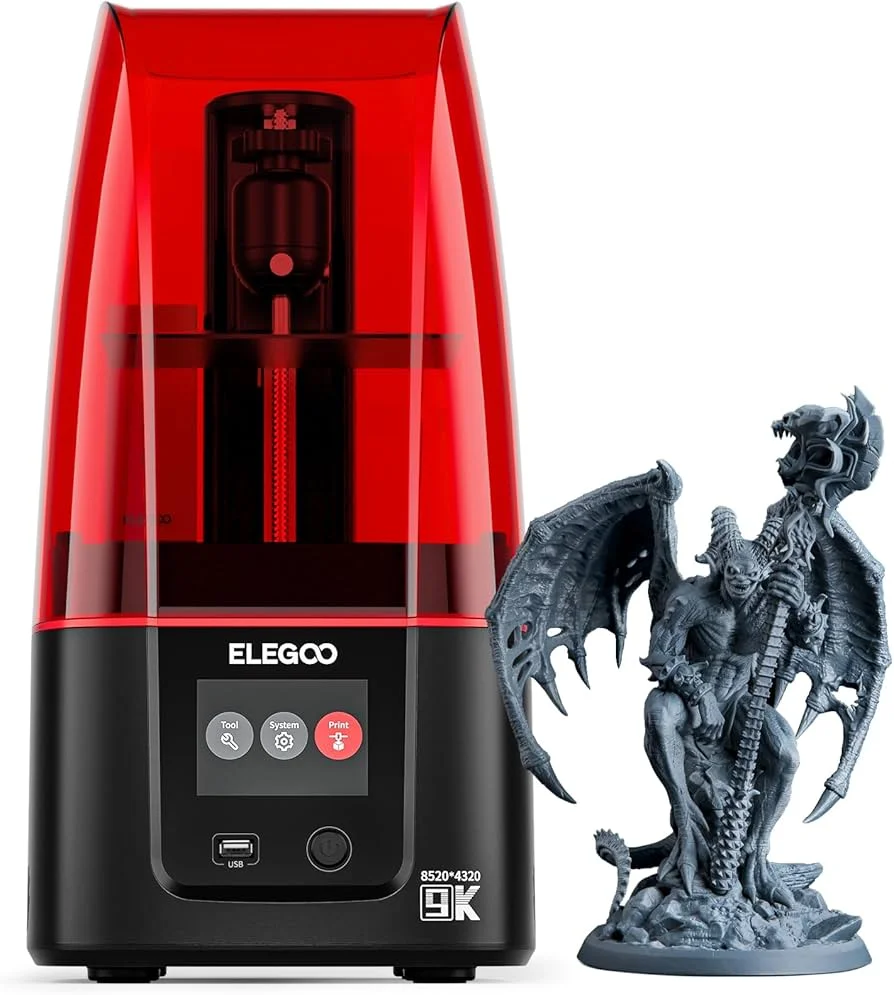
The Elegoo Mars 4 Ultra is a compact 9K mono LCD/MSLA printer in the budget class that delivers exceptional detail at an accessible price. With a 153 × 77 × 165 mm build volume, a 9K matrix and a longer-lasting monochrome LCD panel, the Mars 4 Ultra is the go-to choice for artists, dental technicians and miniature enthusiasts who need precision below 35 microns.
What it is
The Mars 4 Ultra uses mono LCD (MSLA) technology: a powerful UV LED array cures an entire layer at once through a monochrome mask, with exposure times measured in seconds rather than hours. The 9K resolution means 9249 × 4650 pixels spread across a 6.6-inch screen, yielding XY precision of ~18 × 24 µm. The monochrome panel passes more UV light than its color predecessors and lasts significantly longer. The printer targets users who want resin-grade detail without the price of an SLA laser.
Technical specifications
| Technology | Mono LCD / MSLA (UV 405 nm) |
|---|---|
| Build volume | 153 × 77 × 165 mm |
| Resolution (XY) | 9K: 9249 × 4650 px (≈18 × 24 µm/px) |
| Screen | 6.6" monochrome LCD, ~12,000 h lifespan |
| Layer thickness (Z) | 0.01 – 0.2 mm (typical 0.05 mm) |
| Print speed | up to 70 mm/h (resin-dependent) |
| Class / Price | Budget · ~€180 |
Who it’s for
- Tabletop miniatures and figurines: exceptional XY detail (18 µm) for musculature, armor and textures unreachable by FDM (Hobby and collectibles)
- Dental and orthodontic models: precise dental models, surgical guides and temporary crowns with biocompatible resin (Dental medicine)
- Detailed prototypes and jewelry: castable wax resin for direct jewelry casting, or fine-grain design prototypes (Product design and jewelry)
Setup and calibration
- Level the build plate: loosen it, lower it to the FEP sheet using an A4 paper feeler gauge, tighten evenly and lock the level. Uniform first-layer adhesion across the entire surface, no lifted corners.
- Run an Exposure Calibration Test (Cones/R_E_R_F): print a test matrix with varying exposure times. Optimal Normal Exposure Time identified for the chosen resin, no over-cure or under-cure.
- Inspect the FEP film: hold it against light, no cloudy spots, punctures or crinkled edges. A clear and taut FEP ensures a sharp image and easy layer release.
- Fill the vat to the marked line: resin must cover the FEP but not overflow. Sufficient resin level for full adhesion without splashing when the plate lifts.
Common defects and fixes
Resin exposure helper
Pick a resin type for starting exposure values (typical for mono-LCD machines). These are STARTING points: always run an exposure test, because the exact seconds depend on your screen power and the specific resin:
Conclusion
The Mars 4 Ultra proves that 9K detail does not require a high budget. The monochrome panel, fast UV array and compact form factor make it an ideal entry point for anyone stepping into resin printing, from the artist painting miniatures to the dental technician who needs precise models.
The full picture
This article is one page from The Big Book of 3D Printing: 704 illustrated pages covering every technology, material and fix in one reference.
Read it on Kindle →Engineer, author of The Big Book of 3D Printing and additive manufacturing expert
Updated on 11 September 2026
This article was written with AI assistance; the facts were checked against the sources on 11 September 2026.