

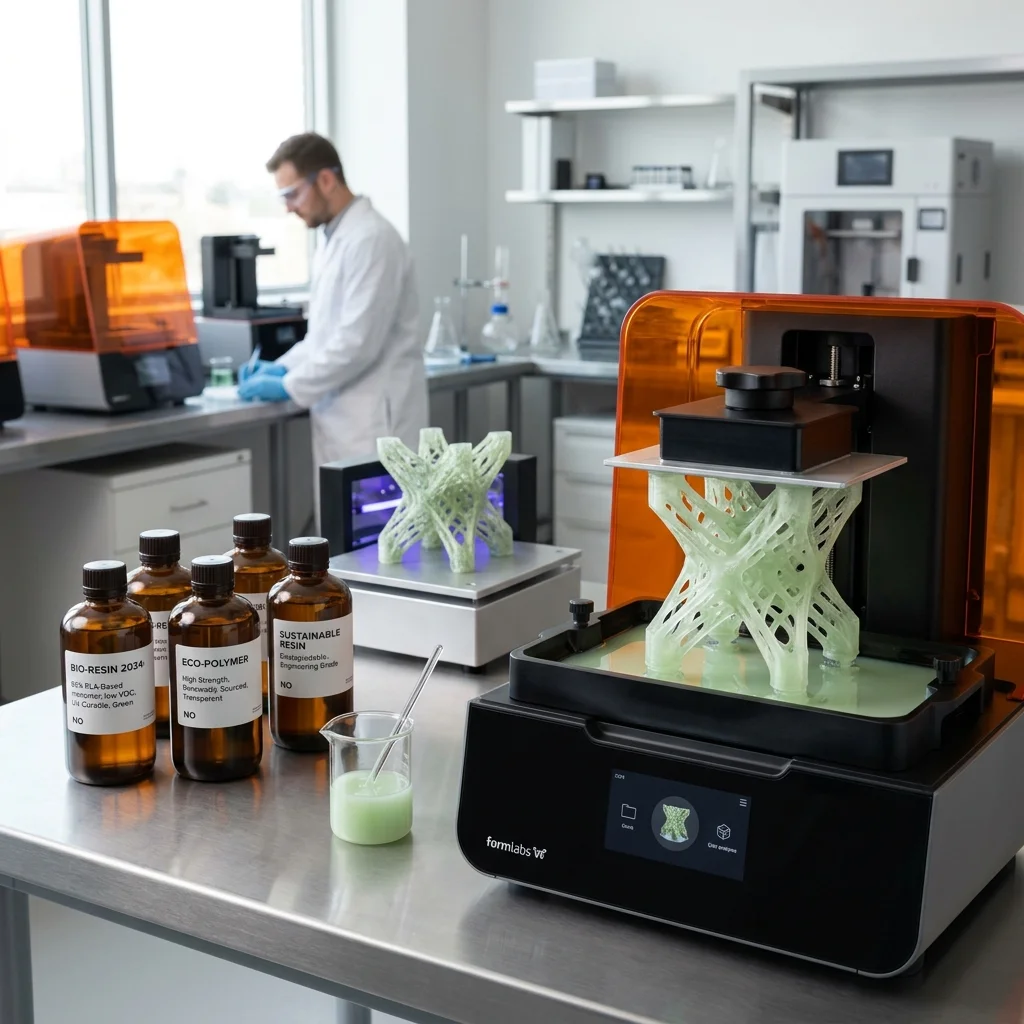
2024 marks a critical turning point in the evolution of photopolymer resins for 3D printing. For years, the industry wrestled with a core paradox: while SLA and DLP technologies offer unmatched precision, they heavily relied on petroleum-based thermosetting plastics. Their irreversible chemical bonds made end-of-life recycling virtually impossible.
Today, we are moving past mere greenwashing and partially "plant-based" alternatives. We are entering the era of true circular polymer economies. Leading research institutes and innovative materials companies have unveiled formulations based on natural monomers that retain industrial-grade mechanical properties while enabling fully closed-loop recyclability. Let's look at the deep technical innovations driving this material revolution.
Beyond 'Plant-Based' Marketing: Breaking the Thermoset Barrier
Until recently, most commercial 'eco' resins featured only a modest percentage of bio-based ingredients (typically soybean oil) blended with standard petrochemical co-monomers to ensure adequate photopolymerization. A breakthrough in 2024, published by researchers at the University of Birmingham, demonstrated a high-resolution resin derived entirely from lipoic acid: a naturally occurring fatty acid. The core innovation lies in dynamic covalent chemistry: unlike traditional thermoset networks, which form permanent bonds upon UV curing, this novel polymer matrix can be depolymerized back into its original monomers using specific solvents and then reprinted. This establishes the first truly closed-loop system for SLA/DLP materials, enabling secondary printing without a degradation in mechanical properties.
Novel Monomers: Succinic, Malic, and Soy Derivatives
The development of industrially viable bio-resins heavily depends on synthesizing functional novel monomers. Academic and industrial partnerships (such as UPC/ICIQ and Liqcreate) have successfully integrated monomers based on succinic, malic, and tartaric acids into standard acrylate and methacrylate systems. These advanced formulations now achieve renewable content ranging from 50% to 80%. The primary engineering challenge is balancing the resin's viscosity, reaction kinetics under 405nm UV exposure, and final tensile strength. Soy derivatives, like epoxidized soybean oil (ESO), undergo complex functionalization to provide flexibility and toughness comparable to ABS-like or engineering-grade resins, all without compromising the rapid layer cure times required by modern monochrome LCD screens.
Biocompatibility and DLP Medical Applications
In the realm of bioprinting and regenerative medicine, 2024 has introduced revolutionary DLP materials. Companies such as BIO INX have launched biodegradable resins (e.g., DEGRES INX) that boast ISO 10993-5 biocompatibility certification. These highly engineered polymers are not only non-toxic but actively support in vitro and in vivo cell cultivation. Interestingly, some of these advanced polymers exhibit 'shape memory' characteristics: deforming at specific temperatures and recovering their original 3D printed structure upon heating. This paves the way for 4D printing and minimally invasive biomedical implants designed to safely degrade within the body once their structural function is fulfilled.
Technical Trade-offs and the Quest for the Holy Grail
Despite rapid advancements, the industry continues to navigate complex technical trade-offs. The 'holy grail' remains the formulation of a 100% bio-based resin that can withstand high operational temperatures (HDT over 150°C) and the extreme mechanical stress typically handled by high-performance plastics like PEEK or Ultem. Current fully eco-friendly variants often exhibit a lower heat deflection temperature. Furthermore, post-print waste management (specifically the ecological impact of cleaning solvents like IPA) remains a challenge. The future of advanced manufacturing requires integrating these materials not just as alternatives, but as the primary standard, educating the next generation of engineers to design parts with a comprehensive lifecycle approach.
Conclusion
The photopolymer revolution of 2024 proves that high-resolution additive manufacturing and environmental responsibility are no longer mutually exclusive. The shift from petroleum derivatives to renewable, recyclable, and biodegradable matrices will underpin the next major wave of 3D printing adoption. By deeply understanding both the hardware and the complex materials science behind these new resins, we make next-generation manufacturing practical.
The full picture
This article is one page from The Big Book of 3D Printing: 704 illustrated pages covering every technology, material and fix in one reference.
Read it on Kindle →Engineer, author of The Big Book of 3D Printing and additive manufacturing expert