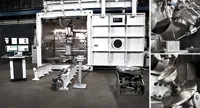
The Sciaky EBAM 110 is an industrial Electron Beam Additive Manufacturing (EBAM) machine: a wire-fed DED process in which a powerful electron beam melts metal wire directly onto the substrate inside a vacuum chamber. The result is the rapid build-up of massive metal near-net-shape preforms, with a build envelope up to 1778 × 1194 × 1600 mm and deposition rates of 3–9 kg/h: a speed and scale unmatched by any powder-bed technology.
What it is
EBAM (Electron Beam Additive Manufacturing) is a DED (Directed Energy Deposition) process developed by Sciaky. Instead of a laser on powder, the machine uses a high-power electron beam focused onto a 1–4 mm metal wire inside a fully evacuated chamber. The vacuum environment eliminates oxidation even for reactive alloys such as titanium, while the wire-feed scheme delivers a substantially higher material utilization rate than powder-bed processes. The EBAM 110 does not replace the mill: it produces rough near-net-shape preforms which are then finish-machined by CNC to final dimensions. The technology targets aerospace, defense and heavy industrial applications where parts are large, materials are costly alloys and the buy-to-fly ratio from conventional machining often exceeds 80–95%.
Technical specifications
| Technology | EBAM: Electron Beam DED, wire-fed |
|---|---|
| Build volume | 1778 × 1194 × 1600 mm |
| Environment | vacuum chamber (prevents oxidation of reactive alloys) |
| Deposition rate | 3–9 kg/h depending on alloy and wire diameter |
| Process control | IRISS (Interlayer Real-time Imaging and Sensing System): closed-loop real-time monitoring |
| Surface finish | rough near-net-shape preform: CNC finish machining required |
| Class / Price | Industrial · from ~€1,500,000 |
Applications and industries
- Large-scale aerospace titanium structures: building wing spars, fuselage frames and load-bearing beams from Ti-6Al-4V with a buy-to-fly ratio below 1.5:1 versus the typical 20:1 when machining from solid billet (Aerospace and defense)
- Defense and naval components: producing spare and non-standard parts for military platforms, submarines and surface vessels where a forged billet takes months to procure, while EBAM delivers in days (Defense and marine)
- Near-net-shape preforms from high-value alloys (direct consolidation of Inconel, tantalum and copper alloys into near-net-shape stock) minimal CNC waste and maximum material yield for exotic metals with a high cost per kilogram (Oil and gas and heavy industry)
Production workflow
- Prepare the CAD model for the EBAM strategy: define a 3–6 mm near-net allowance and deposition toolpaths. Optimized deposition strategy, minimum pass count and controlled heat input.
- Evacuate the chamber to working pressure (< 1 × 10⁻⁴ Torr) and verify the integrity of the vacuum seal. Guaranteed protection of reactive alloys from oxidation during deposition.
- Start the EBAM deposition with active IRISS monitoring: the system adjusts beam power in real time, layer by layer. Controlled geometry and minimized internal porosity and cracking throughout the full part height.
- Remove the cooled preform and subject it to CNC machining to final dimensions and surface finish. Final geometry within drawing tolerances with significantly less material removed compared to machining from solid.
Key considerations
Materials and applications
Pick a material/alloy this machine processes to see its properties and typical applications:
Conclusion
The Sciaky EBAM 110 is a unique tool for industries where part size, deposition speed and material value converge into a single challenge: building large-scale metallic near-net-shape preforms from reactive and high-cost alloys with minimal waste. The wire-fed DED process in full vacuum delivers deposition rates and build envelopes that no powder-bed technology can match, while the built-in IRISS closed-loop control ensures quality layer by layer. The EBAM 110 is not a detail machine: it is a preform machine, and for the right applications it transforms buy-to-fly ratios and compresses lead times from months to days.
The full picture
This article is one page from The Big Book of 3D Printing: 704 illustrated pages covering every technology, material and fix in one reference.
Read it on Kindle →Engineer, author of The Big Book of 3D Printing and additive manufacturing expert
Updated on 11 September 2026
This article was written with AI assistance; the facts were checked against the sources on 11 September 2026.