

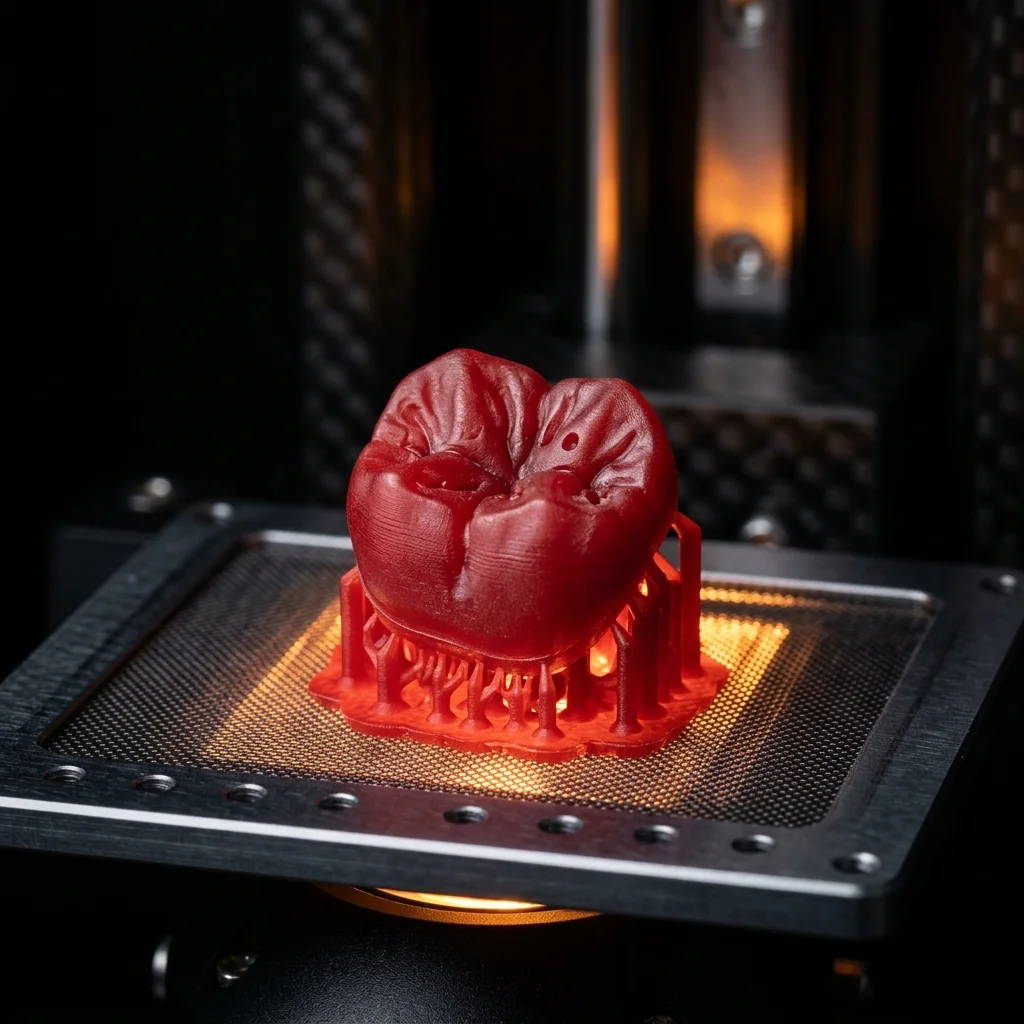
DLP (Digital Light Processing) is a light-projection resin technology that, instead of LCD pixels, uses a micromirror chip (DMD) to draw the layer with UV light. Unlike MSLA’s LCD (which wears out after 2000-4000 hours), DLP’s DMD chip is life-of-the-printer reliable: tens of thousands of hours without replacement. This makes DLP optimal for professional production environments (dental labs, jewelry studios), where one printer runs 8 hours/day every day. Castable resin on DLP is a specialized workflow for serial casting of crowns, bridges, and jewelry. This guide: the DLP technology, when it’s better than MSLA, and the full production workflow.
DLP vs MSLA, production durability
MSLA Mono LCD: lifespan 2000-4000 hours. Replace at ~€30-€60 every 6-12 months heavy use. Higher resolution display = higher pixel density = more strain.
DLP DMD chip: lifespan 25,000-50,000 hours (LED life-limited, not chip). Effectively life-of-printer.
Production implications:
- Dental lab printing 10 crowns/day: MSLA needs LCD replacement every 6-12 months. DLP 0 replacements for 5+ years.
- Jewelry studio batch printing 20-30 patterns/week: same story.
- Cost of LCD replacement over 5 years on MSLA: €300-€500. DLP: €0.
- Downtime: LCD replacement requires re-calibration (4-6 hours). DLP: zero downtime.
When DLP wins: production environments, multi-shift operations, ROI calculation over 3+ years.
When MSLA wins: hobby use (< 5 hours/week), price-sensitive entry, large build volumes (DLP build size limited by projector throw distance, typically 130-150mm vs MSLA 200-220mm).
Recommended DLP printers
Anycubic Photon D2 (€471): entry consumer DLP. 130×73×165mm build, 51 µm pixel size. Recommended for: small jewelry studio starting up, hobby user wanting long-term reliability.
Elegoo Mars 4 DLP (€499): Elegoo’s DLP entry. Similar specs to Photon D2. Compete on price.
Asiga MAX UV385 (€10,000+): professional dental DLP. Validated workflow for dental crowns, surgical guides, orthodontic models. 49 µm pixel.
Asiga PRO 4K (€15,000+): industrial DLP. Higher resolution, larger build, multi-batch automation. For production dental labs.
EnvisionTec D4K Pro (€20,000+): premium dental DLP. Highest dimensional accuracy in dental industry.
MoonRay S (€3500): mid-tier jewelry DLP. Validated castable workflows.
For entry into professional dental/jewelry production: Anycubic Photon D2 (€471). Pay back vs MSLA at ~100 prints (no LCD replacement amortization).
For serial dental crowns (10+/day): Asiga MAX UV385. Validated workflow + ISO compliance.
Castable resin for DLP
Analysis optimized for DLP’s light spectrum (typically 385nm vs MSLA’s 405nm):
For jewelry:
Siraya Tech Cast (€60-€80/liter): works on most DLP printers. Check compatibility with specific 385nm vs 405nm light source.
MoonRay 385 Castable (€80/liter): specifically formulated for 385nm DLP. Premium clarity in cast result.
Phrozen Wax-Like Castable (€70-€85/liter): works on DLP at 405nm. Most popular for Anycubic Photon D2 users.
For dental:
NextDent Cast (€120-€150/liter), for crown patterns. Dental-grade burnout characteristics.
Saremco Print SG (€180-€250/liter): surgical guides clear. Validated for medical use.
Formlabs Dental LT (€199/liter): Form 4 only, but if you have Form 4 alongside DLP, it’s the dental industry standard.
Asiga PlasGray (€150-€200/liter): industrial DLP castable. Used by EnvisionTec, Asiga professional users.
Microsense PlasMix Series (€100-€180/liter): versatile castable + tough hybrid for jewelry prototypes.
Production workflow for dental lab
Daily workflow in professional dental lab using Anycubic Photon D2 + NextDent Cast:
8am: Open lab. Power on printer. Mix fresh resin batch (NextDent Cast has 2-week working life after opening).
8:30am: Receive STL files from CAD designer (DentBird, exocad, 3Shape used). Typical 5-10 crowns per day.
9am: Slice in Anycubic Workshop with dental-optimized profile. Orient crowns with margins down, supports on internal surfaces.
9:30am: Start print. Batch of 8 crowns prints in 90 minutes on Photon D2.
11am: Print complete. Wash 3 minutes in IPA, dry 5 minutes.
11:15am: Short cure (2-3 minutes only, castable!) Remove supports while leather-hard.
11:30am: Inspect under loupe. Re-print any defective patterns.
12pm: Sprue assembly. Attach patterns to wax tree for casting.
1pm: Investment pour. Allow 1-2 hours for investment to set.
3pm: Begin burnout cycle (5-6 hour ramp). Run overnight for batch casting next morning.
8am next day: Cast metal (cobalt-chromium, gold, or titanium). Devest, polish, finalize.
Daily output: 5-10 finished dental crowns. Material cost per crown: €5-€8 (€2 resin + €1 investment + €2-€5 metal). Lab time per crown: 30-45 minutes (including CAD-already provided). Retail price per crown: €80-€300.
Jewelry production workflow
Workflow for small jewelry studio using Anycubic Photon D2 + Siraya Cast or Phrozen Wax-Like:
Monday: Receive 5-10 custom orders from clients (rings, pendants). CAD model in Rhino + RhinoGold (8 hours total for 10 designs).
Tuesday morning: Slice all patterns in Lychee Slicer with jewelry preset. Batch print on Photon D2.
10 small rings print in 60 minutes per batch. Larger pendants print individually (15-30 minutes each).
Wash 2-3 minutes, dry, short cure (1-2 minutes only!). Support removal while leather-hard.
Tuesday afternoon: Sprue patterns onto wax tree. Pour investment in flask. Let set 2 hours.
Wednesday: Burnout cycle (6 hours). Cast bronze (early prototypes for client approval) or silver/gold (final pieces).
Thursday: Polish, set stones, finish. Ship to clients.
Friday: Review designs, plan next week.
Output per week: 10-15 finished pieces. Material cost per piece: €3-€7 castable resin + €1 investment + metal cost (silver €30-€60, gold €60-€200). Selling price per piece: €120-€800 depending on metal and complexity.
ROI on Anycubic Photon D2 (€471): paid back in 3-5 weeks for small jewelry studio.
Frequently Asked Questions (FAQ)
Dlp With Castable Resin, For Dental And Jewelry Production Exposure Calculator
Calculate optimal resin print time.
The full picture
This article is one page from The Big Book of 3D Printing: 704 illustrated pages covering every technology, material and fix in one reference.
Read it on Kindle →Engineer, author of The Big Book of 3D Printing and additive manufacturing expert